
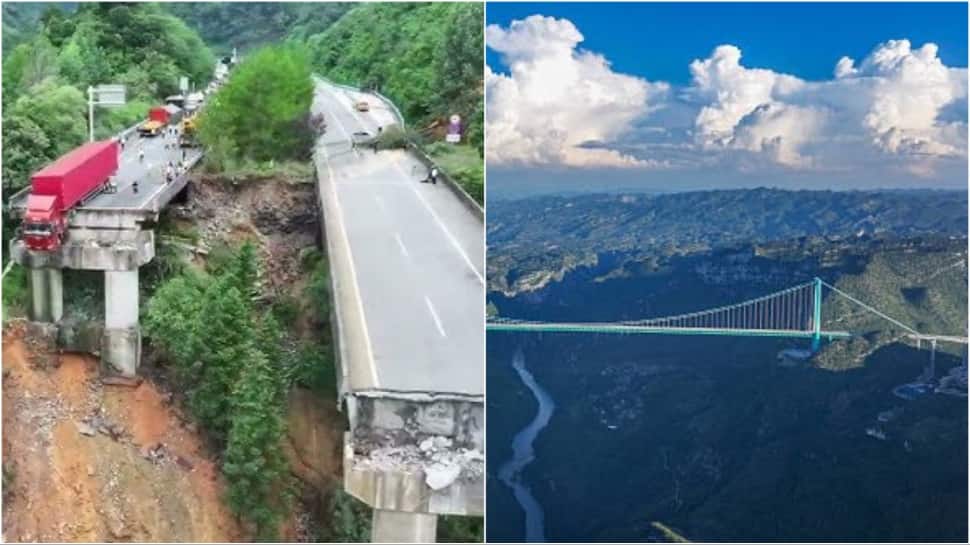
A recently completed section of the Hongqi Bridge in Sichuan province, southwestern China, dramatically collapsed on Tuesday afternoon following a massive landslide, just months after its opening. The 758-meter-long bridge, a crucial part of the national highway that connects central China to Tibet, was partially destroyed as large chunks of the concrete structure plunged into the river below. Fortunately, due to timely action by local authorities, no casualties have been reported.
The Hongqi Bridge, constructed by the state-backed Sichuan Road & Bridge Group, was completed earlier this year and was seen as a vital transportation link in the region. The bridge’s sudden collapse has raised serious concerns about the durability and safety of new infrastructure projects in China’s rugged western provinces, which are often challenged by difficult geological conditions.
Authorities had acted swiftly to prevent disaster after warning signs emerged a day before the collapse. On Monday afternoon, police in the city of Maerkang closed the bridge to all traffic after engineers detected cracks on nearby slopes and roads, along with significant shifts in the terrain of the adjacent mountain. These early warnings prompted officials to shut down the bridge, averting potential loss of life.
However, the geological conditions worsened dramatically on Tuesday. A massive landslide occurred, triggered by the unstable mountainous terrain, which compromised the roadbed and the supporting structures of the approach bridge. The landslide caused the catastrophic failure of the bridge section, resulting in the dramatic collapse captured on viral videos that circulated widely on social media. The footage shows the mountainside giving way, sending large portions of the bridge crashing into the river below.
Preliminary investigations point to geological instability as the immediate cause of the collapse. The region is known for its steep mountainous terrain and a history of landslides, factors that likely contributed to the disaster. However, local authorities have launched a detailed technical investigation to determine whether geological factors alone caused the failure or if structural or engineering weaknesses also played a role. This investigation aims to understand the full scope of the failure and prevent similar incidents in the future.
The collapse of the Hongqi Bridge comes in the wake of other high-profile infrastructure failures in China. In August, a railway bridge under construction in Qinghai province collapsed, killing at least 12 workers. These incidents have intensified scrutiny on the quality control, engineering standards, and maintenance practices of infrastructure projects, especially in challenging terrains.
The destruction of this critical transportation link will have significant repercussions for travel and economic activity between Sichuan and the Tibetan Plateau. With the bridge out of commission, travelers and commercial vehicles will be forced to take lengthy detours, disrupting the movement of goods and people in the region. This disruption highlights the importance of reliable infrastructure in supporting regional development and integration.
In response to the collapse, local government officials have reassured the public that safety remains the utmost priority. They have pledged transparency throughout the investigation and committed to taking corrective measures based on its findings. Meanwhile, emergency response teams are monitoring the area for further geological activity to prevent additional hazards.
The Hongqi Bridge collapse serves as a stark reminder of the challenges faced by infrastructure projects in geologically sensitive areas. While the bridge was a symbol of modernization and connectivity, the event exposes the need for rigorous geological assessments, enhanced engineering solutions, and continuous monitoring to ensure the safety and longevity of such structures.
As China continues to invest heavily in expanding its transportation networks, especially in its western provinces, this incident underscores the balance that must be struck between rapid development and sustainable, safe construction practices. The lessons learned from the Hongqi Bridge collapse will likely influence future infrastructure policies and engineering standards across the country.
In conclusion, the partial collapse of the Hongqi Bridge in Sichuan province, triggered by a massive landslide in a geologically unstable region, has highlighted critical issues regarding infrastructure safety in China’s mountainous western provinces. Thanks to early warnings and prompt closure, no casualties occurred, but the event has disrupted a vital transportation route. A thorough investigation is underway to determine the causes and prevent future failures, as the nation grapples with the challenges of building durable infrastructure in difficult terrains.