
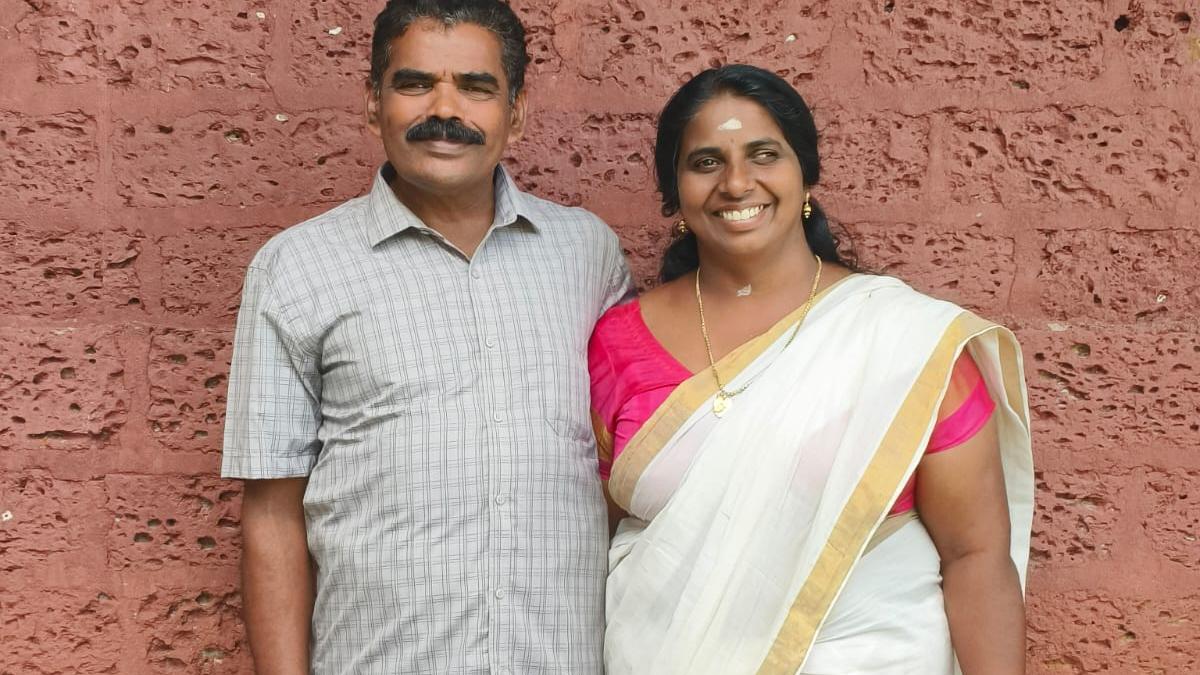
In the upcoming Pullur-Periya grama panchayat election, a unique and compelling story has emerged from the small town of Kasaragod, highlighting how political rivalry can coexist with personal harmony. A husband and wife, each aligned with opposing political parties, are at the center of this narrative, offering a refreshing perspective on political discourse and family life. M. Girija, aged 46, has stepped into the electoral arena for the first time as a candidate from the Indian National Congress, while her husband, K. Vasu, 56, a seasoned Communist Party of India (Marxist) [CPI(M)] worker and Kannoth branch secretary, has chosen to stay away from contesting this time.
Ms. Girija’s political journey is rooted deeply in her family background. Coming from a staunch Congress family, her entry into electoral politics seems like a natural progression, though it is her first time contesting an election. Her political lineage includes her aunt, who had previously contested on a Congress ticket, indicating a tradition of active political engagement within her family. Despite the ideological divide between her and her husband, Girija emphasizes that politics has never disturbed the harmony in their household. She openly shares that discussions on political developments happen frequently at home, but these exchanges have never led to conflict.
For many years, Ms. Girija had been approached by the Congress party with offers to contest from her ward, Kumbala (Ward 7). This ward is particularly significant because it has traditionally been a closely fought battleground where the CPI(M) has narrowly maintained its winning streak. However, Girija had put these offers on hold due to family responsibilities. Known for her active involvement in social work and well-regarded by the local community, she finally felt that this election presented the right opportunity to make her political debut. Her campaign is distinctive in that it relies heavily on her personal connections and rapport with the community, rather than on aggressive political rhetoric or criticism of opponents.
On the other hand, her husband, K. Vasu, is a veteran CPI(M) activist who has earned the trust of his party and community, having been elected branch secretary for the fourth time. Professionally a farmer, Vasu’s political journey has been steadfast and consistent. He candidly acknowledges the political differences between their two families but stresses that both were fully aware of and accepted these differences before their marriage. “Her family has always been with the Congress and ours with the CPI(M). Our marriage happened with full understanding of this,” Vasu said. He further elaborated that while their ideologies may differ, the ultimate goal remains the same: to serve the people. This shared purpose has prevented any political disagreements from spilling over into their personal life.
Their children have grown up witnessing this unique blend of political plurality and familial unity. One child is currently pursuing a doctorate, while the other works as a civil engineer. Vasu notes that the children have learned valuable lessons about respecting differing viewpoints and maintaining harmony despite ideological diversity.
Interestingly, Vasu has chosen a careful approach to the current election campaign. To avoid any potential conflicts or controversies arising from their opposing political stances, he has decided to campaign only in the neighboring Ward 6, rather than Kumbala Ward 7, where his wife is contesting. This decision underscores the couple’s commitment to keeping their political engagements respectful and separate, ensuring that their personal relationship remains unaffected. Vasu expressed confidence that the CPI(M) would retain its seat in Ward 7, while Girija equally believes she has a strong chance of winning based on her grassroots connections and reputation.
Ms. Girija has consistently emphasized that her appeal to voters is based on her personal merit and service to the community rather than on criticizing her political opponents. “I am seeking votes on my merit. I have never believed in blaming others,” she said, highlighting her approach to campaigning as positive and issue-focused rather than combative.
The story of K. Vasu and M. Girija has become a talking point in the local elections, illustrating a rare example of how personal relationships can transcend political divisions. In a time when politics often polarizes and divides communities, their example offers a hopeful message: that ideological differences need not undermine respect, love, or family unity. Their ability to maintain a harmonious household despite belonging to rival political fronts stands as a testament to mature political engagement and personal respect.
This narrative also reflects broader themes relevant to India’s democratic ethos,