
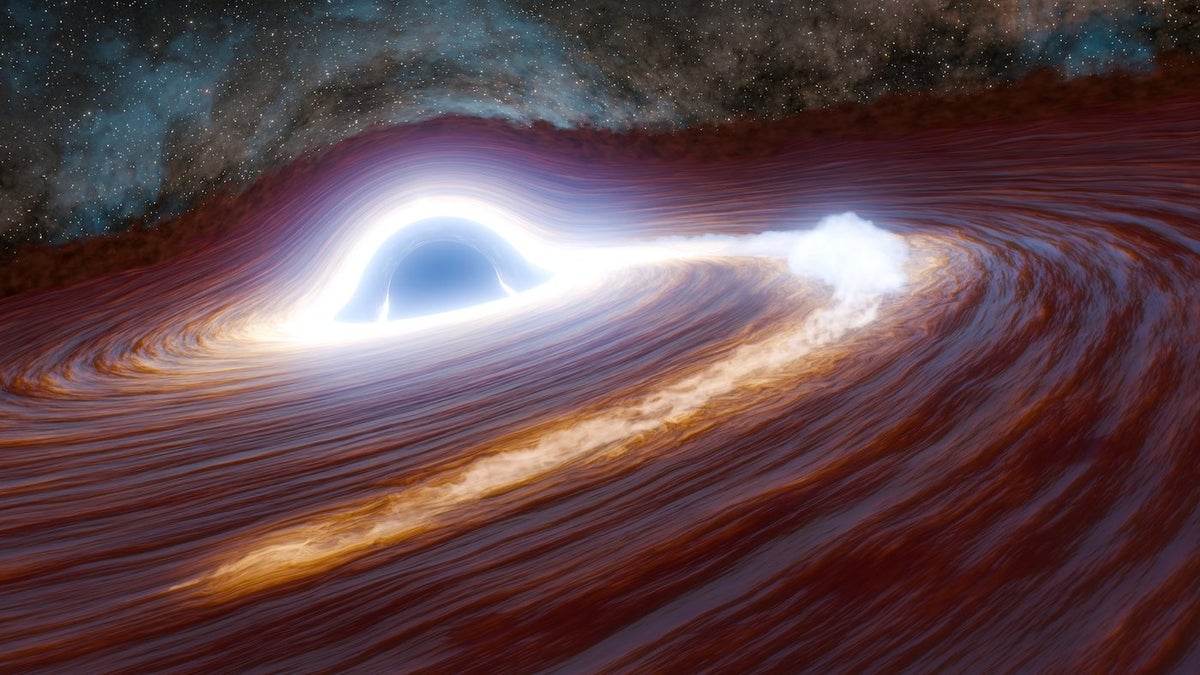
On November 4, 2025, a groundbreaking discovery was published in Nature Astronomy, shedding new light on one of the most extreme cosmic phenomena observed to date—a “superflare” emitted by a black hole that outshines anything previously recorded. This extraordinary burst of energy, reaching luminosities more than 10 trillion times that of the Sun, offers a rare glimpse into the violent final moments of a massive star as it was consumed by a distant black hole. The research, led by astronomers from institutions including the California Institute of Technology (Caltech), reveals not only the immense power of black holes but also the dynamic processes that unfold when stars stray too close to these cosmic behemoths.
### Discovery and Initial Observations
The story of this record-breaking superflare began in 2018, when astronomers first detected an unusual brightening in a distant object. Using the 200-inch Hale Telescope at the Palomar Observatory, researchers aimed to characterize the source of this intense light. However, initial observations were underwhelming. According to Matthew Graham, an astronomer at Caltech and co-author of the study, the light curve—the graph showing how the brightness changed over time—did not initially seem remarkable. The team initially underestimated the significance of the event, as the data did not immediately suggest anything out of the ordinary.
It wasn’t until 2023, five years after the initial detection, that the object’s persistent brightness prompted a more detailed investigation. Observations conducted with the W. M. Keck Observatory in Hawaii revealed something astonishing: the black hole responsible for the flare was located approximately 3 million kiloparsecs away, which translates to about 10 billion light years from Earth. To appear so luminous from such an immense distance, the flare’s intrinsic brightness had to be exceptional, far exceeding any previously known black hole emissions.
### Unprecedented Luminosity and Its Implications
The intensity of this superflare is staggering—about 30 times more luminous than any other black hole flare ever recorded. Such brightness is difficult to explain without invoking extraordinary astrophysical processes. The team behind the discovery considered several possibilities. One was the occurrence of a supernova explosion near the black hole, which can produce intense bursts of light. Another was the idea that gravitational lensing—where the black hole’s gravity bends and magnifies light—might have artificially boosted the brightness. However, neither hypothesis aligned well with the observational data.
Instead, the researchers converged on a more dramatic explanation: a massive star, at least 30 times the mass of our Sun, had wandered too close to the black hole and was being torn apart by its immense gravitational forces. This process, known as a tidal disruption event, occurs when a star’s self-gravity is overwhelmed by the tidal forces exerted by a black hole, effectively shredding the star and feeding its gas into the black hole’s accretion disk. As this stellar material spirals inward, it heats up and generates powerful jets of light and radiation.
In this particular case, the black hole’s jets flared to a brightness approximately 40 times greater than their previous levels. This violent outburst is what produced the superflare detected by astronomers. Notably, the flare has not yet fully faded, suggesting that the star’s destruction is ongoing and the black hole continues to consume the star’s remnants.
### Watching a Star’s Final Act Unfold Across Cosmic Time
One of the most fascinating aspects of this discovery is the sheer scale of time and space involved. Because the black hole is so far from Earth, about 10 billion light years away, astronomers are effectively looking back in time to observe an event that happened when the universe was much younger. Moreover, the distance means that the light from the black hole’s activity takes an enormous amount of time to reach us. Matthew Graham explains that due to relativistic effects and the vast distance, astronomers see the black hole’s activity slowed down, watching two years of its behavior unfold over a seven-year period on Earth. This “time dilation” means that fully understanding these rare flares will require long-term monitoring and patience.
Joseph Michail, an astronomer at the Harvard and Smithsonian Center for Astrophysics, expressed keen interest in observing the evolution of the flare. He speculates that the brightness of the jets might gradually fade as the star is fully devoured, or alternatively, the flare might brighten again if the emitted light interacts with surrounding gas and