
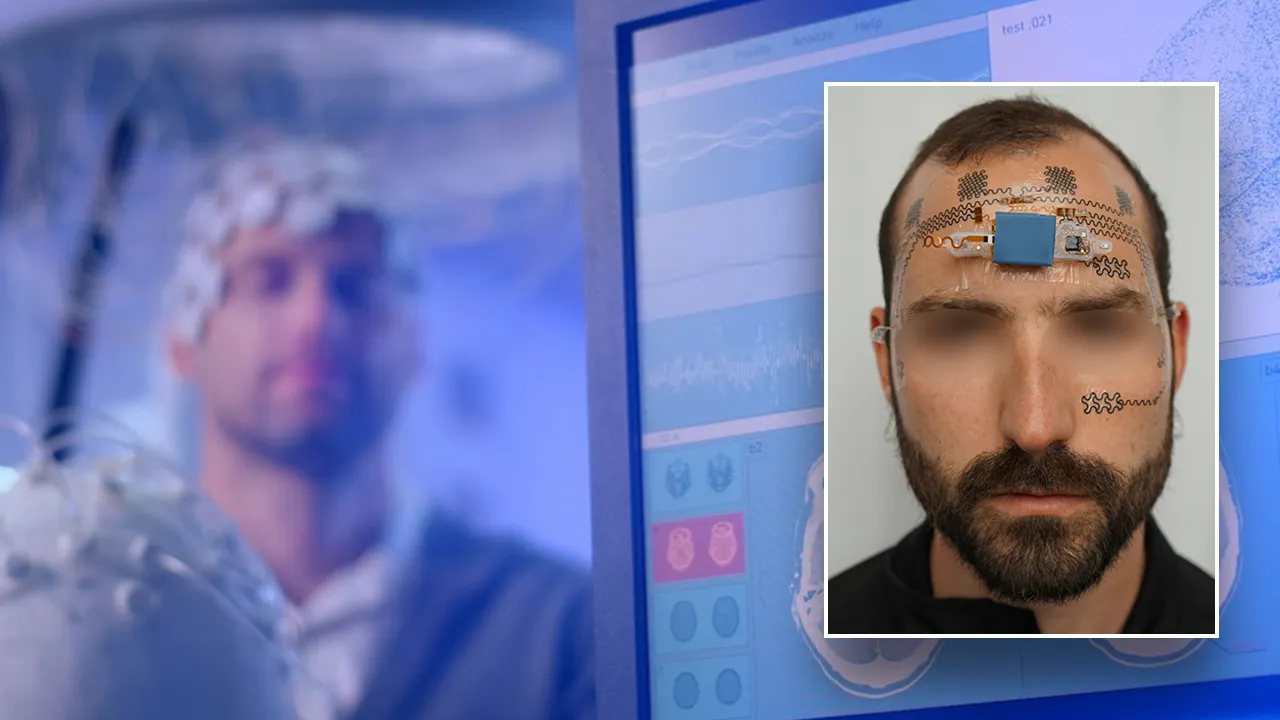
Scientists at the University of Texas at Austin have developed an innovative, cost-effective device designed to help people in high-pressure, mentally demanding jobs monitor their brain activity and mental workload. This new technology, described as an electronic tattoo or "e-tattoo," is a thin, temporary sensor that adheres to the forehead like a sticker, offering a simpler and more affordable alternative to the bulky, expensive electroencephalogram (EEG) and electrooculogram (EOG) machines currently used to measure brain waves and eye movements.
The research, published in the journal Device, was led by Dr. Nanshu Lu, a senior author on the study. Dr. Lu emphasized the importance of tracking mental workload, especially in professions where cognitive performance and decision-making are critical. High-stakes occupations such as pilots, air traffic controllers, doctors, emergency dispatchers, as well as robot and drone operators, could benefit significantly from this technology. By monitoring brain activity in real time, the e-tattoo aims to enhance training, improve performance, and potentially reduce errors caused by cognitive fatigue.
Traditional EEG and EOG devices, while effective, tend to be cumbersome and costly, limiting their practical use outside specialized medical or research environments. The e-tattoo, by contrast, is designed to be wireless, lightweight, and conformable to the skin, making it far more convenient for continuous, real-world applications. Dr. Lu explained that their goal was to create a sensor that users could wear comfortably without impeding daily activities, thus enabling more frequent and accessible monitoring of mental workload.
In the study, six participants were involved in a series of tests designed to measure how their brain waves responded to varying levels of mental challenge. The participants viewed a screen where letters flashed one by one at different locations. Their task was to click a mouse whenever a letter or its position matched a previously shown target. This setup allowed the researchers to simulate different difficulty levels by varying the number of letters participants had to remember and respond to. The brain activity recorded by the e-tattoo showed clear shifts in response patterns as the tasks became more challenging, indicating increased mental workload.
The e-tattoo consists of a disposable sensor patch that attaches to the skin, along with reusable electronic chips and a small battery pack. This modular design helps keep costs low, with the current prototype priced at approximately $200. Although promising, the device remains in the prototype stage. Dr. Lu noted that further development is necessary before it can be commercialized. This includes enhancements such as real-time mental workload decoding directly on the tattoo itself and extensive testing involving more participants in realistic work environments.
Beyond the immediate applications in high-demand professions, the e-tattoo technology holds potential for broader use in fields requiring human-machine interaction and ergonomics. By providing continuous, non-invasive monitoring of cognitive states, the device could help optimize workload management, prevent burnout, and improve safety in various settings.
This innovation arrives amid growing interest and concern around advanced technologies, including artificial intelligence. Tyler Saltsman, founder and CEO of EdgeRunner AI, has recently cautioned about the risks of artificial general intelligence, warning that its development could fundamentally alter or even “destroy the world as we know it.” While AI advances rapidly, tools like the e-tattoo represent efforts to better understand and support human cognition, helping people manage mental strain in complex tasks.
In summary, the e-tattoo developed by researchers at the University of Texas at Austin represents a significant step forward in wearable brain monitoring technology. By combining affordability, comfort, and functionality, it offers a practical means to track mental workload in real time, with promising applications for professionals in high-stakes environments. As development continues, this technology could transform how cognitive fatigue is managed, enhancing both safety and performance across various demanding fields.