
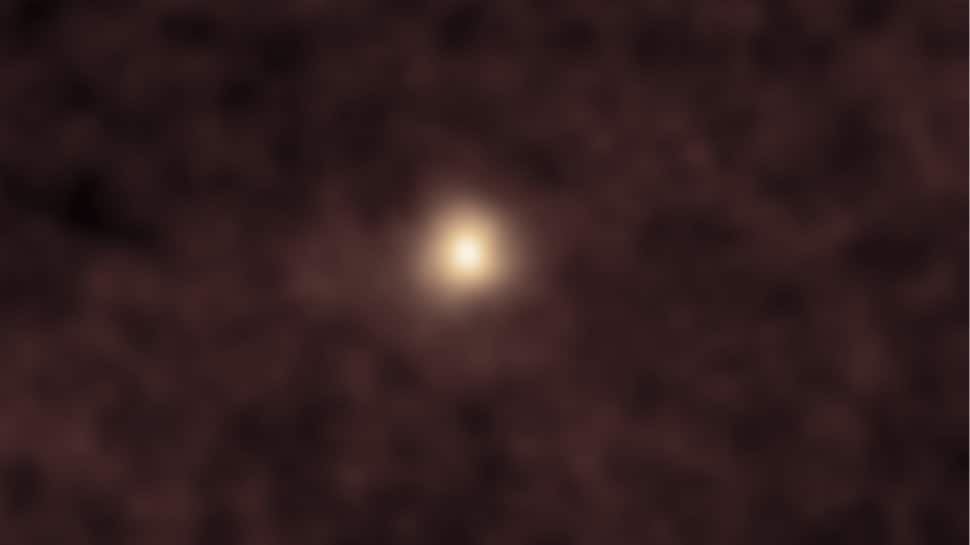
In an extraordinary display of international scientific collaboration, NASA and the Indian Space Research Organisation (ISRO) have jointly observed and studied the interstellar comet 3I/ATLAS, providing unprecedented insights into this rare cosmic visitor. Traveling at a staggering speed of 130,000 miles per hour, 3I/ATLAS is only the third interstellar object ever confirmed to have passed through our Solar System, following the discoveries of ‘Oumuamua in 2017 and comet Borisov in 2019. Its recent close approach to Mars this autumn presented a unique opportunity for scientists to capture detailed images and extensive data from multiple vantage points across the Solar System.
The observations were made possible through a combination of ground-based and space-borne instruments. ISRO’s 1.2-meter Mount Abu telescope in India produced high-resolution optical images between November 12 and 15, revealing a near-circular coma — the cloud of gas and dust enveloping the comet’s nucleus. Spectroscopic analysis from these observations detected emissions of cyanogen (CN), diatomic carbon (C₂), and triatomic carbon (C₃), all chemicals commonly associated with active comets. These findings were shared publicly by ISRO’s Physical Research Laboratory on November 19, highlighting the crucial role of Earth-based observatories in complementing space missions.
Meanwhile, NASA’s fleet of spacecraft provided close-up and multi-wavelength perspectives of 3I/ATLAS as it zipped past Mars. The Mars Reconnaissance Orbiter (MRO) employed its high-resolution HiRISE camera to capture some of the sharpest images ever taken of an interstellar object. When the comet was about 19 million miles (30 million kilometers) from Mars, these images revealed the development of the coma, showing the cloud of gas and dust expanding as solar radiation heated the comet’s nucleus. This detailed visual documentation marks a milestone in interstellar comet studies, offering clarity on how such objects behave when exposed to the Sun’s energy.
Adding a new dimension to the observations, NASA’s Mars Atmosphere and Volatile Evolution (MAVEN) orbiter used its Imaging Ultraviolet Spectrograph to detect a hydrogen halo surrounding the comet. This halo is indicative of water-ice sublimating—turning directly from solid to gas—as the comet warmed while approaching the Sun. The identification of water sublimation from an object originating outside our Solar System confirms that 3I/ATLAS carries water from an alien star system, a groundbreaking discovery that expands our understanding of the distribution of water in the galaxy.
NASA’s Perseverance rover, stationed on the surface of Mars, also contributed to this historic study. Despite the comet being nearly 30 million kilometers away, Perseverance’s Mastcam-Z camera managed to record a faint streak of 3I/ATLAS moving across the Martian sky. This feat underscores the remarkable precision of modern planetary science instruments and highlights the benefits of observing celestial phenomena from multiple platforms and perspectives.
As the comet drew closer to the Sun, NASA deployed its solar observation spacecraft—including STEREO, SOHO, and PUNCH—to study the comet’s tail. Through advanced techniques like image stacking and polarimetry, scientists enhanced faint details in the comet’s tail that are typically invisible to ground-based telescopes. These enhanced images revealed complex structures within the tail, shaped by the interactions of solar wind and radiation. Such detailed observations provide new insights into how the Sun’s energetic environment influences the behavior and evolution of interstellar debris.
In addition to Mars orbiters and solar observatories, two of NASA’s deep-space missions—Psyche and Lucy—played pivotal roles in refining the comet’s trajectory and physical characteristics. Psyche, observing from about 33 million miles away, captured four sets of images over an eight-hour period in early September, while Lucy, positioned some 240 million miles from the comet, recorded a sequence of images on September 16. These observations were instrumental in precisely calculating 3I/ATLAS’s hyperbolic orbit, confirming that it is not gravitationally bound to our Solar System and will eventually return to interstellar space.
This multi-mission approach, combining data from eight different spacecraft, satellites, and telescopes, has allowed scientists to study 3I/ATLAS comprehensively across the electromagnetic spectrum and from diverse vantage points. NASA and ISRO’s coordinated efforts exemplify the power of international cooperation in advancing space science and expanding humanity’s knowledge of