
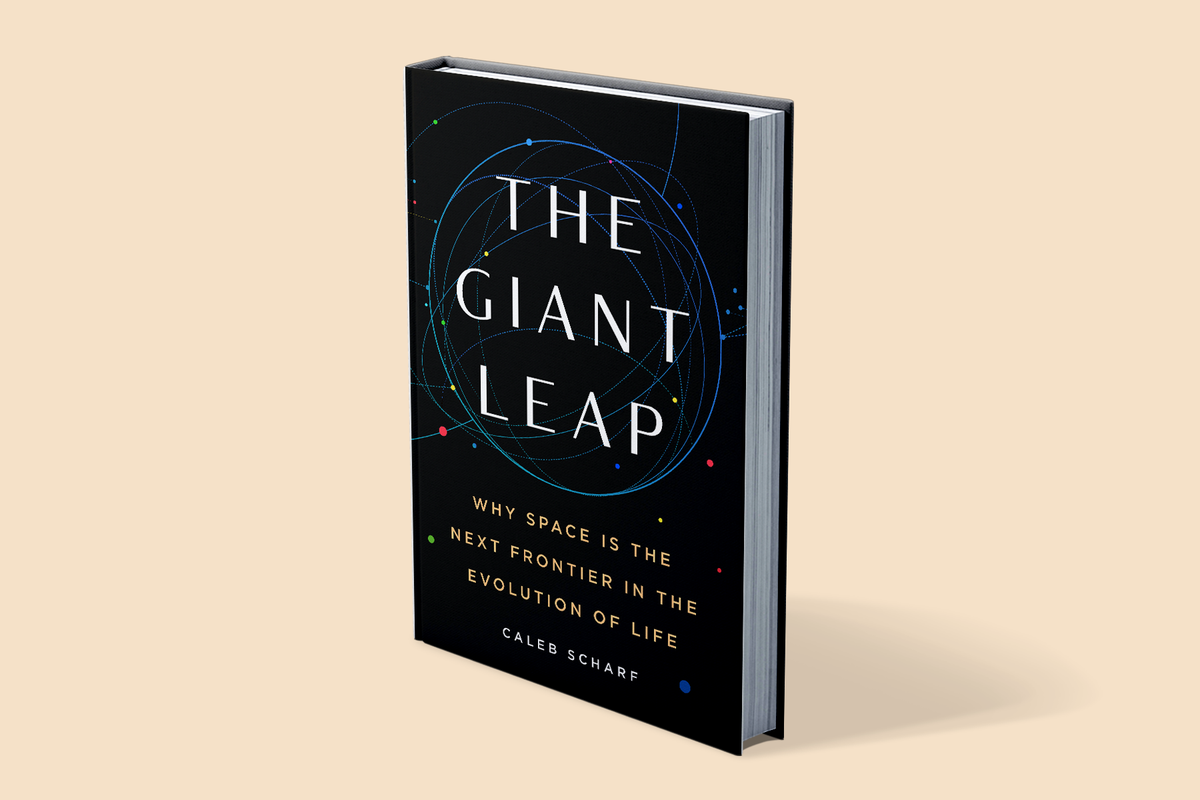
In his new book *The Giant Leap* (Basic Books, 2025), NASA astrobiologist Caleb Scharf explores a profound and compelling idea: the future of life on Earth—and perhaps life itself—may depend on humanity’s expansion beyond our home planet. Scharf, a senior scientist at NASA’s Ames Research Center, argues that the current era of space exploration is not simply a matter of technological progress or geopolitical rivalry, but part of a grand evolutionary transition he calls the “Dispersal.” This transition marks the moment when life, propelled by human technology, begins to permanently extend beyond Earth into the vast resources and environments of the solar system.
Life on Earth has undergone several major evolutionary leaps over billions of years—from the origin of cells to the rise of complex multicellular organisms, and the spread of life from oceans to land and sky. Today, life occupies nearly every conceivable niche on the planet, making it seem as though the evolutionary frontier has run its course. However, Scharf suggests that space represents the next vast evolutionary frontier, a new arena where life can evolve and diversify on an unprecedented scale.
When discussing the genesis of his book, Scharf admits that his fascination with space exploration played a role, but he was also motivated by a desire to understand what it means for life to transcend its planetary origins. He critiques many existing visions of humanity’s space future as overly speculative or focused on specific technologies and fantasies—space elevators, warp drives, and the like—that often ignore the broader evolutionary and planetary context. Instead, he sought to analyze space exploration from a “natural history” perspective, considering it as a planetary phenomenon shaped by fundamental physical constraints and evolutionary imperatives.
Central to Scharf’s thesis is the concept of the Dispersal, which he frames as an evolutionary leap analogous to the way species diversify when they spread into new environments. Just as life on Earth has radiated into different ecological niches, life dispersing through space will encounter radically different conditions that will drive divergence and new forms of existence—potentially far removed from what we currently recognize as human. While this idea can be unsettling, Scharf emphasizes that such transformations are not inherently negative; they represent the creative potential of life adapting to new frontiers.
A key strength of Scharf’s approach is his focus on first principles, such as orbital mechanics and energy constraints, that define the “boundary conditions” of how and where life can expand in the solar system. These boundary conditions shape the landscape of possibilities and challenges, ranging from the intense solar radiation near Mercury to the faint sunlight and high cosmic radiation in the outer solar system. For example, although Mercury is close to the Sun, it is surprisingly difficult to reach due to the energy required to penetrate the Sun’s gravity well. Conversely, the outer planets pose other challenges, such as extreme cold and radiation hazards.
By mapping these constraints, Scharf identifies a “zone of easiest exploration” within the solar system—regions where the physical and energetic conditions make human or robotic presence more feasible. This framing helps clarify why certain destinations, like Mars and the Moon, are natural stepping stones, while others, such as asteroids or orbital habitats, might offer more practical long-term prospects.
Scharf delves into one of the most enduring debates in space exploration: the relative merits of focusing on the Moon versus Mars, or alternatively, developing orbital habitats instead of planetary settlements. He acknowledges the scientific and symbolic importance of studying and even temporarily inhabiting the Moon and Mars, but he is skeptical of the idea of building permanent cities on planetary surfaces. The fundamental problem, he explains, is that planets impose severe environmental stresses—such as low gravity and hostile atmospheres—that conflict with the evolutionary heritage of Earth-based life.
Instead, Scharf argues that engineered habitats—whether built on asteroids or constructed artificially in orbit—offer far greater flexibility. These habitats can provide Earth-like gravity through rotation, controlled atmospheres tailored to human biology, protection from cosmic radiation, and even engineered seasons and climates. Such environments could better support the long-term survival and evolution of life beyond Earth.
This perspective leads Scharf to question the popular Silicon Valley narrative championed by figures like Elon Musk, who advocate for Mars colonization as a way to “backup” humanity against existential threats. Scharf cautions that this rationale is overly simplistic and ignores the immense practical and ethical challenges involved. Living on Mars, he notes, would likely be a harsh and dystopian existence, and the idea that Mars