
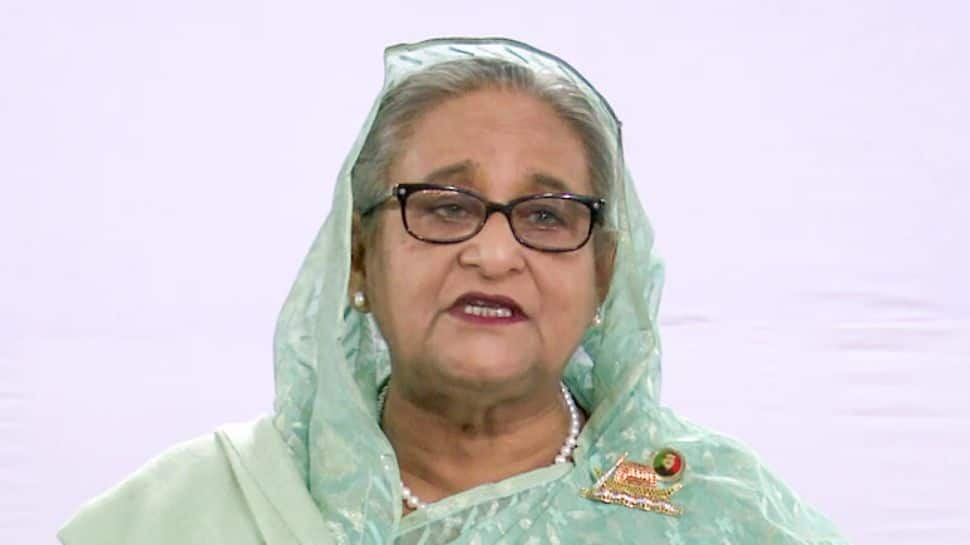
Former Bangladesh Prime Minister Sheikh Hasina has voiced vehement criticism against the country’s Interim Chief Adviser Muhammad Yunus, accusing his administration of undermining the nation’s founding legacy and destabilizing its political and social fabric. In an exclusive interview with WION’s Sidhant Sibal, Hasina expressed deep concerns over the direction Bangladesh has taken since Yunus assumed power following her unexpected removal from office in August last year. She painted a bleak picture of the current state of affairs, accusing Yunus’s government of opening the doors to radical elements, dismantling the country’s established foreign policy, and triggering widespread chaos across Bangladesh.
Sheikh Hasina’s central contention is that Yunus’s government lacks democratic legitimacy and has been operating without a popular mandate, making decisions that could have enduring consequences for the country’s future. A core grievance she raised was the strengthening of ties between Dhaka and Islamabad under Yunus’s leadership—a significant shift from the long-standing estrangement rooted in the traumatic legacy of the 1971 Liberation War. Hasina condemned this rapprochement with Pakistan, describing it as an “unstrategic desire for international validation” that disregards the sacrifices made during Bangladesh’s fight for independence. She charged Yunus with attempting to “erase Sheikh Mujibur Rahman’s name from history,” a direct affront to her father, the Father of the Nation, whose role in Bangladesh’s liberation is sacrosanct for many citizens.
Highlighting the deteriorating internal conditions, Hasina painted a grim picture of Bangladesh’s social and political climate since July 2024. She referenced the vandalism of her father’s historic home as a symbolic act representing a broader assault on the country’s founding principles. According to her, radicals within the unelected government are intent on reshaping the national identity and undermining secular values that have been foundational to Bangladesh’s statehood. She accused Yunus’s administration of silencing journalists, fostering an environment of fear among minorities, and marginalizing women from public life. She also alleged that convicted terrorists have been released and that those involved in violent acts during recent unrest—referred to by Yunus’s government as “July warriors”—have been granted immunity and even rewarded with government positions. This, Hasina claimed, has led to a breakdown in law and order, with the justice system becoming a tool for political revenge rather than impartial adjudication.
Economically, Hasina noted a sharp decline from the rapid growth Bangladesh experienced under her tenure. She described the economy as being “in freefall,” blaming the interim government’s mismanagement and political instability for reversing years of progress. This economic downturn, coupled with increasing repression and instability, she warned, threatens the welfare and stability of the nation.
Regarding the upcoming elections planned for Bangladesh next year, Hasina expressed skepticism about their fairness and inclusiveness given the ongoing ban on the participation of her political party, the Awami League. She stressed that the Awami League, which has a long history intertwined with Bangladesh’s identity and has been democratically elected nine times, should not be sidelined. She argued that excluding her party disenfranchises millions of citizens and undermines the legitimacy of any government formed under such conditions. Hasina emphasized the need to break the cycle of political bans and boycotts to ensure that Bangladesh can have a government with genuine popular consent. She affirmed the party’s commitment to serving the country in whatever capacity possible—whether in government or opposition—and pledged to continue to challenge the ban through legal, diplomatic, and peaceful means.
Sheikh Hasina also addressed the complex regional dynamics, particularly Bangladesh’s relationship with India and Pakistan. She reiterated the historical and deep-rooted friendship between Bangladesh and India, expressing gratitude to the Indian people for their support. However, she voiced concern over recent developments, including persecution of minority Hindus in Bangladesh, the unraveling of long-standing economic partnerships, and hostile rhetoric from some officials in Dhaka toward India. Hasina suggested that India’s cautious stance toward the Yunus government is justified, given his lack of electoral legitimacy and inability to maintain governance and stability. Nonetheless, she expressed confidence that India recognizes these developments as temporary and that Bangladesh will eventually return to a sensible government that restores the natural partnership between the two nations.
On the subject of Bangladesh’s growing engagement with Pakistan, Hasina was unequivocal in her criticism. While acknowledging that a stable relationship with Pakistan is logically sound, she condemned Yunus’s swift and seemingly desperate outreach to Islamabad as politically shortsighted