
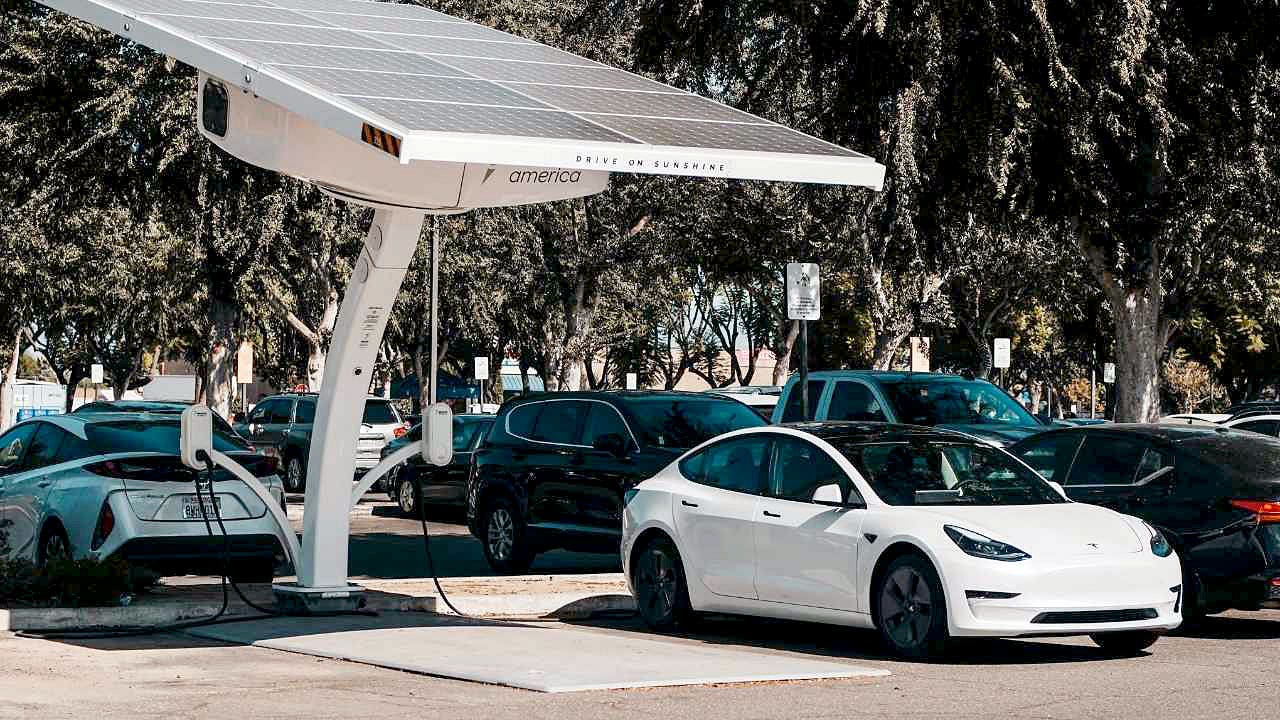
In a recent segment on “Jesse Watters Primetime,” Fox News host Jesse Watters highlighted a story about President Donald Trump purchasing a red Tesla while at the White House, sparking a range of reactions from Democrats. This anecdote serves as a timely backdrop to a broader discussion about the rising prominence and environmental impact of electric vehicles (EVs). Beyond politics, the conversation about EVs is deeply rooted in their potential to reduce emissions and combat climate change, a topic increasingly supported by scientific research.
Electric vehicles have long been praised for their zero tailpipe emissions, but critics often point to the environmental costs associated with their production — particularly the energy-intensive manufacturing of lithium-ion batteries. However, recent peer-reviewed research paints a more promising picture of EVs’ overall climate impact when viewed over their entire lifecycle. A significant study published in the journal PLOS Climate, authored by researchers Pankaj Sadavarte, Drew Shindell, and Daniel Loughlin, provides robust evidence that electric vehicles quickly surpass traditional gasoline-powered cars in terms of total carbon dioxide (CO2) savings.
The study, titled “Comparing the climate and air pollution footprints of Lithium-ion BEVs and ICEs in the U.S. incorporating systemic energy system responses,” offers a comprehensive analysis of the emissions generated not only during vehicle manufacturing but also throughout fuel production and vehicle operation. Utilizing the Global Change Analysis Model (GCAM), which simulates interactions between transportation and energy systems through 2050, the researchers examined various scenarios of EV adoption rates across the United States.
One of the key findings is that while manufacturing an EV initially releases about 30% more CO2 compared to producing a gasoline car, this “carbon debt” is rapidly offset once the vehicle hits the road. After roughly two years of typical driving, electric vehicles begin to emit less carbon overall, and this advantage continues to grow as the electric grid becomes greener over time. As more renewable energy sources such as wind, solar, and nuclear power replace coal and other fossil fuels in electricity generation, charging EVs becomes progressively less carbon-intensive.
The study projects that each additional kilowatt-hour of battery capacity in an EV will eliminate approximately 485 pounds of CO2 by 2030 and about 280 pounds by 2050. These numbers reflect ongoing improvements in battery efficiency and cleaner electricity generation. Over an estimated 18-year lifespan, the environmental damage caused by gasoline vehicles—considering both climate change and health impacts from air pollution—is two to three and a half times greater than that of electric vehicles.
One of the strengths of this research is its systemic approach. Unlike many earlier analyses, it accounts not only for tailpipe emissions but also for upstream effects such as mining raw materials, refining fuels, and processing energy. Additionally, the model factors in how increasing EV adoption influences the broader energy mix. As electric vehicle demand rises, cleaner energy sources gain market share, and coal’s dominance diminishes, dropping below 6% of the electricity generation mix by 2050. This evolution of the power grid significantly enhances the environmental benefits of EVs.
Beyond climate benefits, the study underscores the public health advantages of shifting to electric vehicles. Gasoline-powered cars emit nitrogen oxides and carbon monoxide, pollutants that contribute to respiratory problems and smog formation. As EVs replace internal combustion engines, these harmful emissions decline, leading to improved air quality and reduced healthcare costs for communities.
The researchers also highlight regional variations in how quickly EVs start to deliver net emission reductions. In states with cleaner electricity grids, such as those heavily reliant on renewables, EVs reach their environmental break-even point sooner than in areas still dependent on coal-fired power plants. Nevertheless, even in coal-heavy regions, the study shows that EVs surpass gasoline cars in lifetime emissions well before the vehicles reach three years of age.
It is important to note that the analysis does not include emissions associated with recycling or disposing of vehicle components at the end of their lifecycle. Nor does it factor in the carbon footprint of building charging infrastructure or upgrading power grids to accommodate increased electricity demand. Despite these omissions, the study remains one of the most comprehensive long-term evaluations of electric vehicle adoption’s environmental and economic effects to date.
Looking ahead, the researchers caution that the projections depend on future technological advancements and changes in energy policies. However, across multiple scenarios, the consistent finding is that electric vehicles provide substantial reductions in greenhouse gases and air pollutants over their lifetimes. For drivers who frequently use their cars and plan