
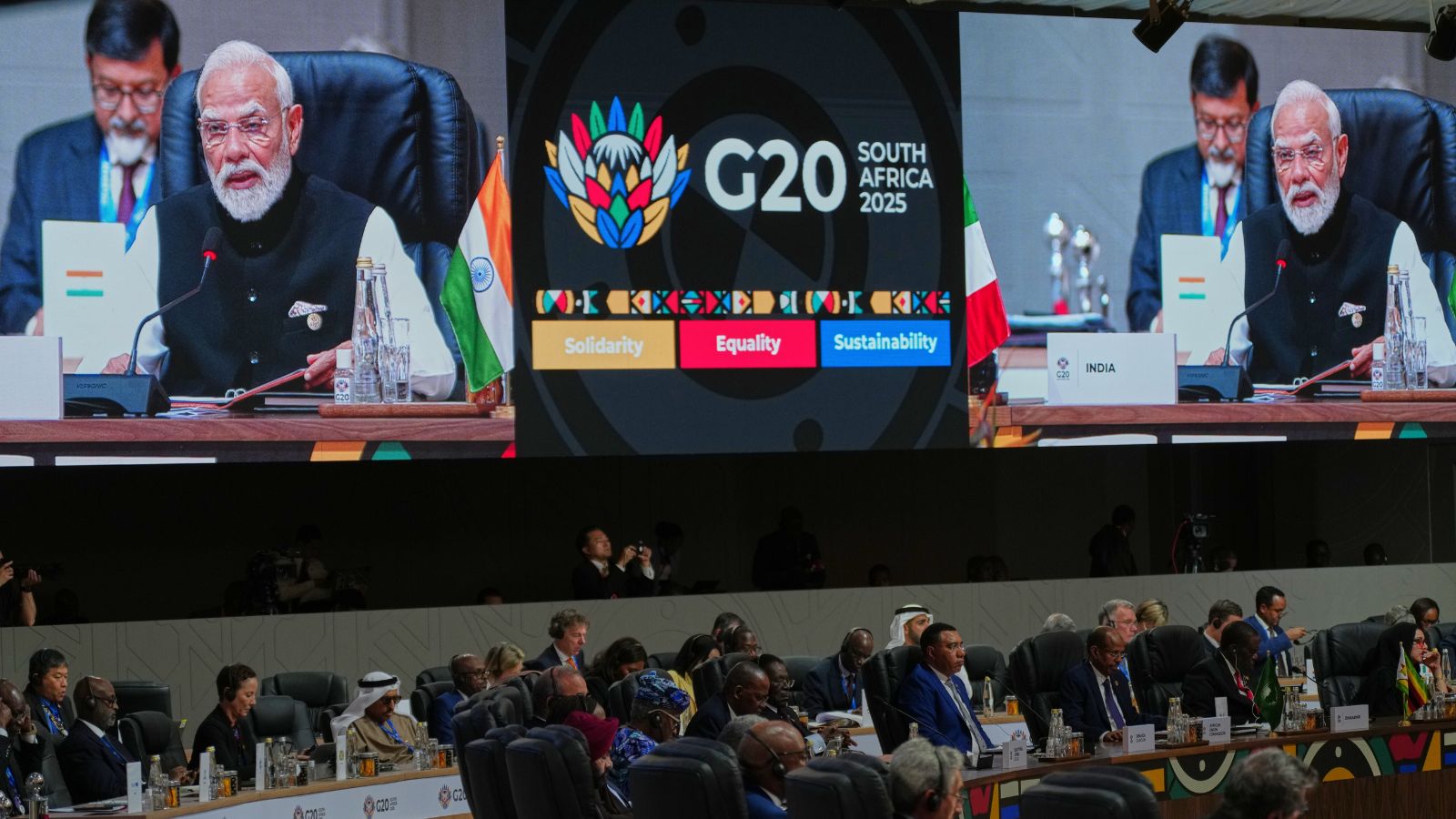
At the recently concluded G20 leaders’ summit in Johannesburg, South Africa, Prime Minister Narendra Modi raised several critical global issues, placing a special emphasis on the challenge of drug trafficking and its broader implications for global security. Modi highlighted how the trafficking of deadly drugs, particularly fentanyl, has become a major threat not only to public health and social stability but also serves as a significant financial conduit for terrorism. To address this multifaceted issue, he proposed a comprehensive initiative titled the “G20 Initiative on Countering the Drug-Terror Nexus,” aimed at dismantling the economic foundations that sustain drug trafficking and terrorism by leveraging coordinated efforts across finance, governance, and security sectors.
Prime Minister Modi’s remarks at the summit underscored the urgency of tackling the drug-terror nexus as a global priority. He pointed out that the rapid spread of highly lethal narcotics like fentanyl demands an integrated response. The proposed initiative seeks to bring together diverse instruments and mechanisms from different countries to systematically weaken the drug-terror economy that fuels instability worldwide. Modi’s proposal reflects India’s broader commitment to enhancing global cooperation on security challenges that transcend borders.
The summit, held under South Africa’s presidency, also provided a platform for Modi to deepen India’s engagement with the African continent. Recognizing Africa’s vital role in the global community and its unique development challenges, Modi proposed the launch of a “G20-Africa Skills Multiplier” initiative. This ambitious program aims to train one million certified trainers across Africa over the next decade, adopting a “train-the-trainers” approach. The goal is to empower African youth with skills across various sectors, thereby fostering local capacity building and sustainable development. Modi urged all G20 partners to support and finance this initiative, emphasizing that Africa’s growth and the empowerment of its young population are of global interest.
In addition to the focus on drug trafficking and skills development, Modi advanced several other visionary proposals at the summit. He called for the establishment of a “G20 Global Healthcare Response Team,” a rapid-deployment medical unit comprising trained experts from G20 countries, ready to respond swiftly to any global health emergencies or natural disasters. This proposal reflects a recognition of the interconnectedness of health security across nations and the need for collective preparedness and response mechanisms.
Further, Modi advocated for the creation of a “Global Traditional Knowledge Repository” within the G20 framework. Drawing from India’s rich heritage and its “Indian Knowledge Systems” initiative, this repository would serve as a platform to preserve and transmit humanity’s collective cultural wisdom, traditional lifestyles, and eco-balanced practices to future generations. Modi emphasized that many communities worldwide have sustained their traditional ways of living in harmony with nature, embodying sustainability, social cohesion, and respect for the environment. The repository aims to honor and leverage such knowledge in addressing contemporary global challenges.
Modi also reflected on the broader developmental paradigms and the role of Africa as the host of the G20 summit for the first time. He critiqued the conventional growth models that have historically deprived large populations of resources while causing environmental degradation, with Africa bearing significant adverse impacts. Highlighting the importance of adopting more holistic and sustainable development frameworks, Modi referenced India’s philosophy of “Integral Humanism,” which views humans, society, and nature as an interconnected whole. This approach, he argued, is essential to achieving harmony between economic progress and environmental stewardship.
On the diplomatic front, Modi’s presence at the G20 summit reinforced India’s strategic partnerships and global outreach. He held bilateral meetings with several world leaders, including British Prime Minister Keir Starmer, Italian Prime Minister Giorgia Meloni, Australian Prime Minister Anthony Albanese, and UN Secretary-General António Guterres. These interactions underscored India’s proactive role in shaping global discourse on issues ranging from security and development to climate change and governance reforms.
The outcomes of the summit also reflected many of the priorities championed by India during its G20 presidency. According to sources, the joint declaration of the G20 leaders strongly condemned terrorism “in all its forms and manifestations,” echoing India’s firm stance on global security threats. The declaration also emphasized the transformative potential of digital public infrastructure and reinforced commitments to harness emerging technologies, including artificial intelligence, in a safe, secure, and trustworthy manner.
Women’s empowerment remained a key theme, with the summit endorsing the concept of women-led development, a highlight of India’s G20 agenda. Efforts to strengthen disaster resilience and response capabilities were also prioritized, building on initiatives launched during India’s presidency