
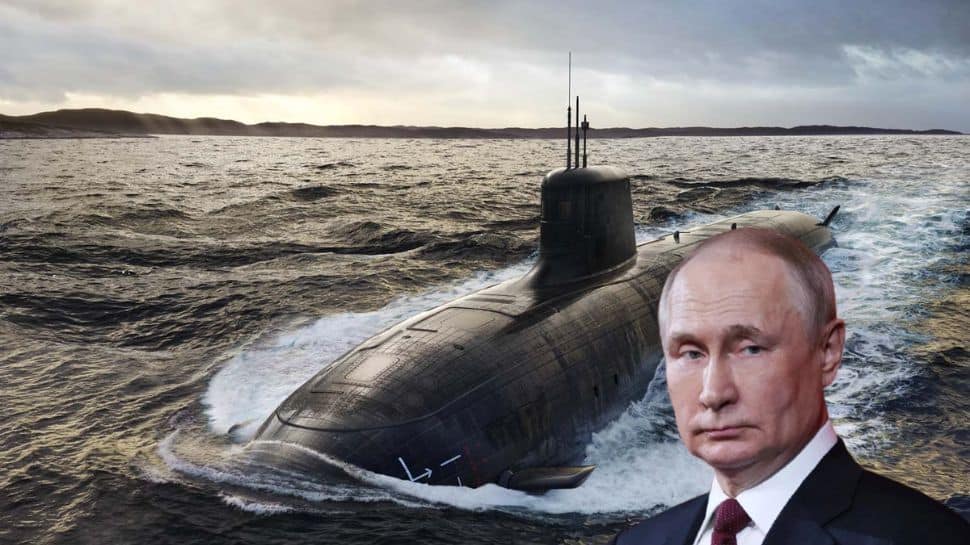
Russia has recently unveiled its most advanced nuclear-powered submarine, the Khabarovsk, a vessel that marks a significant shift in naval warfare due to its unprecedented capabilities. Designed by the Rubin Central Design Bureau of Marine Engineering, the Khabarovsk-class submarine is not just another addition to Russia’s naval fleet but a strategic game-changer that poses a profound threat to coastal cities worldwide. This new submarine is engineered to carry the Poseidon underwater nuclear drone, known ominously as the "Doomsday Weapon," a weapon system that has the potential to unleash catastrophic destruction from the depths of the ocean.
The unveiling ceremony of the Khabarovsk submarine took place at the Sevmash Shipyard in Russia, attended by top military officials including Russian Defense Minister Andrei Belousov and Navy Chief Admiral Alexander Moiseyev. Experts and defense analysts have described the Khabarovsk as the most lethal underwater threat ever created, emphasizing its role in enhancing Russia’s maritime defense and offensive capabilities. The submarine is outfitted with cutting-edge underwater weapons and robotic systems capable of autonomous operation at extreme ocean depths, allowing it to operate silently and undetected while delivering devastating strikes.
What makes the Khabarovsk particularly fearsome is its payload: the Poseidon nuclear drone. This autonomous underwater vehicle is unlike any conventional torpedo or missile. It can travel thousands of kilometers underwater, moving faster than existing torpedoes and submarines, and remains virtually undetectable until it reaches its target. The Poseidon is designed to strike enemy coastal regions with nuclear warheads, capable of causing massive radioactive tsunamis that could wipe out entire cities and render vast areas uninhabitable for decades. Such capability places the Poseidon among the most destructive weapons ever developed, earning it the chilling nickname of a "Doomsday Missile."
The Poseidon drone’s power stems from its innovative nuclear reactor, which is dramatically smaller—about 100 times—than those used in conventional submarines but capable of generating immense energy. This compact reactor allows the drone to operate underwater indefinitely, making it a persistent and relentless threat. Russian Security Council Deputy Chairman Dmitry Medvedev has publicly referred to the Poseidon as a "Doomsday Missile," while President Vladimir Putin has hailed it as a tool that will render Russia’s naval forces "invincible." The combination of near-infinite underwater endurance, high speed, and nuclear payload makes Poseidon virtually unstoppable once launched.
Operating at extreme depths where traditional naval defenses are ineffective, the Poseidon drone circumvents all known anti-submarine warfare measures. Its speed and stealth outrun any current NATO naval defense systems, meaning once it is deployed, the chance of interception or neutralization is negligible. The weapon is engineered to generate radioactive tsunamis upon detonation, a scenario that could devastate coastal regions and cause environmental damage and human casualties on a scale never before seen. The sheer scale of destruction envisioned by this weapon redefines the concept of deterrence and naval combat.
The launch of the Khabarovsk submarine and its Poseidon payload sends a clear strategic message to the world: Russia is committed to defending its national interests and borders with overwhelming force if necessary. This development signals a new era where underwater nuclear strike capabilities have reached unprecedented levels of lethality and stealth. The silent and invisible nature of the Khabarovsk and Poseidon system allows Russia to strike adversaries from beneath the ocean’s surface without warning, complicating defense strategies for any potential opponent.
In addition to the Khabarovsk and Poseidon, Russia has recently unveiled other advanced weapons systems, such as the Burevestnik nuclear-powered missile, which further underscore its focus on developing next-generation strategic weapons. These developments collectively represent a significant evolution in military technology and geopolitical power balances, raising concerns about global security and strategic stability.
The implications of the Khabarovsk and Poseidon system extend beyond military strategy; they challenge existing arms control frameworks and highlight the risks of an escalating arms race under the sea. The ability to launch devastating nuclear strikes from virtually anywhere in the world’s oceans without detection introduces new uncertainties and dangers in international relations. Coastal cities around the globe now face an increased threat, emphasizing the urgent need for dialogue and potentially new treaties to manage these emerging technologies.
In summary, Russia’s launch of the Khabarovsk nuclear submarine equipped with the Poseidon underwater nuclear drone represents a monumental advancement in naval warfare capabilities.