
)
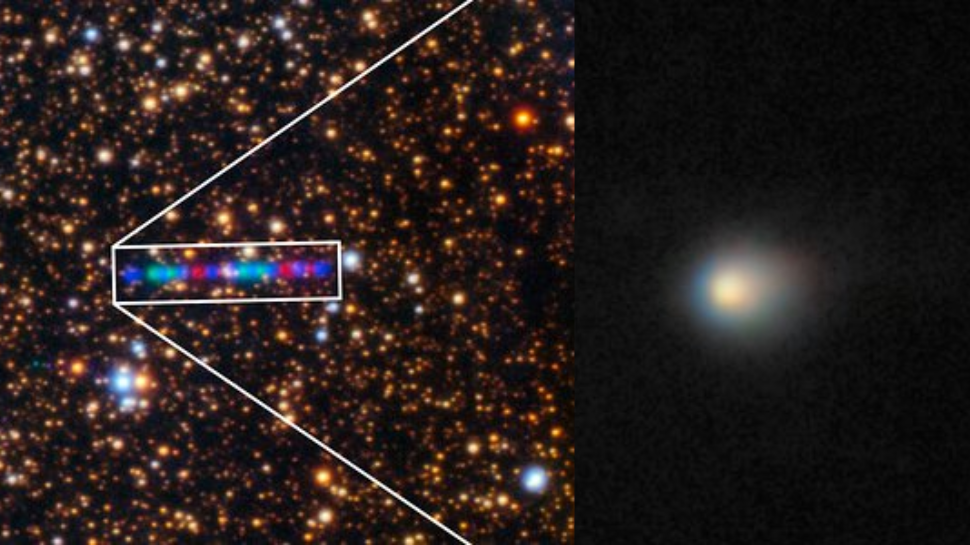
In a remarkable and historic cosmic discovery, NASA has detected definitive signs of water on the interstellar comet known as 3I/ATLAS. This finding marks a significant milestone in planetary science, as it is the first time water’s chemical signature has been confirmed on a comet originating from beyond our Solar System. The detection was made by NASA’s Neil Gehrels Swift Observatory, which observed a faint ultraviolet (UV) signal indicative of hydroxyl gas—a byproduct formed when water molecules break apart under the influence of sunlight. This breakthrough could profoundly reshape our understanding of how planetary systems form and whether the essential ingredients for life are widespread throughout the galaxy.
### The Arrival of an Ancient Visitor
3I/ATLAS was first discovered in July 2025 by the Asteroid Terrestrial-impact Last Alert System (ATLAS) telescope located in Hawaii. It is only the third known interstellar object to traverse our Solar System, following the enigmatic ‘Oumuamua in 2017 and the comet Borisov in 2019. What makes 3I/ATLAS particularly extraordinary is its age and origin. Astronomers estimate that this comet is approximately seven billion years old, nearly twice as old as the Earth itself, which formed around 4.5 billion years ago. Traveling at a staggering speed of over 58 kilometers per second on a hyperbolic trajectory, 3I/ATLAS entered our Solar System from another star system and is destined to leave it forever after its brief visit. This rare journey provides scientists a unique opportunity to study the chemistry and composition of materials from distant worlds, potentially offering clues about the early conditions of other planetary systems.
### Unveiling the Water Signature
The most groundbreaking aspect of this discovery comes from the ultraviolet glow detected by NASA’s Swift Observatory. This glow is caused by hydroxyl radicals, which form when solar ultraviolet radiation breaks apart water molecules in the comet’s icy grains. Remarkably, 3I/ATLAS was found to be losing about 40 kilograms of water per second, despite being located at a distance from the Sun where temperatures are typically too low to cause ice sublimation—the process by which ice turns directly into vapor. This unusual water activity suggests that the comet’s icy grains may be undergoing chemical reactions or physical processes not previously observed in comets either within or outside our Solar System.
Professor Dennis Bodewits, a co-author of the study, emphasized the significance of this behavior by stating, “It’s rewriting what we know about cometary behavior.” This unexpected activity challenges existing models of comet physics and chemistry, indicating that interstellar comets may behave very differently from their Solar System counterparts.
### Why This Discovery Matters
The detection of water on 3I/ATLAS has far-reaching implications beyond the comet itself. It supports the tantalizing possibility that the basic ingredients for life—such as water—are not unique to our Solar System but may be common throughout the galaxy. Previous interstellar visitors painted a diverse picture: ‘Oumuamua appeared dry and lacking in volatiles, while Borisov was rich in carbon monoxide gas. Now, 3I/ATLAS adds to this diversity by revealing a composition abundant in water ice. This variety suggests that interstellar objects originate from different environments and that water-rich comets might be scattered widely across the Milky Way.
As Professor Bodewits put it, “When we detect water from an interstellar comet, we’re essentially reading a message from another planetary system. It tells us that the chemistry of life’s origins might be universal.” This finding lends weight to the idea that the building blocks necessary for life—water, carbon, and other complex molecules—could be widespread, increasing the chances that life exists elsewhere in the cosmos.
### The Journey Ahead: What’s Next for 3I/ATLAS?
Although the comet has temporarily faded from telescopic view, astronomers anticipate that 3I/ATLAS will become visible again by mid-November 2025. This upcoming window presents another valuable opportunity to observe the comet’s activity and composition with even more advanced instruments. Scientists worldwide are collaborating and preparing to study the comet closely, hoping to uncover further insights about the evolution of ancient star systems and the potential habitability of planets beyond our own.
By studying 3I/ATLAS and other interstellar visitors, researchers aim to piece together a more comprehensive picture of how planetary systems form and evolve over billions of years. These observations may also