
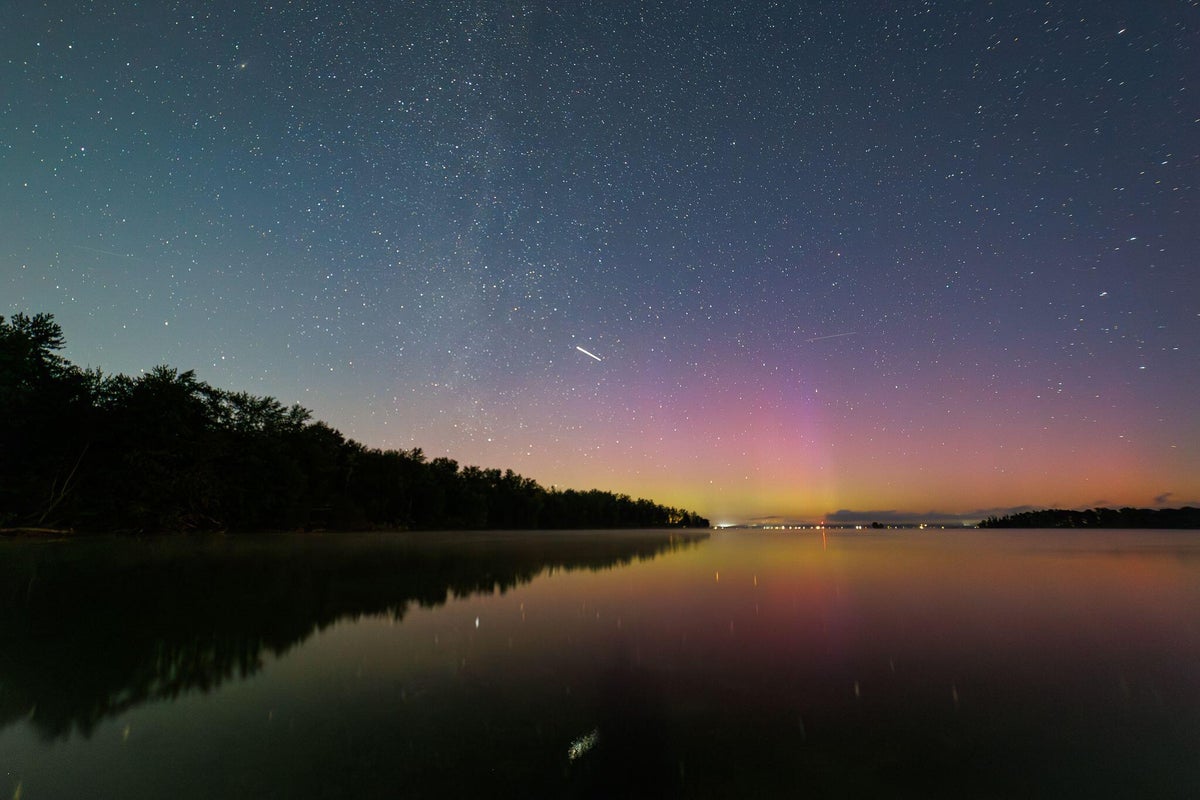
Every autumn, stargazers around the world look forward to the Taurid meteor shower, a celestial event that paints the night sky with streaks of light. Known for its “Halloween fireballs,” the Taurids are a pair of meteor showers that occur annually as Earth passes through streams of debris left behind by a periodic comet. While these luminous trails have long captivated observers, recent scientific studies suggest that the Taurid meteor showers may also provide important clues about potential impact hazards to Earth. As researchers intensify their scrutiny, the Taurids have become a subject of both wonder and caution.
The Taurid meteor showers originate from Comet 2P/Encke, a comet with one of the shortest known orbital periods in our solar system. Encke completes a full orbit around the sun every 3.3 years, and as it approaches the sun, the warmth causes the comet’s ice to vaporize, shedding dust and rocky fragments that spread out along its orbital path. Earth encounters this debris trail twice each year. In late June, the daytime side of our planet passes through what is called the Beta Taurids, while from October through November, the nighttime side encounters two related showers: the Southern Taurids and the Northern Taurids.
This year, the Southern Taurid meteor shower is active from early November, peaking around November 5 and continuing through about November 12. Unfortunately for observers hoping for a dazzling display, the full moon coincides with the peak on November 5, which will likely wash out the fainter meteors with its brightness. Compared to other meteor showers, the Taurids generally produce fewer meteors overall, but they are distinguished by a higher frequency of bright fireballs—meteors that flare brilliantly as they burn up in Earth’s atmosphere. These fireballs are what have earned the Taurids their spooky nickname, “Halloween fireballs,” a popular attraction for skywatchers during the fall.
For those eager to witness the Taurids, experts recommend finding a dark, open spot away from city lights and giving your eyes at least 30 minutes to adjust to the darkness. Rather than straining your neck, it’s best to sit or lie down comfortably while scanning the sky. The meteors appear to radiate from the constellation Taurus, which gives the showers their name, but the activity can be spotted across nearby constellations as well. The Northern Taurids, which also began earlier this season, peak slightly later on November 9 and continue through December 2. They appear to radiate from a point in the sky higher than the Southern Taurids and are believed by scientists to originate not from Comet Encke itself but from an asteroid named 2004 TG10.
Both Comet Encke and asteroid 2004 TG10, along with several other celestial bodies, are thought to be fragments of a much larger object that broke apart roughly 5,000 to 6,000 years ago. This ancient fragmentation event is a focus of scientific interest because it may have produced not only the Taurid meteor showers but also other hazardous debris in near-Earth space. Among these fragments, researchers believe, was the object responsible for the Tunguska Event of 1908, a powerful explosion over Siberia that leveled an estimated 800 square miles of forest and is considered the largest impact event in recorded history. Had that explosion occurred over a populated area, it could have caused widespread devastation.
The Tunguska Event helped inspire a new field of planetary defense, where scientists seek to identify and monitor asteroids and comets that might pose an impact threat to Earth. Mark Boslough, a physicist at the University of New Mexico, is among the researchers closely studying the Taurid complex and its potential risks. He likens Comet Encke to the “character Pigpen” from the Peanuts comics, always followed by a cloud of dust and debris. This debris forms a broad trail through space that Earth crosses twice annually, but some scientists hypothesize that Jupiter’s powerful gravity may have gravitationally concentrated some of this rubble into a denser “resonant swarm” within the Taurid stream.
This hypothetical swarm of debris has not yet been directly observed, but if it exists, it could contain larger fragments that pose a small but non-negligible impact risk to Earth. Such a swarm would not be part of the Southern Taurids themselves but rather an associated cluster of material sharing similar orbits. Based on orbital calculations, the