
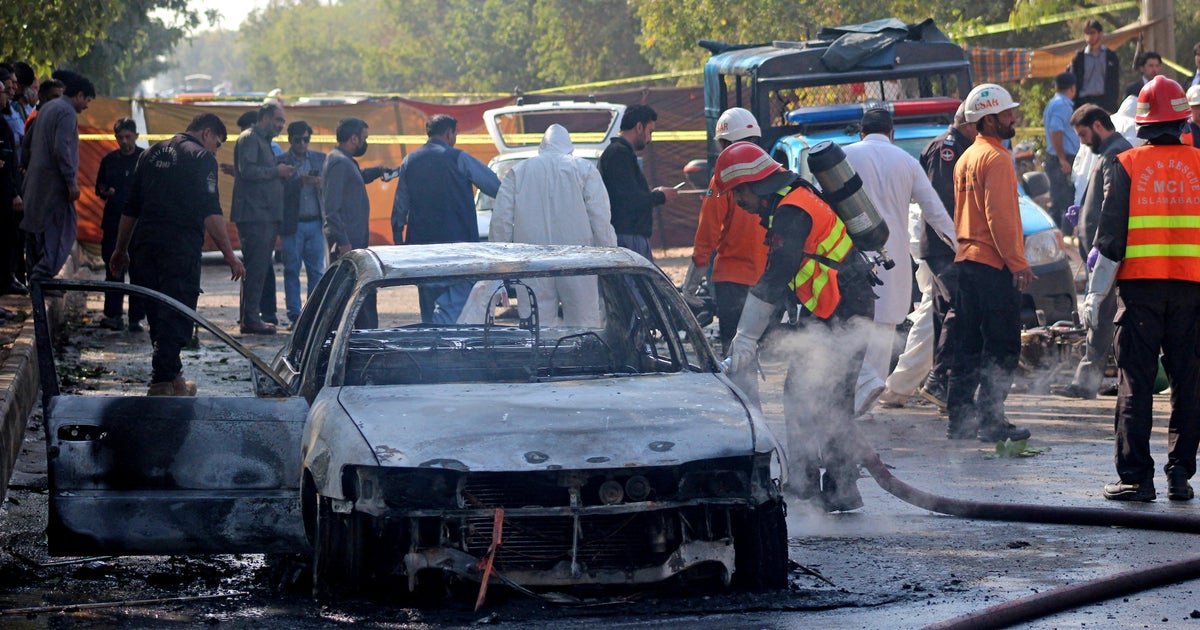
On Tuesday, November 11, 2025, a devastating suicide bombing struck outside the district court buildings located in a residential area of Islamabad, the capital city of Pakistan. The attack claimed the lives of at least twelve people and left around 27 others wounded, according to Pakistan’s Interior Minister Mohsin Naqvi, who provided details at the scene. The bombing occurred at 12:39 p.m. local time and caused significant destruction and panic in the area.
Eyewitness accounts from individuals present during the attack underscore the suddenness and violence of the explosion. Zahid Khan, an assistant to a lawyer working at the court, recounted his harrowing experience to CBS News. He described entering the court premises just moments before the blast, noting that he had been in the exact vicinity three minutes earlier while parking his bike. Khan recalled the blast’s force, saying he feared the entire judiciary building might collapse on him. Upon moving upstairs, he observed people lying injured and bleeding on the ground amid the smoke and fire. His vivid description paints a grim picture of the chaos and suffering wrought by the attack.
The timing of this suicide bombing is particularly notable, coming just a week after the Pakistani Taliban, also known as the Tehreek-e-Taliban Pakistan (TTP), along with some elements of the Afghan Taliban, issued threats targeting Pakistani cities. Following the incident, Pakistani authorities issued a strong condemnation of the attack, labeling it a cowardly act aimed at spreading fear and undermining the country’s justice system. The TTP has claimed responsibility for the bombing, according to official Pakistani statements, which highlight the group’s continued campaign of violence against state institutions.
The attack in Islamabad was not an isolated incident. It came only a day after militants carried out an assault on a military college in Wana, located in the South Waziristan region of Pakistan. During that attack, two militants were killed, and Pakistani officials suggested a link between the two violent episodes. While the TTP officially denied responsibility for both the Islamabad and Wana incidents in statements shared with CBS News, Pakistani security officials and analysts remain convinced that the group was behind these attacks. The militants’ denial contrasts with their past actions and the broader security situation in the region.
In the days leading up to the bombing, a source within the TTP described to CBS News the group’s view of its campaign against the Pakistani government as a “holy struggle.” The source warned that the TTP possesses “human and technical resources in all major cities” of Pakistan and indicated plans to carry out new, large-scale attacks. This declaration highlights the persistent threat posed by the group and the challenges Pakistan faces in combating domestic terrorism.
According to Interior Minister Mohsin Naqvi, the suicide bomber initially attempted to enter the court premises but, unable to do so, instead targeted a police vehicle outside. Naqvi also accused “Indian-backed elements and Afghan Taliban proxies” linked to the TTP of orchestrating the attack, suggesting a complex web of regional involvement. However, he emphasized that authorities were investigating all aspects of the explosion to fully understand its origins and implications.
The government of India swiftly responded to Pakistan’s accusations. Indian government spokesperson Shri Randhir Jaiswal categorically rejected the allegations, calling them “baseless and unfounded.” Jaiswal described Pakistan’s claims as a “predictable tactic” to concoct false narratives against India, underscoring the ongoing tensions and mistrust between the two neighboring countries.
Pakistan’s Defense Minister Khawaja Asif also weighed in on the incident, blaming the Taliban rulers in Afghanistan for allowing the attack to transpire. The relationship between Pakistan and Afghanistan has long been strained, with Islamabad accusing Kabul of harboring or tolerating the TTP within Afghan territory. Asif stated that Afghanistan’s leadership has the power to stop terrorism in Pakistan but has failed to do so, as evidenced by the suicide bombing at the Islamabad district courts. He framed the attack as part of a nationwide war against Pakistan, warning that the conflict is not limited to border regions or remote areas but affects the entire country.
Efforts to improve security cooperation between Pakistan and Afghanistan have so far been unsuccessful. The two countries conducted two rounds of talks in October and earlier in November 2025, aimed at addressing mutual security concerns, including the threat posed by the TTP. However, these negotiations ended without any substantive agreements. Following the Islamabad bombing, Asif expressed skepticism about the prospects of future talks