
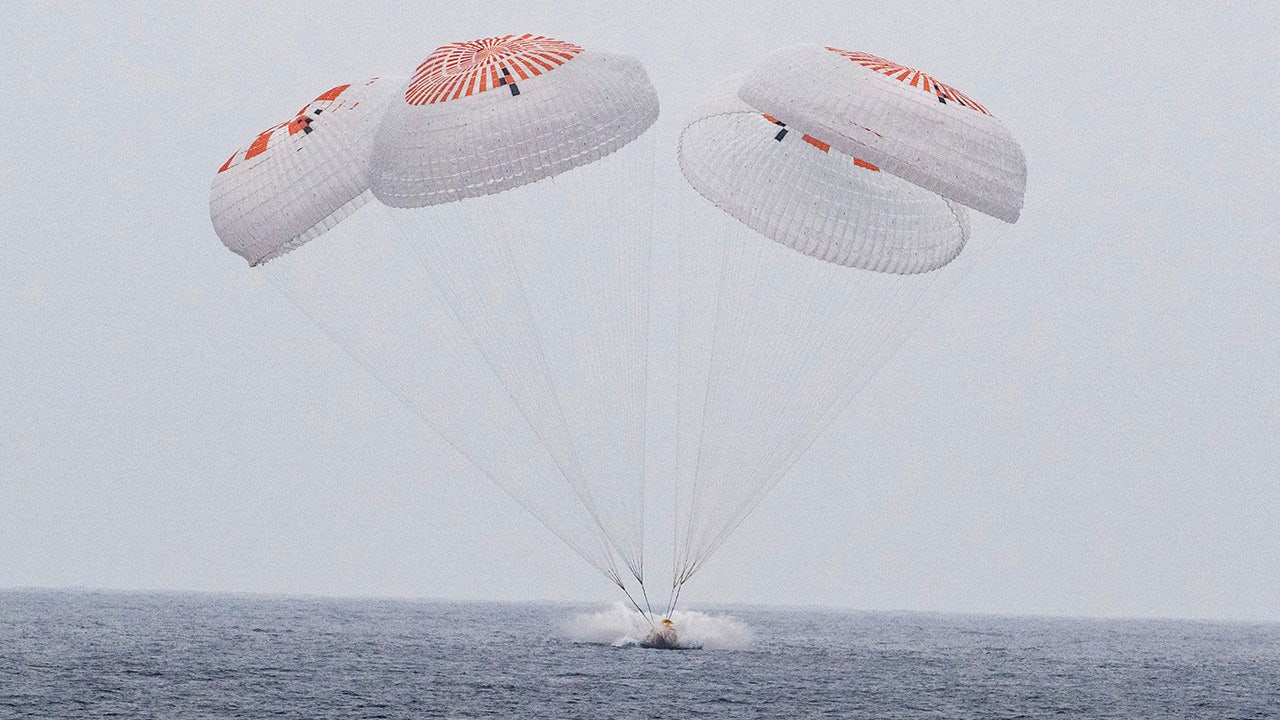
On Saturday morning, four astronauts returned safely to Earth after completing a mission aboard the International Space Station (ISS) that lasted nearly five months. NASA astronauts Anne McClain and Nichole Ayers, Japan’s Takuya Onishi, and Russia’s Kirill Peskov splashed down in the Pacific Ocean off the coast of Southern California at 11:33 a.m. Eastern Time, arriving in a SpaceX crew capsule. This marked a historic moment for NASA, as it was the agency’s first splashdown in the Pacific Ocean in 50 years, and only the third time a SpaceX capsule with astronauts aboard has landed in the ocean.
The last time NASA astronauts splashed down in the Pacific was in 1975, during the Apollo-Soyuz mission, which was notable as the first international crewed space mission involving American and Soviet astronauts. The recent splashdown brings a historic echo of international cooperation in space exploration, highlighting the ongoing collaborations between NASA, Japan’s JAXA space agency, and Russia’s Roscosmos.
The four astronauts had launched to the ISS in March of this year as part of the Crew-10 mission, tasked with relieving two astronauts who had become stranded at the space station due to technical problems with their original return vehicle. NASA astronauts Suni Williams and Butch Wilmore had been scheduled for a short mission, but their Boeing Starliner capsule suffered thruster issues and helium leaks, which made it unsafe to carry the crew back to Earth. As a result, the Starliner returned uncrewed, and Williams and Wilmore stayed aboard the ISS for nine months, far longer than initially planned.
The arrival of McClain, Ayers, Onishi, and Peskov aboard the SpaceX Dragon capsule enabled Williams and Wilmore to finally return safely to Earth in March. This unusual series of events underscored the challenges and complexities of human spaceflight, especially when unexpected technical difficulties arise. It also illustrated the importance of having multiple vehicles and international partners capable of supporting ISS missions.
Following his return to Earth earlier this year, Butch Wilmore announced his retirement from NASA after a distinguished 25-year career. His departure marks the end of an era for one of the agency’s veteran astronauts who contributed significantly to space exploration.
Before leaving the ISS, Anne McClain reflected on the mission’s significance amid global challenges. “We want this mission, our mission, to be a reminder of what people can do when we work together, when we explore together,” she said. McClain acknowledged the "tumultuous times on Earth" and emphasized the importance of international cooperation and shared goals in space exploration. She also expressed her personal anticipation of returning home, looking forward to “doing nothing for a couple of days.” Her crewmates shared similar sentiments, excited about simple comforts like hot showers and burgers after months in space.
This mission also marked a change in SpaceX’s splashdown procedures. Earlier in the year, the company decided to shift its astronaut splashdowns from the traditional landing area off the coast of Florida to the Pacific Ocean near California. The change was made to minimize the risk of debris falling on populated areas, enhancing the safety of splashdowns for both the crew and people on the ground.
After safely exiting the capsule, the crew underwent immediate medical evaluations to ensure they were in good health following their time in microgravity. Subsequently, they were transported by helicopter to rendezvous with a NASA aircraft that flew them back to Houston, where they reunited with family, friends, and NASA officials.
NASA’s Commercial Crew Program manager Steve Stich praised the successful recovery in a post-splashdown press conference, stating, “Overall, the mission went great, glad to have the crew back. SpaceX did a great job of recovering the crew again on the West Coast.” His comments underscored the smooth operation and reliability of SpaceX’s crewed missions, which have become an integral part of NASA’s ongoing efforts to maintain a continuous human presence in space.
Dina Contella, deputy manager of NASA’s International Space Station program, echoed this positive assessment, expressing happiness at seeing the Crew-10 astronauts back on Earth in good condition. She highlighted the impressive achievements of the crew during their 146 days aboard the ISS, noting they had orbited Earth 2,368 times and traveled over 63 million miles—a testament to the endurance and dedication required for long-duration space missions.
The successful completion of the Crew-10