
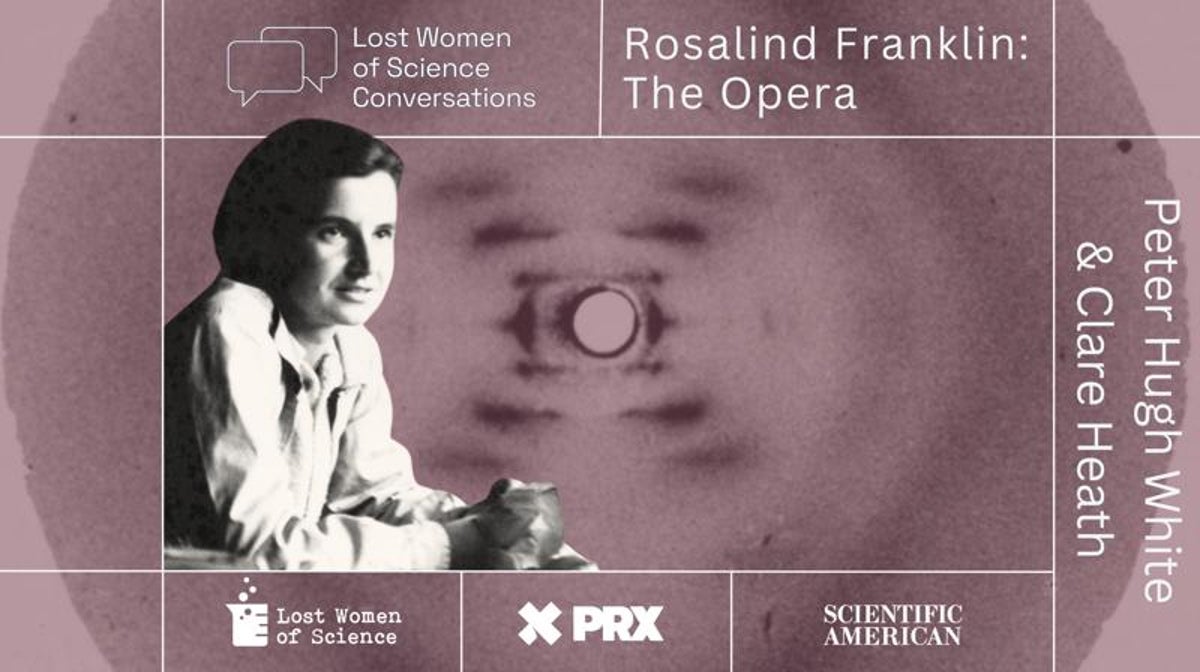
An Opera Illuminates the Life of Rosalind Franklin and the Discovery of DNA
The remarkable story of Rosalind Franklin, the pioneering chemist and x-ray crystallographer whose work was fundamental to understanding the structure of DNA, has been brought to life in a new opera that delves into the ambition, rivalry, and betrayal surrounding one of science’s most significant discoveries. This innovative artistic project, created by composer Peter Hugh White and librettist Dr. Clare Heath, was recently showcased in front of a live London audience as part of the Lost Women of Science initiative, a podcast and movement dedicated to highlighting the contributions of often-overlooked female scientists.
Rosalind Franklin’s scientific legacy is both profound and poignant. She was the creator of “Photograph 51,” an x-ray diffraction image that revealed the double helix structure of DNA. This image became the critical piece of evidence upon which James Watson and Francis Crick built their famous DNA model. Yet, for decades, Franklin’s contributions were overshadowed or misrepresented, particularly in popular accounts such as Watson’s own 1968 memoir, *The Double Helix*, which portrayed her in an unfairly negative light. Franklin died tragically young at the age of 37 from ovarian cancer, just before the Nobel Prize was awarded to Watson, Crick, and Maurice Wilkins, her colleague at King’s College London, who had a complicated and strained working relationship with her.
The opera, simply titled *Rosalind*, explores this intricate narrative with a fresh emotional intensity that music and drama uniquely provide. Composer Peter Hugh White explains that while the story lacks traditional operatic tropes like love affairs or murders, it is rich with elements essential to compelling opera: suspicion, betrayal, and psychological tension. The characters themselves are vividly drawn—from the brash, impulsive Watson to the more measured Crick, and Wilkins, uneasy about being eclipsed by Franklin’s brilliance. The opera’s music reflects these contrasting personalities, with anxious, syncopated motifs for Wilkins and more flamboyant, major-key themes for Watson and Crick.
Dr. Clare Heath, a retired general practitioner and granddaughter of Sir Lawrence Bragg (who played a pivotal role in the scientific race to decode DNA), undertook the challenge of writing her first libretto for the opera. She was motivated by a desire to counteract the misrepresentation of Franklin in popular culture and to honor her as an extraordinary scientist who was neither a victim nor a difficult personality, but a dedicated and brilliant researcher. Clare drew extensively from Franklin’s letters and other historical documents to create an authentic voice for the opera’s characters, blending historical accuracy with poetic license to fit the musical form.
Set in the early 1950s, the opera centers on Franklin’s two-year tenure at King’s College London—a time when the scientific community was feverishly trying to unlock the secrets of DNA. The atmosphere was marked by intense competition and complex interpersonal dynamics. Franklin worked in a cramped, dismal basement laboratory, where she persevered despite the challenges posed by her environment and her male colleagues’ attitudes. The opera captures this through poignant arias, including one in which Franklin sings of her struggle to be taken seriously in a male-dominated world.
Maurice Wilkins, Franklin’s colleague and sometimes rival, is also a central figure in the drama. His uneasy relationship with Franklin is portrayed with nuance: he is shown as anxious and overshadowed by her brilliance, singing of his feelings of inadequacy and frustration. The complicated interactions between Wilkins and Franklin, including the controversy over Photograph 51, are brought to life on stage. While Watson and Crick viewed the photograph as a revelation that confirmed the double helix structure, Franklin’s data had been shared without her full consent or due credit—a betrayal that the opera treats with care and sensitivity.
The opera also touches on the broader scientific and social context of the era. DNA was only beginning to be understood as the molecule of heredity, and the 1950s saw a surge of excitement and discovery. Yet, gender biases and professional rivalries shaped the scientific landscape. Franklin’s exclusion from the Nobel Prize recognition—awarded posthumously to her male colleagues—is a moment of injustice that the opera confronts head-on. The libretto and music culminate in a powerful scene where Franklin’s specter joins Watson, Crick, and Wilkins at the Nobel ceremony, asserting her rightful place in the discovery.
In conversation with host