
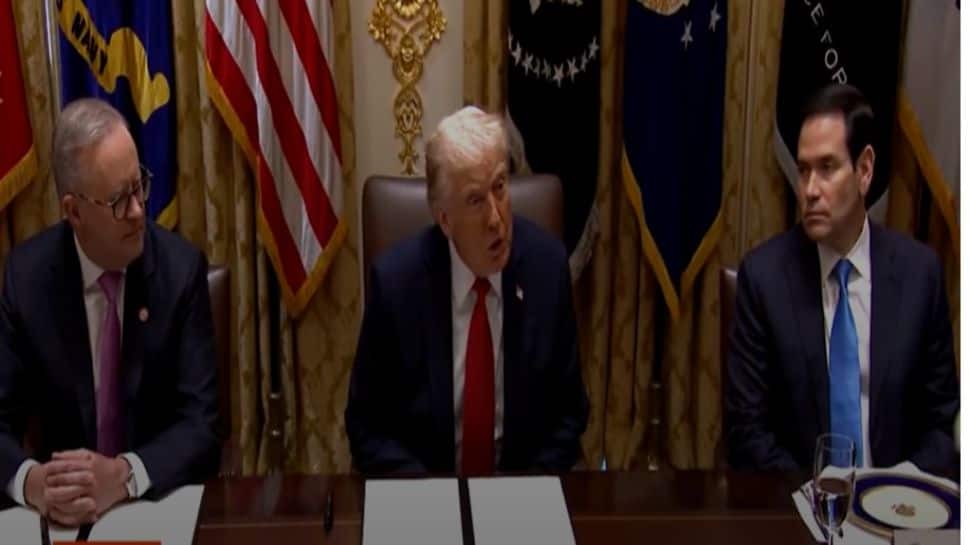
On Monday night at the White House, US President Donald Trump delivered a firm and pointed message regarding trade relations with China, announcing a potential escalation in tariffs and signaling both heightened tensions and forthcoming diplomatic engagement. Speaking during a high-profile meeting with Australian Prime Minister Anthony Albanese, Trump revealed plans to impose an enormous 155% tariff on Chinese imports starting November 1, 2025, should no comprehensive trade deal be reached between the two economic giants. This announcement marked a significant intensification of the ongoing trade disputes between Washington and Beijing, underscoring the administration’s tough stance on China’s trade practices.
President Trump emphasized that China is already paying substantial tariffs to the United States, currently at a rate of 55%, which he described as “a lot of money.” He argued that many countries, including China, had previously taken advantage of the US economically, but asserted that period was over. “A lot of countries took advantage of the United States and they are not able to take advantage anymore,” Trump stated firmly. He made clear that, unless a deal is struck, the tariff rate on Chinese goods could nearly triple to 155%, a move that would significantly impact bilateral trade and global markets.
In addition to tariff threats, Trump announced new export controls targeting China’s critical software sectors, set to commence simultaneously with the tariff increase on November 1. He accused China of adopting an “extraordinarily aggressive position on trade,” citing a “hostile letter” China sent to the international community announcing its own sweeping export controls on nearly all Chinese-made products, as well as some manufacturing goods from other countries. Trump described China’s planned export restrictions as “absolutely unheard of in international trade” and a “moral disgrace” for how they affect all nations without exception.
Despite the escalating trade rhetoric, the US president signaled an openness to diplomacy. He revealed plans to meet Chinese President Xi Jinping in South Korea in the coming weeks, describing their relationship as “very good” and optimistic about reaching a “fair and really great trade deal.” Trump expressed hope that the negotiations would result in China increasing purchases of American goods, particularly soybeans, which he said would benefit not only the two countries but the global economy as a whole.
The day’s agenda also featured a significant development in US-Australia relations. President Trump and Prime Minister Albanese signed a multi-billion dollar agreement focused on critical minerals and defense cooperation, a pact valued at approximately $8.5 billion. This agreement, the fruit of months of bilateral negotiations, aims to enhance supply-chain security, bolster energy independence, and deepen military collaboration between the two allies. The deal reflects a broader strategic alignment in the Indo-Pacific region, particularly in response to China’s growing economic and military influence.
Earlier on the day of the White House meeting, Trump took to his social media platform, Truth Social, to outline the new tariff and export control measures. In a detailed post, he confirmed that the United States would impose an additional 100% tariff on top of existing tariffs on Chinese goods starting November 1, or potentially sooner depending on China’s actions. He also reiterated the decision to implement export controls on all critical software exports to China from the same date, highlighting concerns about technology transfer and national security.
Trump’s social media statement accused China of having “taken an extraordinarily aggressive position on trade” and criticized the country’s planned export controls as a premeditated strategy devised years ago. He warned that these controls would impact all countries globally, without exception, and portrayed China’s approach as unprecedented and damaging to international trade norms.
Concluding the White House meeting, Trump announced he had accepted an invitation to visit China, with plans to travel early in 2026. This forthcoming trip indicates a willingness to engage directly with Chinese leadership to resolve trade tensions and improve bilateral relations. The president’s remarks suggested that while the US is prepared to apply significant economic pressure, it remains open to negotiation and dialogue.
In summary, the US administration is preparing to escalate trade pressures on China through sharply increased tariffs and export controls in response to what it views as aggressive and unfair trade practices by Beijing. However, diplomatic channels remain active, with high-level meetings scheduled between President Trump and President Xi Jinping, as well as an upcoming presidential visit to China. Meanwhile, the US is strengthening strategic partnerships with key allies such as Australia through substantial agreements aimed at enhancing defense and critical mineral supply chains. These moves collectively reflect the complex and multifaceted nature of US-China relations as the