
Recent satellite imagery has exposed China’s ongoing military expansion along the sensitive India-China border, revealing the construction of a large, sophisticated air defense complex in Tibet. This development is particularly alarming as it is situated perilously close to Pangong Lake, just about 110 kilometers from the site of the 2020 Galwan Valley clash — a violent confrontation between Indian and Chinese troops that resulted in casualties on the Indian side. The new facility’s scale, design, and capabilities suggest that it is far more than routine infrastructure; experts view it as a clear indication that China is gearing up for possible future conflict, aiming to establish air dominance over the region.
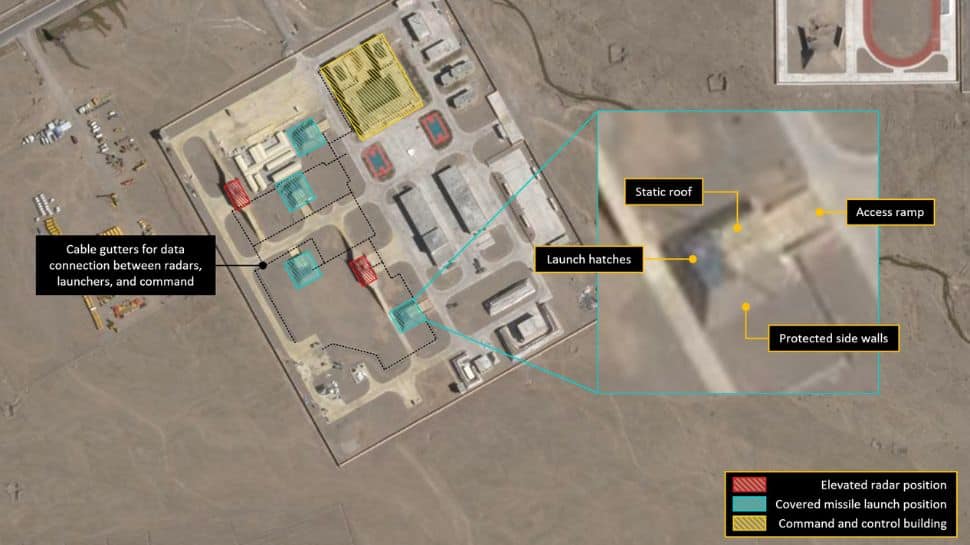
The air defense complex under construction on the eastern banks of Pangong Lake has been identified through high-resolution satellite images analyzed by multiple intelligence sources, including US-based geo-intelligence firm AllSource Analysis and space intelligence agency Vantor. The imagery reveals multiple covered missile launch positions with sliding roofs large enough to accommodate two vehicles each. These roofs have hatches that can open to allow missile launchers to fire while remaining mostly concealed, a design that significantly reduces the likelihood of detection by surveillance or air strikes. This innovative concealment feature highlights the strategic sophistication behind the facility, intended to protect critical assets while maintaining operational readiness.
Intelligence experts believe that the hardened shelters within this complex house China’s long-range HQ-9 surface-to-air missile (SAM) systems. The HQ-9 is a formidable weapon capable of targeting Indian aircraft at considerable distances, posing a serious threat to India’s air operations in the region. The missile system’s deployment so close to the Line of Actual Control (LAC) — the de facto border between India and China — is viewed as part of Beijing’s broader strategy to assert military dominance and restrict Indian maneuverability in the airspace above this contested frontier.
Adding to the concern is the discovery of a nearly identical missile complex located in Gar County, approximately 65 kilometers from the LAC, directly opposite India’s advanced Nyoma airfield in Ladakh. This “ring of missile fortresses” effectively boxes in Indian forward bases and restricts Indian military options, creating a heavily militarized zone with overlapping layers of air defense. The presence of multiple such complexes reflects China’s intention to build a robust and integrated air defense network in the region.
The design of these complexes is particularly noteworthy for its emphasis on survivability and stealth. The hardened launch positions for the HQ-9 Transporter Erector Launcher (TEL) vehicles feature roofs with hatches that allow the launchers to remain hidden and protected while firing. This architectural choice not only conceals the exact location of missile launchers but also shields them from potential preemptive strikes, thereby enhancing the facility’s resilience in a conflict scenario.
Further satellite imagery from late September 2025 captured some missile launch positions with their sliding roofs open, confirming that launchers were already positioned inside and ready for deployment. This suggests that the complex is nearing operational capability, adding urgency to concerns about China’s military build-up along the border.
The facility is also strategically situated near an existing Chinese radar installation, which likely serves as a command-and-control hub for the air defense system. Analysts have identified extensive wired data connections linking the missile launchers to this command center, indicating a sophisticated, integrated network capable of rapid response and coordinated air defense operations. This “web of destruction,” as described by experts, represents a significant enhancement of China’s defensive and offensive capabilities in the region.
Geospatial researcher Damien Symon was among the first to identify the Pangong Lake complex in July 2025, describing it as a “military-linked complex” featuring garages, highbay structures, and protected storage facilities. Although parts of the site remain under construction, the overall footprint and infrastructure clearly point to a military purpose, likely evolving into a fully operational surface-to-air missile position or another weapons-related facility.
The implications of these developments for India are profound. The proximity of these missile complexes to key Indian military installations, combined with their advanced concealment and networked command systems, poses a direct challenge to India’s air superiority and freedom of movement in the border region. This build-up exacerbates already high tensions following the deadly Galwan Valley clash and subsequent stand-offs, signaling a sustained effort by China to consolidate territorial claims and deter Indian military actions.
Moreover, the deployment of long-range SAM systems in such forward positions could alter the strategic calculus in any future conflict, potentially restricting Indian air operations and complicating India’s ability