
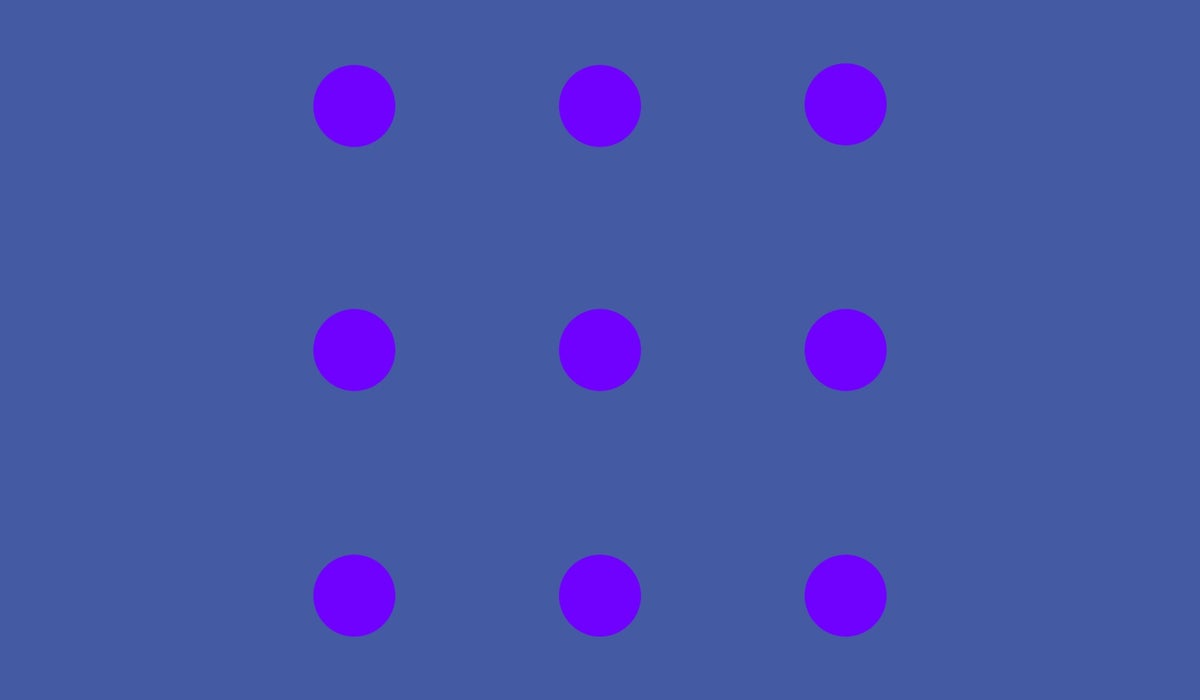
In August 2025, Hinnerk Schulz-Hildebrandt, a biomedical optics engineer at Harvard Medical School, made an intriguing observation while looking at a flight map on his phone. As his eye followed the plane’s flight path, he noticed the line’s color seemed to shift mysteriously—it appeared purple when he stared directly at it but shifted to blue when seen through his peripheral vision. This subtle but striking visual quirk sparked Schulz-Hildebrandt’s curiosity and led him to create a new optical illusion that reveals fascinating insights into how our eyes and brain perceive color.
The illusion, published recently in the journal Perception, features nine purple dots arranged against a blue background. When a viewer focuses on one dot, that dot appears distinctly more purple, while the surrounding dots seem to shift toward a blue hue. This simple visual setup serves as a powerful demonstration of the malleability of human color perception, illustrating that what we see depends heavily on where and how we look.
At the heart of this illusion’s effect are the specialized cells in the retina known as cones, which are responsible for detecting color. Our retinas contain different types of cones, each sensitive to specific wavelengths of light corresponding roughly to red, green, or blue hues. However, the distribution of these cones is uneven. In the very center of the retina, an area called the fovea centralis—which is responsible for our sharpest, most detailed vision—there are relatively few blue-sensitive cones. This scarcity means that when we look directly at something, our perception of blue is diminished, which can lead the brain to interpret the color differently, such as perceiving a dot as more purple than blue.
Adding another layer to this phenomenon is a natural anatomical feature of the eye: a yellow pigment layer that sits in front of the fovea. This layer acts much like a pair of internal sunglasses, absorbing some blue and near-ultraviolet light before it even reaches the cones. This absorption further reduces blue sensitivity in the center of our vision compared to the periphery. Usually, we don’t notice this difference because our brains compensate or “calibrate” for it, seamlessly blending the signals we receive. But under certain conditions—like those created in Schulz-Hildebrandt’s illusion—this subtle imbalance becomes perceptible.
The yellow pigment’s role in color perception is also responsible for a related phenomenon known as Maxwell’s spot. This is a reddish spot that some people perceive in the center of their vision, caused by the absorption of blue light by the macular pigment. Interestingly, a similar illusion to Schulz-Hildebrandt’s was independently developed last year by experimental psychologist Akiyoshi Kitaoka of Ritsumeikan University in Japan. Kitaoka’s version uses combinations of blue, green, and red dots on solid green or blue backgrounds to highlight the reduced blue perception in central vision, underscoring the robustness of this perceptual quirk.
The background color in Schulz-Hildebrandt’s nine-dot illusion plays a crucial role in amplifying the effect. According to Jenny Bosten, a visual neuroscientist at the University of Sussex, this is due to a phenomenon called simultaneous contrast. Our brains perceive colors not in isolation but in relation to the colors surrounding them. For example, a gray circle on a red background often appears tinged with green, its complementary color, because the brain interprets the gray as “less red.” Similarly, a blue-purple dot on a blue background can look more purple, particularly when combined with the reduced blue sensitivity in central vision. The interaction of these effects creates a striking and somewhat disorienting illusion.
While the “9 Purple Dots” illusion doesn’t reveal a completely new aspect of visual processing, it cleverly exploits several known features of human color vision to produce a compelling visual experience. It demonstrates how our perception is not simply a direct reflection of the world but a constructed interpretation shaped by the biology of our eyes and the processing of our brains. Such illusions remind us of the complexity underlying even the simplest acts of seeing.
Nora Bradford, a freelance science writer and cognitive science Ph.D. student, authored the article detailing this illusion. She emphasizes the importance of supporting quality science journalism, noting how science reporting helps us appreciate and understand the discoveries and ideas that shape our world. Bradford also shares her personal connection to Scientific American, highlighting how the publication has inspired awe and curiosity about the universe since her childhood.
Scientific American, with a legacy spanning