
For decades, the waters surrounding Britain’s Caribbean territories—namely the Cayman Islands, Anguilla, and Turks and Caicos—have held many secrets beneath their sparkling surfaces. These marine environments, largely unexplored beyond the shallow coastal areas, have now begun to reveal astonishing underwater landscapes and ecosystems thanks to a groundbreaking scientific expedition. This first-ever deep-sea survey has uncovered an underwater mountain range, a colossal blue hole, coral reefs that appear untouched by the devastating effects of climate change, and a host of previously unknown marine species.
The expedition, led by Dr. James Bell and conducted aboard the British research vessel RRS James Cook, has been operating around the clock over the past six weeks. Using advanced cameras and scientific instruments capable of withstanding extreme pressures at depths of up to 6,000 meters (about 19,700 feet), the research team has ventured into largely uncharted ocean territory. Navigating these deep waters was challenging, as the team had to rely on decades-old nautical maps riddled with inaccuracies and significant gaps.
The UK Centre for Environment, Fisheries and Aquaculture Science (CEFAS) collaborated closely with environmental experts from the territories themselves, sharing their discoveries exclusively with BBC News. These British Overseas Territories are critically important for biodiversity, as up to 90% of Britain’s unique species are found in these waters. With climate change and pollution posing growing threats, the expedition’s findings underscore the urgent need to protect these relatively pristine marine ecosystems.
Dr. Bell describes this mission as a pioneering step into environments previously unseen and, in some cases, unknown to science. “Just yesterday we found a kind of swimming sea cucumber, and we still don’t know what it is,” he said, marveling at the extraordinary diversity encountered. The three territories are known to host 146 species found nowhere else on Earth, and this latest research is expected to add even more unique species to that list.
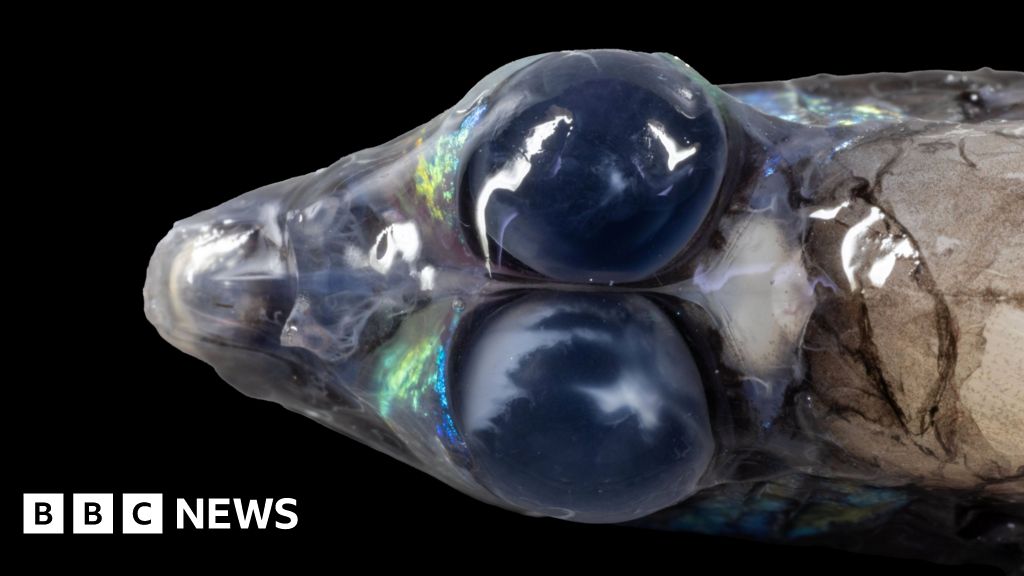
Over the course of the expedition, the team documented nearly 14,000 individual specimens representing 290 different marine species, though further scientific analysis is required to confirm all identifications. Among their remarkable discoveries were a pelican eel with a glowing pink tail that flashes red to attract prey, a barreleye fish with upward-pointing tubular eyes designed to spot silhouettes above, and a dragonfish equipped with a bioluminescent rod beneath its chin.
One of the most striking features discovered is an underwater mountain range near Little Cayman Island, dubbed Pickle Bank. The team worked cautiously to map this submerged massif, which rises dramatically from depths of 2,500 meters (8,200 feet) to just 20 meters (65 feet) below the ocean surface. The mountain’s steep flanks are alive with vibrant coral communities, including golden coral towers alongside brain coral formations. Fish dart among gorgonian whip corals, while black corals provide habitat for jelly-like orange sea sponges, creating a rich and colorful underwater landscape rarely seen at these depths.
This mountain supports one of the healthiest and most diverse coral reefs in the region, notable for being free of the stony coral disease that has ravaged much of the Caribbean’s reefs. Scientists believe that the reef’s depth and the mountain’s steep slopes have shielded it from the warming ocean temperatures that have caused widespread coral bleaching. Deep-water or mesophotic reefs, like those found here, often lie beyond the reach of temperature fluctuations that harm shallow coral systems, offering a potential refuge from the impacts of climate change, which has damaged approximately 80% of the world’s coral reefs since 2023.
The expedition also employed echo-sounders and deep-sea cameras to map nearly 25,000 square kilometers (about 9,700 square miles) of seabed and capture some 20,000 photographs. These images revealed glowing lantern fish and other bioluminescent creatures that seem almost alien, such as cephalopods with otherworldly features. Dr. Bell highlighted the irony that humanity knows more about the surfaces of Mars and the Moon than the ocean floors of our own planet. “You send a satellite around them and map them in a few weeks,” he said, “but we can’t do that for our ocean. We have to map it bit by bit using acoustic instruments on ships.”
In Turks and Caicos, the team uncovered a previously uncharted, extremely steep underwater mountain ridge stretching 70 kilometers (45 miles) along the sea floor west of Gentry Bank. This