
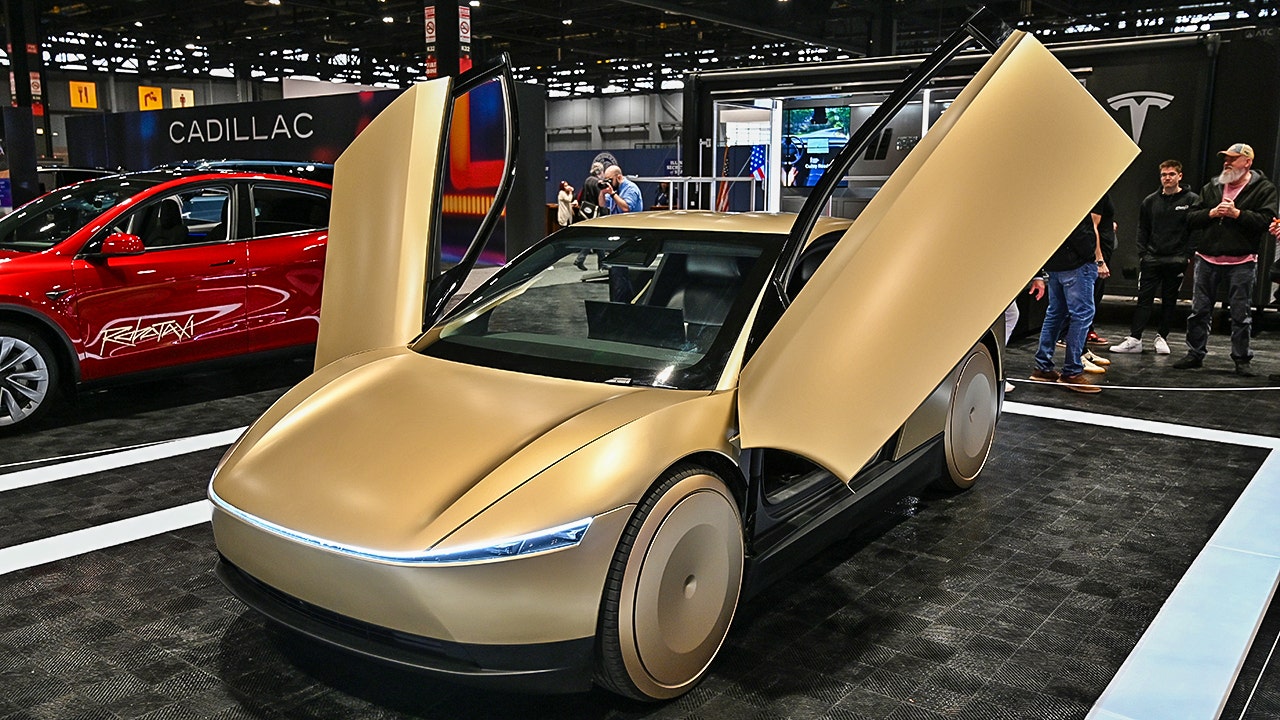
Tesla has taken a bold leap forward in the automotive and transportation industries with the unveiling of its first Cybercab, which recently rolled off the production line at the Tesla Gigafactory in Texas. This groundbreaking vehicle is notable for its radical departure from traditional car design—it has no steering wheel, no pedals, and no manual controls whatsoever. This design shift underscores Tesla’s ambitious push toward fully autonomous, unsupervised robotaxi services, a move that could reshape the way people think about and use personal and shared transportation.
The Cybercab is a two-passenger vehicle specifically engineered to operate as a fully autonomous taxi. It relies entirely on Tesla’s Full Self-Driving (FSD) software, which uses a camera-based system powered by advanced neural networks. Unlike other autonomous vehicle developers that depend on a combination of sensors including LiDAR (light detection and ranging), Tesla’s approach eschews LiDAR in favor of vision-only technology. Elon Musk, Tesla’s CEO, has consistently argued that vision-based systems alone can solve the challenges of self-driving. However, critics remain skeptical, emphasizing the importance of sensor redundancy—particularly in poor weather conditions or complex traffic scenarios—to ensure safety and reliability.
Currently, Tesla’s robotaxi testing program uses modified Model Y vehicles that require human supervision, which is categorized as Level 2 automation. This means a human driver must be ready to take control at any moment. The Cybercab, however, aims to reach full Level 4 or even Level 5 autonomy, which would allow the vehicle to operate entirely without human intervention under most conditions. This is a significant leap, as the difference between supervised and unsupervised autonomy is vast. The Cybercab’s lack of any manual override means that if the software encounters a problem, passengers cannot physically take control of the vehicle, raising critical questions about safety, reliability, and passenger trust.
Tesla plans to start production of the Cybercab in April, although as with many of Musk’s ambitious deadlines, the timeline may evolve as the company refines the manufacturing process. The Cybercab’s production is tied to Tesla’s innovative “Unboxed” manufacturing strategy, which replaces the traditional linear assembly line with a modular approach. Instead of building the entire vehicle step by step down a line, different modules are constructed separately and then brought together late in the process. This technique could drastically reduce the amount of factory space needed and potentially speed up the production cycle, with Musk suggesting a theoretical output rate of one vehicle every 10 seconds. Nevertheless, early production is expected to be slower as Tesla works out the complexities of scaling a new vehicle design alongside a novel manufacturing method.
One of Tesla’s goals with the Cybercab is to compete with major ride-hailing services like Uber and Lyft, offering an autonomous alternative that could significantly lower operational costs by removing the need for human drivers. The vehicle’s design and production costs reportedly position it to undercut much of the current autonomous vehicle competition, potentially making robotaxi rides more affordable and accessible. Additionally, Tesla has hinted that private ownership of the Cybercab might be possible, although the initial focus is clearly on ride-hailing fleets.
Despite the Cybercab’s promising features and Tesla’s confidence, the road ahead is fraught with regulatory and safety challenges. U.S. federal motor vehicle safety standards currently require vehicles to have basic driver controls such as a steering wheel and pedals. Because the Cybercab lacks these features, Tesla is reportedly seeking exemptions from regulators. This situation places authorities in a difficult position—whether to accept the premise that advanced software can replace traditional mechanical controls and meet or exceed existing safety standards. The decisions regulators make could profoundly impact the future deployment of fully autonomous vehicles in public spaces.
Safety remains the paramount concern as Tesla pushes toward unsupervised robotaxi service. Long-term reliability data for fully autonomous driving systems across diverse weather, traffic, and road conditions is still limited. Many competitors have adopted sensor fusion strategies, combining cameras, radar, and LiDAR to create overlapping layers of sensing for greater safety. Tesla’s camera-only system, while innovative, will be tested rigorously once the Cybercab begins operating on public roads. Public trust will be critical to the vehicle’s success, especially since passengers will have no ability to intervene if something goes wrong.
The psychological impact of riding in a car without traditional controls cannot be understated. For over a century, driving has symbolized personal control—hands on the wheel, feet on pedals, and eyes on the road. The Cybercab challenges this deeply ingrained notion