
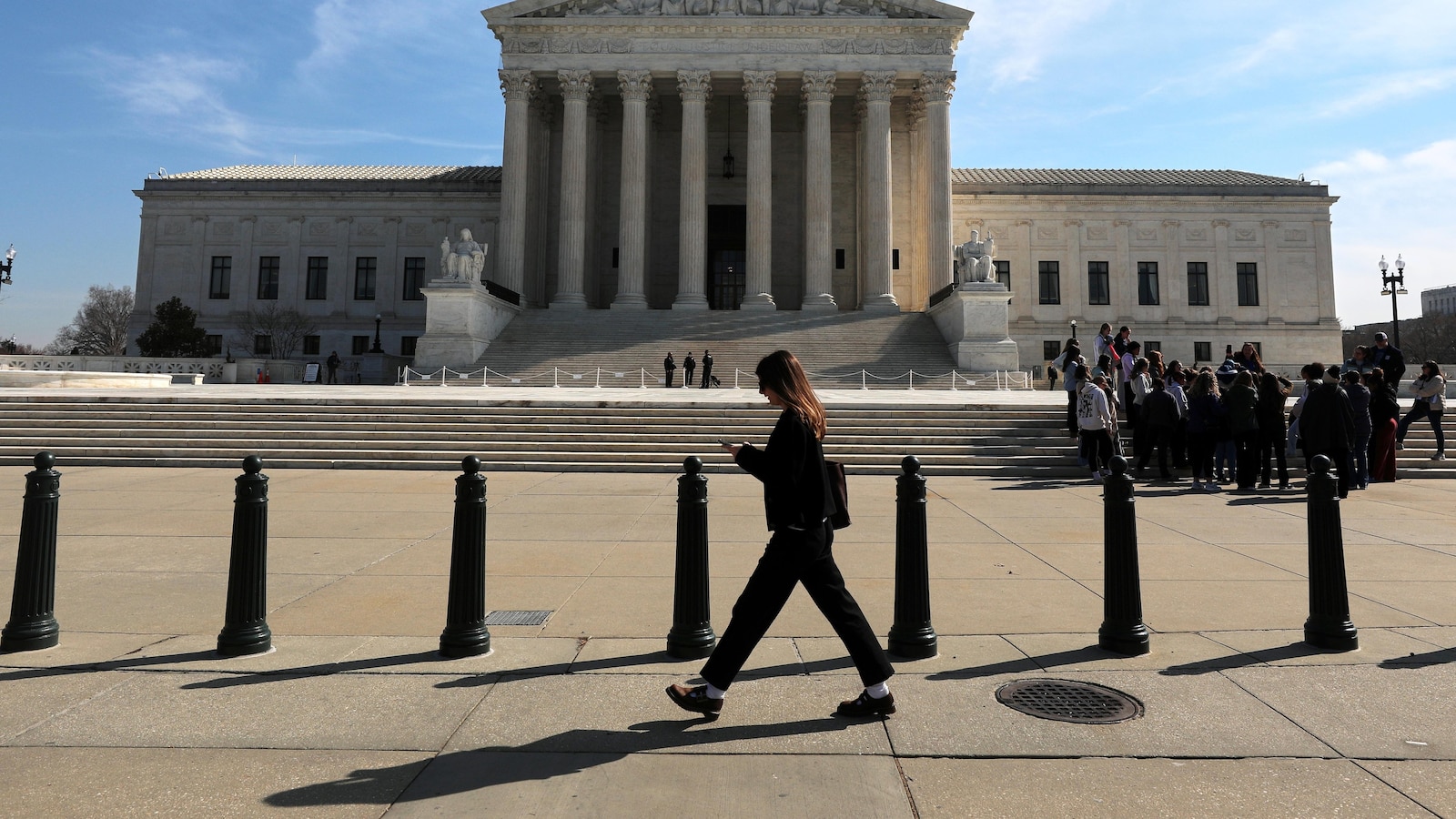
The U.S. Supreme Court is set to hear arguments on Tuesday in a significant case involving Terry Pitchford, a Black death row inmate from Mississippi. This case has drawn attention not only for its serious implications but also because it involves familiar figures and legal issues that have previously come before the Court.
At the center of the controversy is Doug Evans, a now-retired district attorney from Mississippi who has a well-documented history of dismissing Black jurors during jury selection, often for reasons that have been deemed discriminatory. During Pitchford's trial, Evans struck all but one Black juror from the jury pool, a move that was permitted by the trial judge, Joseph Loper. The Mississippi Supreme Court later upheld Pitchford's conviction and death sentence.
This situation echoes a landmark case from just seven years ago involving the same prosecutor, trial judge, and state Supreme Court. In that earlier case, the Supreme Court overturned the conviction and death sentence of Curtis Flowers, another Black man from Mississippi, due to what Justice Brett Kavanaugh described as a "relentless, determined effort to rid the jury of Black individuals." Notably, seven of the nine justices currently on the Supreme Court were also serving at the time of that ruling.
The Supreme Court's recent track record on capital cases reveals a tendency to be skeptical of last-minute appeals from death row inmates. For instance, just last week, the Court rejected an appeal from Rodney Reed, a Texas death row inmate who sought to introduce new evidence that he claims would exonerate him. That decision was made despite dissent from three liberal justices who supported allowing Reed to present the evidence. However, the Court's decision to hear Pitchford's appeal suggests a willingness to engage with claims of racial discrimination in jury selection, an issue that has historically resonated even with some conservative justices.
Pitchford was sentenced to death for his role in the 2004 fatal shooting of Reuben Britt, the owner of a small grocery store outside Grenada, Mississippi. Pitchford was 18 years old at the time, and he and a friend went to the store intending to rob it. During the robbery, Pitchford's friend shot Britt three times, killing him. Because the friend was under 18, he was ineligible for the death penalty, so Pitchford was tried and sentenced to death for capital murder.
The legal battle surrounding Pitchford has stretched on for two decades. In 2023, U.S. District Judge Michael P. Mills overturned Pitchford's conviction on the grounds that the trial judge, Loper, did not give sufficient opportunity for Pitchford's lawyers to argue that the prosecution was improperly excluding Black jurors. Mills emphasized that his ruling was influenced in part by Evans' conduct in previous cases, highlighting a pattern of racial bias. However, a unanimous panel of the 5th U.S. Circuit Court of Appeals reversed Mills' decision, reinstating Pitchford's conviction.
The central legal issue revolves around jury selection practices. During jury selection, attorneys can remove potential jurors based on a variety of reasons, including suspicions about how they might vote. However, the Supreme Court has prohibited the exclusion of jurors solely based on race since the landmark decision Batson v. Kentucky in 1986. That ruling established a framework for judges to evaluate claims of racial discrimination during jury selection by examining the prosecutor's reasons for dismissing jurors and the defense's counterarguments.
In Pitchford's case, the prosecution removed four of the five remaining Black individuals in the jury pool. The defense objected to these strikes, arguing they were racially motivated. However, Judge Loper accepted all of the prosecution's race-neutral explanations without scrutinizing whether race was the true factor behind the dismissals. According to Judge Mills, Loper failed in his constitutional duty to carefully evaluate the credibility of the prosecutor's reasons, effectively allowing discrimination to go unchecked.
The Supreme Court's review will focus on whether Pitchford's lawyers adequately challenged the trial judge's rulings and whether the Mississippi Supreme Court reasonably upheld those rulings. Joseph Perkovich, who is set to argue Pitchford's case before the Court, criticized Judge Loper's handling of the jury strikes, stating that the judge did not understand his constitutional obligation to assess the legitimacy of the prosecutor's explanations. Perkovich contends that the judge simply neglected this crucial responsibility despite the defense's repeated objections.
On the other side, Mississippi's Attorney General Lynn Fitch has defended the state Supreme Court's decision and argued that Evans did not improperly exclude Black jurors. The state maintains that if the Supreme Court rules in Pitchford's favor, the case should be sent back to the Mississippi Supreme Court for further review rather than resulting in Pitchford's immediate release or retrial. However, Pitchford's legal team insists that a favorable ruling should at least lead to his release or a new trial.
The parallels to the Curtis Flowers case are striking. Flowers was tried six times for the shooting deaths of four people. After years of legal battles, he was released from prison in 2019, and the charges against him were dropped the following year after Evans handed the case over to state officials. Evans himself resigned from his position in 2023 amid growing scrutiny of his prosecutorial conduct.
Judge Mills pointed out that while the Flowers case alone does not prove misconduct in Pitchford's trial, it should have been considered by the Mississippi Supreme Court as part of the "totality of the circumstances" when evaluating the fairness of Pitchford's jury selection. In other words, the Court should have taken into account the broader pattern of racial discrimination associated with Evans' office when reviewing the case.
As the Supreme Court prepares to hear arguments, the outcome could have significant implications for the enforcement of Batson protections against racial discrimination in jury selection, especially in capital cases. It will also test the Court's willingness to intervene in cases where prosecutors have a documented history of racial bias. For Pitchford and his supporters, the case represents a critical opportunity to challenge systemic injustices that have long plagued the criminal justice system in Mississippi and beyond.
The decision is eagerly awaited by legal observers, civil rights advocates, and those concerned about the integrity of the justice system. It holds the potential to reaffirm or reshape the standards for addressing racial discrimination in jury selection, an issue central to ensuring fair trials and equitable treatment under the law.
As this case unfolds, it will join a growing list of high-profile capital cases that have brought national attention to the intersection of race, justice, and the death penalty in the United States. The Supreme Court's ruling will be closely watched for its impact on future capital trials and appeals, particularly in states with histories of racially biased prosecutorial practices.