
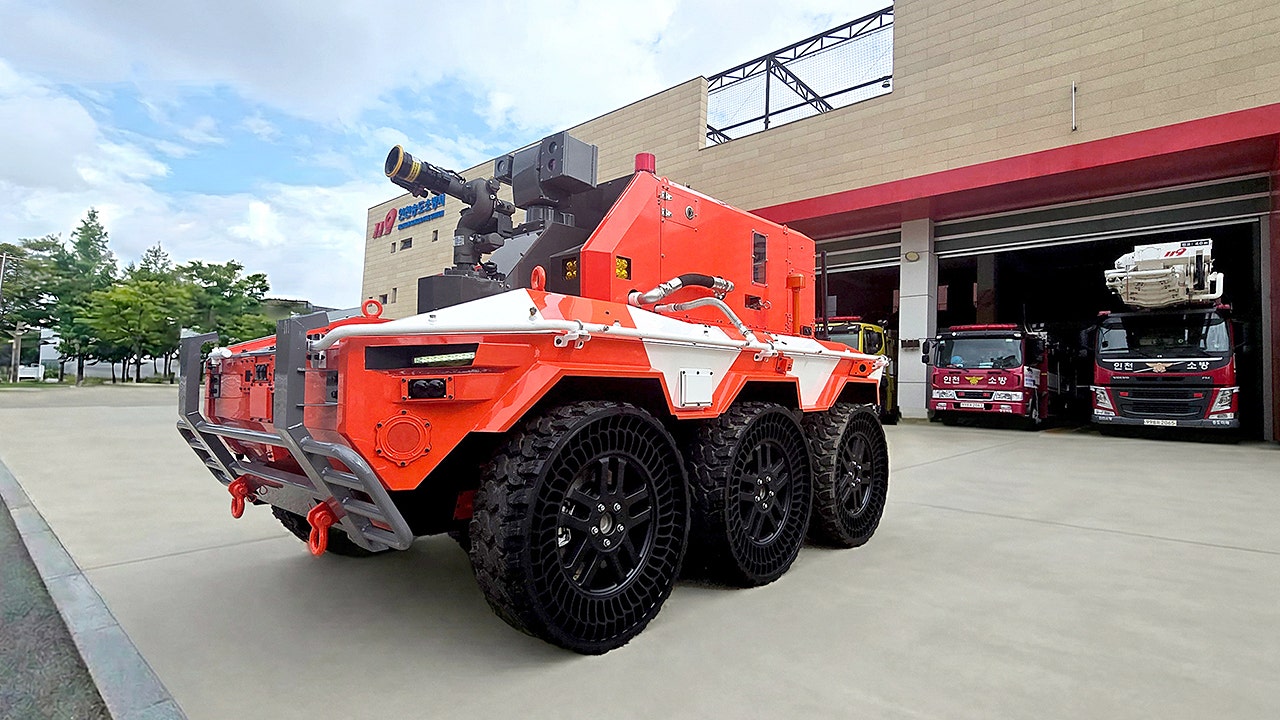
Firefighters often face immense challenges when responding to major fires. One of the most pressing difficulties is entering burning buildings with very limited information about what lies inside. Thick smoke can obscure vision, floors may be unstable or collapsing, and dangerous gases can accumulate rapidly, creating life-threatening conditions. Even the most experienced firefighting crews sometimes have to step blindly into these hazardous environments, risking their lives with little knowledge of the exact dangers they face. However, recent advancements in robotics technology may soon transform how firefighters approach these deadly situations, providing them with critical insights before human entry.
A new generation of rugged firefighting robots is being developed to enter burning buildings ahead of human crews. These robotic vehicles are equipped with specialized tools and sensors that allow them to scan fire scenes, locate flames, detect hazards, and transmit real-time information back to firefighters outside. This capability gives emergency responders a clearer picture of the conditions inside, enabling them to make smarter, safer decisions before putting themselves in harm’s way.
One notable example is a firefighting robot created by Hyundai Motor Group in collaboration with South Korea’s National Fire Agency. This robot is specifically designed to operate in environments where heat, smoke, and the risk of structural collapse make human entry extremely dangerous. It carries a powerful water cannon capable of delivering either a focused stream or a wide spray to combat fires effectively. Advanced thermal cameras enable the robot to “see” through dense smoke by detecting infrared heat signatures, helping to pinpoint the location of flames and heat sources.
Perhaps one of the most impressive features of this robotic firefighter is its self-cooling system. To withstand the extreme temperatures often encountered in fires—which can soar up to nearly 1,500 degrees Fahrenheit—the robot sprays a protective water curtain around its body. This cooling mechanism prevents overheating and allows it to operate for extended periods in conditions that would be fatal to humans. This capability opens new possibilities for firefighting in environments previously deemed too dangerous for humans to enter.
Fire scenes are notoriously chaotic and unpredictable. Debris can block hallways, floors may be unstable or missing, and visibility often drops to near zero. To navigate these challenges, the Hyundai robot is equipped with six independently powered wheels, each driven by its own motor. This design allows it to rotate in place, maneuver through tight spaces, climb steep ramps like those found in parking garages or warehouses, and roll over obstacles as high as one foot. An advanced driving system continuously scans the terrain around the robot, helping it avoid hazards that might otherwise immobilize it.
As the robot explores the fire scene, it sends live video footage back to firefighters stationed outside the building. This real-time visual feed provides invaluable situational awareness, showing where flames are spreading and potentially revealing trapped survivors. Having this information upfront allows crews to devise better rescue strategies and prepare for what lies ahead before ever stepping inside.
In addition to scouting and firefighting capabilities, the robot also addresses a practical safety concern faced by firefighters during rescue operations. It carries a hose embedded with glowing technology, which illuminates in dark, smoke-filled environments. Firefighters frequently rely on hoses as physical guides to find their way out when visibility is severely compromised. A glowing hose provides a visible path in the thick smoke, which can be life-saving during disorienting and dangerous escapes.
The development of firefighting robots like Hyundai’s is part of a broader global trend toward using autonomous and semi-autonomous machines in high-risk emergency response roles. Around the world, robots are increasingly deployed to handle tasks that place human workers in peril. Autonomous mining trucks operate in remote, hazardous mines; robots are used to clear landmines in former conflict zones; and robotic “dogs” have been introduced to assist firefighters by carrying equipment or even water cannons. The underlying philosophy is to let machines undertake the riskiest initial tasks, allowing human responders to focus on rescue, strategy, and decision-making with better information and less risk.
Looking ahead, engineers are exploring ways to incorporate artificial intelligence into these systems. AI could analyze factors such as fire size, smoke patterns, and heat distribution to assist firefighters in making even more informed decisions during emergencies. By combining robotic mobility with sophisticated data processing, future firefighting robots may act as intelligent assistants, enhancing human capabilities and improving outcomes in life-or-death situations.
Hyundai Motor Group’s firefighting robot has already been deployed in South Korea, where the company donated several units to local fire stations for real-world use. Two robots have been delivered so far, with more expected to enter service soon.