
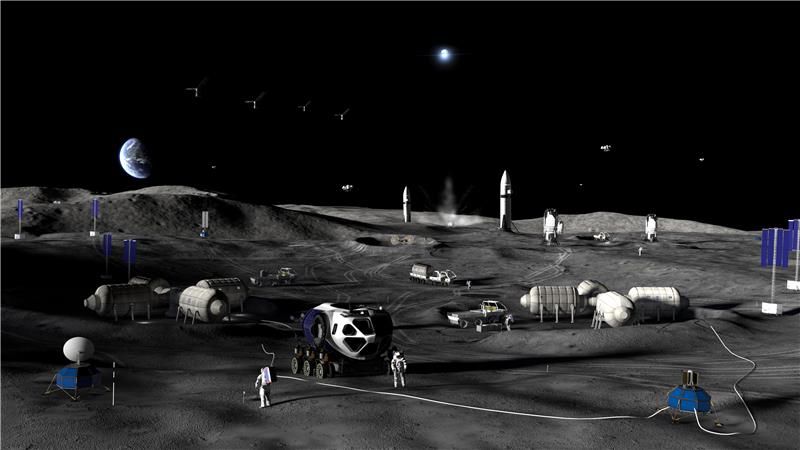
On March 24, 2024, NASA unveiled a series of ambitious, agency-wide initiatives aimed at fulfilling President Donald J. Trump’s National Space Policy and reinforcing American leadership in space exploration. These transformative plans were announced during NASA’s “Ignition” event and reflect a sense of urgency amid global competition, as well as the immense potential for breakthroughs in science and discovery.
NASA Administrator Jared Isaacman emphasized the critical importance of this moment in history. He declared NASA’s commitment to achieving what was once considered near-impossible: returning humans to the Moon before the end of President Trump’s term, constructing a lunar base, and establishing a permanent human presence there. Isaacman underscored that this mission is a national imperative requiring total alignment and swift action. “The clock is running in this great-power competition, and success or failure will be measured in months, not years,” he stated. Isaacman highlighted the need to focus NASA’s resources on these national objectives, remove bureaucratic barriers, and mobilize the workforce and industrial capabilities of the United States and its partners. He suggested that the achievements of returning to the Moon and building a lunar base may be just the beginning of what humanity can accomplish in space.
Supporting this vision, NASA Associate Administrator Amit Kshatriya outlined the agency’s strategic approach. He described NASA’s shift toward a focused, phased lunar architecture that incrementally builds capabilities with each landing, integrating efforts with industrial and international partners. In low Earth orbit (LEO), NASA plans to foster a competitive commercial ecosystem by recognizing existing market realities, valuing the International Space Station (ISS), and carefully transitioning to commercial platforms in a way that ensures no gaps in American human space presence. In terms of science, NASA is opening the Moon’s surface to researchers and students nationwide and aims to launch Space Reactor-1 Freedom, the first nuclear-powered spacecraft destined for deep space. Kshatriya also stressed the importance of investing in NASA’s workforce by bringing in critical skills, placing teams close to manufacturing hubs, and creating pathways for future NASA leaders. “Our workforce is the jewel of NASA,” he said, emphasizing the need for clear goals and the tools necessary to succeed.
**Returning to the Moon and Building a Lunar Base**
NASA’s renewed Moon program builds on previous Artemis updates, such as standardizing the Space Launch System (SLS) rocket and increasing the frequency of lunar missions. Artemis III, scheduled for 2027, will focus on testing integrated systems in Earth orbit before attempting a lunar landing with Artemis IV. Beyond Artemis V, NASA revealed plans to incorporate more commercially procured and reusable hardware to enable frequent, affordable crewed missions to the Moon, initially aiming for landings every six months with potential to increase as technology matures.
A key element of NASA’s vision is a phased approach to constructing a sustainable lunar base. This involves temporarily pausing the Gateway project in its current form to redirect resources toward infrastructure that supports sustained surface operations on the Moon. Despite challenges with some hardware, NASA intends to repurpose usable equipment and leverage commitments from international partners to achieve these goals. To facilitate progress, NASA will soon issue Requests for Information (RFIs) and draft Requests for Proposals (RFPs) targeting the development of lunar infrastructure and mission capabilities.
The lunar base plan will unfold in three deliberate phases, though specific details on each phase were not fully disclosed at the announcement. The goal is clear: to establish an enduring human presence on the Moon, providing a foundation for future exploration of Mars and beyond.
**Sustaining American Presence in Low Earth Orbit**
While focusing heavily on lunar exploration, NASA reaffirmed its commitment to maintaining an active role in low Earth orbit. The International Space Station has been a cornerstone of human spaceflight for over two decades, facilitating more than 4,000 research investigations by over 5,000 researchers and hosting astronauts from 26 countries. The ISS was an extraordinary achievement requiring 37 shuttle flights, 160 spacewalks, and over $100 billion.
Recognizing that the ISS cannot operate indefinitely, NASA stressed the importance of a thoughtful, deliberate transition to commercial space stations to maintain uninterrupted U.S. human presence in LEO. To that end, NASA introduced an additional LEO strategy that preserves all existing pathways while adding a phased approach anchored by the ISS. Under this new model, NASA would procure a government-owned Core Module that attaches to the ISS. Over time, commercial modules would be validated while attached to the station and eventually