
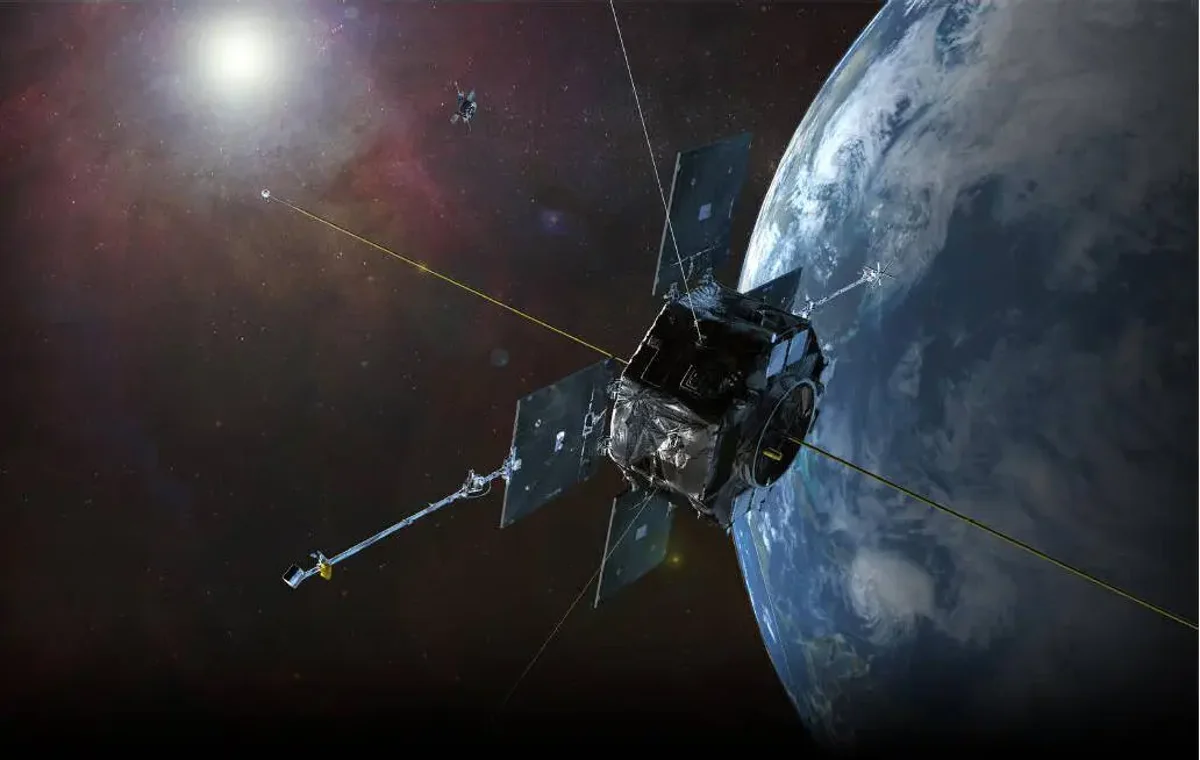
On the evening of March 10, 2026, NASA’s Van Allen Probe A, a spacecraft that has been orbiting Earth since 2012, is expected to reenter the planet’s atmosphere. The event is anticipated to occur around 7:45 P.M. EDT, although the exact timing remains uncertain, with a possible window of plus or minus 24 hours. This spacecraft, weighing approximately 600 kilograms, studied the Van Allen belts—intense bands of radiation that surround Earth and protect it from harmful space weather. While most of the probe will burn up upon reentry, NASA cautions that some debris could survive the fiery descent and potentially reach the surface. However, the agency has emphasized that the risk to human safety is very low, estimated at about one in 4,200.
The Van Allen Probes, of which Van Allen Probe A is one, were launched in 2012 with the mission to investigate the radiation belts encircling Earth. These belts, composed primarily of protons and electrons, act as a protective shield against dangerous solar and cosmic radiation. Understanding their dynamics is crucial not only for scientific knowledge but also for safeguarding satellites and astronauts exposed to these hazardous regions of space. The mission concluded in 2019 when the probes exhausted their fuel, but the spacecraft remained in orbit until now.
Originally, NASA expected Van Allen Probe A to remain in space until around 2034. However, an unexpectedly intense solar cycle accelerated the spacecraft’s orbital decay, causing it to descend back toward Earth much earlier than anticipated. Solar activity affects Earth’s upper atmosphere, increasing drag on satellites and hastening their reentry. This phenomenon explains the probe’s premature fall from orbit.
Because the spacecraft’s orbit is highly elliptical, predicting the precise moment of reentry is challenging. Jonathan McDowell, an astrophysicist known for tracking satellites and space launches, noted that depending on ongoing observations, the probe might have already reentered or could remain in orbit until late the following night. NASA and the U.S. Space Force are closely monitoring the probe’s trajectory to gather the most accurate data possible.
NASA has not disclosed a specific location where the spacecraft will enter the atmosphere or where any debris might land. The vast majority of the probe is expected to burn up due to the intense heat generated during atmospheric reentry. Any surviving fragments are most likely to fall into the ocean, as water covers about 70 percent of Earth’s surface, substantially reducing the chance of debris impacting populated areas. The agency has stressed that there is no targeted landing zone for any remnants that survive the descent.
Despite the low risk to people on the ground, NASA’s estimate of a one-in-4,200 chance of harm is notable. To provide context, this risk exceeds the statistical likelihood of certain rare events such as being struck by lightning or being bitten by a shark while surfing or scuba diving. Nonetheless, these odds remain very low in absolute terms, and the overall threat posed by the probe’s reentry is minimal.
During their operational years, the Van Allen Probes significantly advanced scientific understanding of the radiation belts. These belts had been known since the 1950s, but the probes revealed new complexities and previously undetected features. One of their key discoveries was the identification of an additional, previously unknown radiation belt, which was a groundbreaking finding in space physics. According to Sasha Ukhorskiy, a project scientist at the Johns Hopkins Applied Physics Laboratory who worked on the mission, the probes “rewrote the textbook on radiation belt physics.” Their sophisticated instruments unveiled intricate processes of radiation belt acceleration and loss, information that had eluded earlier spacecraft and sensors.
The probes’ revelations have been vital for improving models of space weather and protecting current and future space missions. Understanding how particles are accelerated and lost in the belts helps engineers design more robust satellites and informs safety protocols for human spaceflight. The data collected by the Van Allen Probes continue to influence research and technology even after the mission’s conclusion.
The impending reentry of Van Allen Probe A marks the end of an era for this pioneering mission. While the event is a routine part of the lifecycle of many satellites and spacecraft, it draws attention to the broader issue of space debris and the challenges associated with managing objects in Earth’s orbit. As more satellites and probes are launched, safe disposal and tracking of defunct spacecraft become increasingly important to avoid potential collisions and hazards.
NASA and the scientific community remain vigilant in monitoring space debris and mitigating