
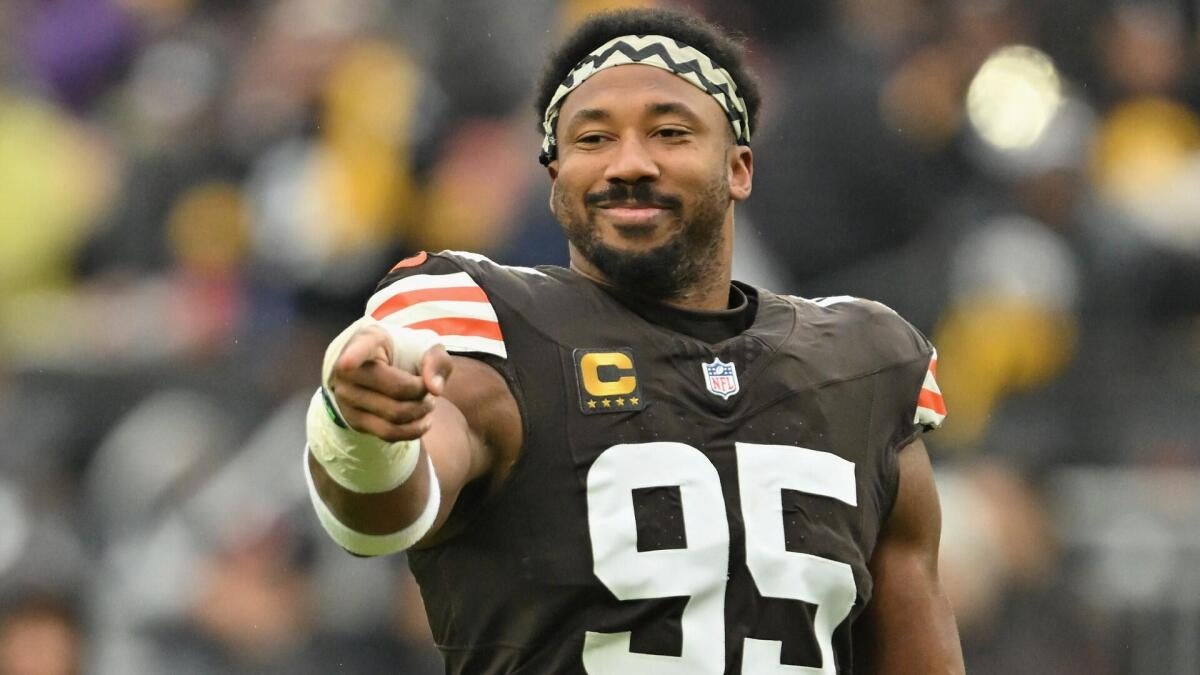
The Cleveland Browns have made a subtle yet significant contractual adjustment involving star defensive end Myles Garrett, a move that could set the stage for a potential trade this offseason. Although the team has not publicly indicated any intent to trade Garrett, the modification to his contract's payment schedule has sparked serious speculation about his future in Cleveland.
Garrett's contract originally included an option bonus payment scheduled for the 15th day of the league year, which falls on March 25. However, the Browns and Garrett have agreed to push that payment to seven days before the start of the regular season. This change means the Browns are no longer obligated to pay that sum in March, instead deferring the payment to September. Importantly, if Garrett is not on the team's roster at that time, the Browns are not required to make the payment at all. Similar adjustments were made to option bonuses in Garrett's contract for the 2027 and 2028 seasons, also pushing those payments to seven days before the start of the respective seasons.
This contract restructuring effectively extends the window during which the Browns could trade Garrett without incurring the immediate financial burden of his option bonuses. Previously, the team's deadline to make such a move was mid-March, narrowing the offseason trade period to about two months. Now, they have until roughly a week before the new season begins to make a decision, widening the timeframe considerably.
The move is particularly notable because Garrett remains one of the NFL's most dominant defensive players. After signing a massive four-year, $160 million contract extension last year, Garrett rebounded from a trade request to deliver a historic performance. In the first season under his new deal, he was named NFL Defensive Player of the Year, setting a single-season sack record with 23. This achievement has made his trade value higher than ever.
From a salary cap perspective, the change benefits the Browns by giving them greater flexibility. If the Browns decide to trade Garrett before the 2026 NFL Draft, it would be more financially feasible to do so. The Browns are currently in a rebuilding phase, and acquiring the kind of compensation Garrett would command could accelerate that process. Alternatively, if a trade is not finalized before the draft, the Browns could wait until after June 1. Post-June 1 roster cuts by other teams typically free up salary cap space, possibly making it easier for a trade partner to absorb Garrett's salary.
In addition to the contract modification, the Browns have proposed a rule change to the NFL that would facilitate trades involving future draft picks. Under current rules, teams can only trade picks up to three years in the future. Cleveland's proposal would extend that to five years, giving teams more flexibility in structuring trades. This change could make it easier for the Browns to secure a significant haul for Garrett by allowing potential trading partners to spread out the cost of multiple first-round picks over a longer timeline.
While a trade is not guaranteed, the Browns have clearly positioned themselves to entertain offers for Garrett. Should the team decide to move on from their star pass rusher, several franchises could be interested landing spots, given their needs and Garrett's elite talent.
One potential destination is the San Francisco 49ers. The 49ers had the fewest sacks of any NFL team last season, totaling just 20, which is fewer than Garrett recorded individually. The team's defense requires a boost in pass rush to complement its overall talent. San Francisco has already demonstrated its willingness to invest aggressively in 2026 by signing veteran defensive end Mike Evans, and adding Garrett would represent a bold move to strengthen their defense further.
The Philadelphia Eagles could also be a fit. They recently lost pass rusher Jaelan Phillips to free agency and could benefit from adding another dominant edge rusher. The Eagles sacked Kansas City Chiefs quarterback Patrick Mahomes six times in their Super Bowl LIX victory, underscoring the value they place on a strong pass rush. General Manager Howie Roseman has shown a willingness to make impactful moves to improve the roster, so pursuing Garrett would align with his approach.
The Dallas Cowboys have shown serious interest in adding a star pass rusher, having been active in the Maxx Crosby trade market last year. Their offer included a 2026 first-round pick (No. 12 overall) and a 2027 second-round pick, though Garrett's price would likely demand even more. With two first-round picks in the upcoming draft, the Cowboys have the draft capital to make a competitive offer. Acquiring Garrett would immediately bolster their defense and position Dallas as a strong NFC East favorite. It would also be a dramatic move, especially given that the Cowboys traded star linebacker Micah Parsons just seven months prior, making a Garrett acquisition a headline-grabbing "Jerry Jones move."
The New England Patriots, who posted the worst sack differential in the league last season at minus-13, could benefit from adding Garrett's elite pass rush. They allowed 48 sacks while registering only 35 themselves. Head coach Mike Vrabel has prioritized fixing the pass rush, and despite adding Dre'Mont Jones in free agency, Garrett operates on another level and could be the game-changing addition the Patriots need.
Finally, the Buffalo Bills, already in a Super Bowl window with quarterback Josh Allen, could make a strong case for acquiring Garrett. The Bills have been aggressive in enhancing their pass rush, having traded for Von Miller in 2022 and signed Joey Bosa last year. They recently added Bradley Chubb this offseason, and pairing him with Garrett would instantly elevate their defensive front from solid to elite, potentially pushing Buffalo beyond its current competitive ceiling.
Any trade involving Garrett would come at a steep cost. The Cowboys' Maxx Crosby deal, which brought in two first-round picks, sets a precedent. Given Garrett's rare talent and impact, the Browns could reasonably demand three first-round picks or two first-round picks plus another premium selection in return. Players of Garrett's caliber seldom become available, so teams interested in acquiring him would likely be willing to meet such a high asking price.
In summary, the Browns' contract restructuring for Myles Garrett signals that they are preparing for the possibility of trading their star defensive end. By deferring key payments, they have extended their offseason trade window and created more salary cap flexibility. Additionally, their push to expand the future draft pick trading window could enhance their ability to negotiate a blockbuster deal. With several teams in desperate need of elite pass rushers, Garrett's future may well lie elsewhere, provided a trade package meets the Browns' high valuation. Whether or not a trade happens remains uncertain, but the groundwork is clearly laid for significant movement surrounding one of the NFL's best defensive players.