
In a remarkable development for the history of science and mathematics, researchers have rediscovered a long-lost page from the Archimedes Palimpsest—a treasured medieval manuscript containing the writings of the ancient Greek mathematician Archimedes of Syracuse. This rediscovery promises to deepen our understanding of one of history’s greatest scientific minds, whose work laid foundational concepts in calculus, geometry, and physics.
The Archimedes Palimpsest is a manuscript dating back to the 10th century that preserves copies of several of Archimedes’ treatises. Archimedes, who lived around 250 B.C.E. in the Greek city of Syracuse, is celebrated as one of the most brilliant thinkers of antiquity. His pioneering contributions continue to influence modern mathematics and science. The Palimpsest itself is a rare artifact because it contains texts that would have otherwise been lost to history, as many of Archimedes’ original works survive only through such medieval copies.
Despite its significance, the Palimpsest has not been fully intact in modern times. While a historian photographed much of the manuscript in 1906, some pages subsequently went missing under mysterious circumstances. Now, in an exciting turn of events, researchers affiliated with the French National Center for Scientific Research (CNRS) have located one of these missing pages—page 123—in the Museum of Fine Arts in Blois, France.
This rediscovered page is particularly valuable because one side contains text from Archimedes’ treatise *On the Sphere and the Cylinder*, a work that explores the geometry of three-dimensional shapes and has been influential in mathematical thought. According to the CNRS, much of this text is still legible, offering scholars new opportunities to analyze Archimedes’ mathematical reasoning and methods in greater detail.
The other side of the page presents a more intriguing challenge. It is covered by a gilded illustration depicting the Biblical prophet Daniel, a later addition that obscures the original Archimedean text underneath. Researchers are optimistic about using advanced imaging techniques, including x-rays, to see beneath the artwork and reveal the hidden writing. These methods, which have been successfully employed in previous studies of the Palimpsest, allow scholars to recover texts that are invisible to the naked eye without damaging the precious manuscript.
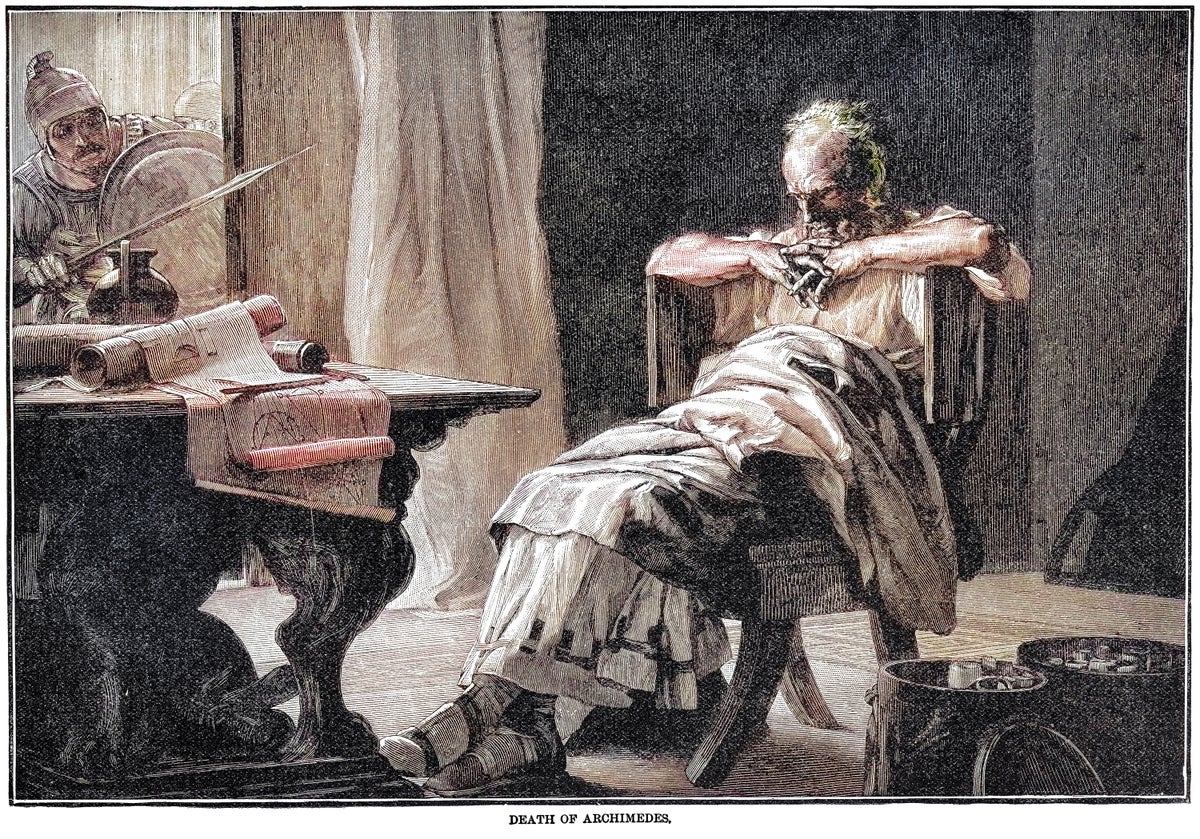
Archimedes’ legacy is legendary. Beyond his theoretical work, he is famed for practical inventions and experiments in physics and engineering. Stories about his life blend historical fact and myth, such as the widely told but unconfirmed account of his death—killed by a Roman soldier while engrossed in a mathematical problem drawn in the sand during the Roman conquest of Syracuse. His impact on science and mathematics has resonated through millennia, making any new findings related to his work a subject of great excitement and importance.
Currently, the majority of the Archimedes Palimpsest is housed at the Walters Art Museum in Baltimore, Maryland. It remains to be seen whether the newly found page will be returned to this collection or remain in France. Regardless, its discovery is a significant addition to the corpus of Archimedes’ surviving writings and highlights the ongoing efforts to preserve and study ancient scientific heritage.
The rediscovery of this page not only enriches our understanding of Archimedes’ intellectual contributions but also underscores the fascinating journey of ancient manuscripts through time—how they can be lost, hidden beneath later artworks, and then uncovered centuries later through modern technology and dedicated scholarship.
This discovery, reported by Jackie Flynn Mogensen, a breaking news reporter at *Scientific American*, is a testament to the enduring allure of scientific history and the continuous quest to uncover humanity’s intellectual past. Mogensen, who has an academic background in environmental communication and earth sciences, brings attention to the importance of supporting science journalism. In her reporting, she emphasizes the critical role that publications like *Scientific American* play in advancing public understanding of science and discovery.
In a broader context, the Archimedes Palimpsest story illustrates the intricate relationship between history, science, and technology. It shows how modern scientific tools can breathe new life into ancient texts, helping us unlock knowledge that had been obscured for centuries. As researchers continue to analyze the rediscovered page and employ cutting-edge imaging techniques, we can anticipate further insights into Archimedes’ genius and the origins of scientific thought.
The Archimedes Palimpsest has long been a source of fascination for historians, mathematicians, and scientists alike. The manuscript’s survival through the