
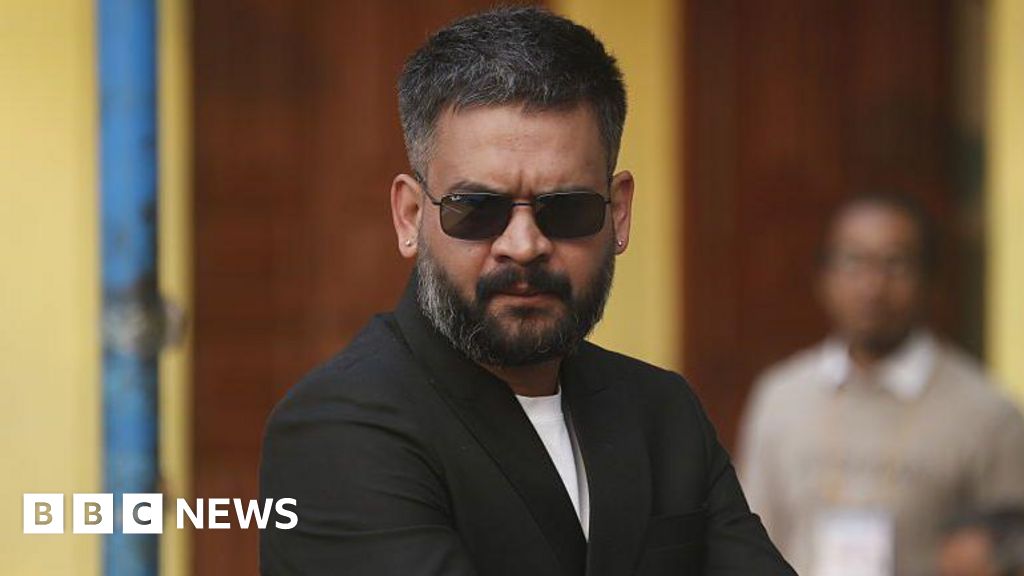
In Nepal’s recent general election, rapper-turned-politician Balendra Shah, popularly known as Balen, has taken a commanding early lead, positioning himself to become the country’s next prime minister. While vote counting is still ongoing, early results indicate Shah’s centrist Rastriya Swatantra Party (RSP), or National Independent Party, is ahead in more than two-thirds of the 165 directly elected parliamentary seats. This represents a significant shift in Nepal’s political landscape, traditionally dominated by established parties such as the Nepali Congress and the Communist Party of Nepal (UML), whose candidates are currently trailing behind.
The election, held on Thursday, featured a competitive field that included Shah, former prime minister KP Oli of the UML, and Gagan Thapa from the Nepali Congress. Shah’s rise is unexpected by many, given his unconventional background. At 35 years old, Shah is a trained structural engineer who gained popularity as a member of Nepal’s hip hop scene, known locally as Nephop. Over the years, he released several socially conscious songs, including the widely viewed “Balidan” (meaning “sacrifice”), which resonated with young Nepalis. His appeal particularly surged during last year’s protests against a social media ban and widespread grievances related to corruption, unemployment, and economic stagnation.
The protests of 2022 were a watershed moment for Nepal. Sparked by the government’s attempt to restrict social media, they quickly grew into a broader movement demanding accountability and reform. The demonstrations resulted in 77 deaths, many protesters killed by police action, and ultimately led to the resignation of then-prime minister KP Oli. Despite this, Oli, a veteran politician aged 74, remained defiant and stood for election again, confident he could reclaim power. Shah, by contrast, openly supported the protests and went so far as to label Oli a “terrorist” who had betrayed the nation—a statement that polarized public opinion about Shah’s suitability for leadership.
Shah’s tenure as mayor of Kathmandu, a position he held until January, was also controversial. While he earned praise for addressing problems like street congestion and unlicensed businesses, human rights groups criticized him for allegedly using police force against street vendors and landless people in a heavy-handed manner. These actions have fueled debate about whether Shah’s approach to governance would be effective or damaging if scaled to the national level. His campaign chose not to respond to BBC requests for comment on these issues.
In the key constituency of Jhapa 5, a traditional stronghold of KP Oli, Shah is reportedly leading by a significant margin, highlighting the extent of his grassroots support. Despite his growing popularity, Shah has maintained a low media profile during the campaign, avoiding interviews and refusing to speak directly to the press on election day. His reluctance to engage with the media has raised concerns among journalists about transparency should he assume office. Nevertheless, many young voters view Shah’s youth, energy, and outsider status as exactly what Nepal needs to break from decades of political stagnation.
Nepal’s parliamentary elections are conducted through a mixed system. Of the 275 members of parliament, 165 are elected through a first-past-the-post system, where the candidate with the most votes in a constituency wins. The remaining 110 seats are allocated based on proportional representation, which reflects the national vote share of each party. Nearly 19 million people were eligible to vote in this election, and officials anticipated a turnout of about 60%.
This election has been widely seen as a contest between the old political guard and new forces seeking change. The RSP, Shah’s party, previously came fourth in the 2022 general election, but has surged ahead this time, signaling a shift in voter sentiment. Young voters, including around 800,000 first-time participants in the electoral process, played a critical role. Political parties have targeted this demographic with promises to create jobs, fight corruption, and improve governance—issues that resonate deeply with a population frustrated by economic challenges and political instability.
For over 30 years, Nepal’s political scene has been characterized by a revolving door of coalition governments, mostly controlled by three major parties—two of which are communist. This election is notable for the lack of broad nationwide alliances, meaning voters had a clearer view of each party’s platform and leadership. Additionally, a significant number of new parties and independent candidates entered the fray, with about a third of all candidates running without party affiliation. This diversification