
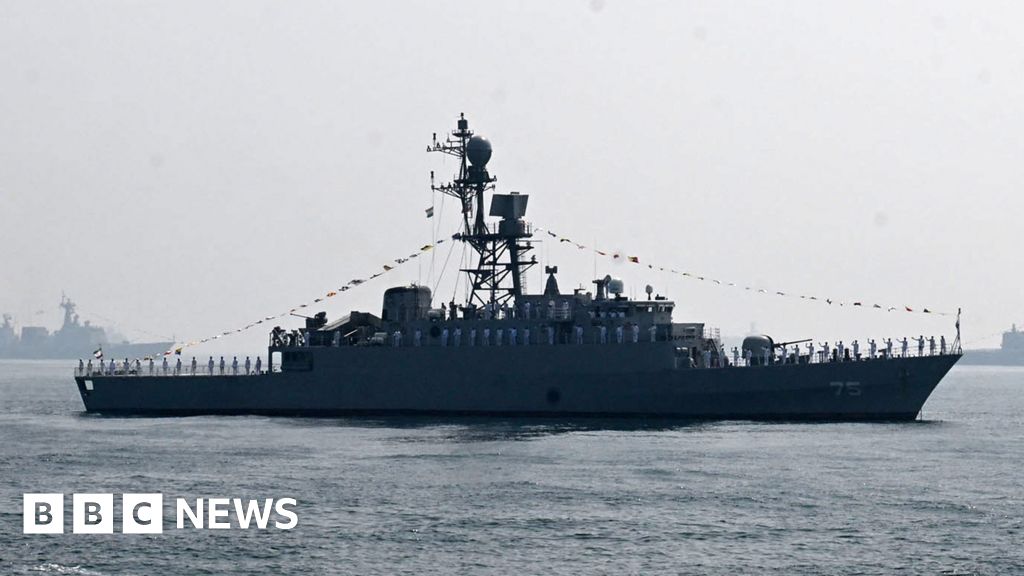
On 17 February, the Indian Navy warmly welcomed the Iranian warship Iris Dena as it arrived at the port of Visakhapatnam to participate in an international naval gathering. The Navy’s social media posts showcased cheerful sailors in crisp white uniforms and images of the sleek grey frigate gliding through the sunlit harbor, accompanied by hashtags such as “Bridges of Friendship” and “United Through Oceans.” This friendly reception highlighted India’s efforts to foster goodwill and cooperation among regional naval powers.
However, just two weeks later, the situation took a tragic and dramatic turn. On 4 March, the Iris Dena, carrying 130 sailors, was torpedoed by a US submarine off the southern coast of Sri Lanka and sank to the bottom of the Indian Ocean. The attack left at least 87 sailors dead, according to rescue teams from Sri Lanka, and only 32 survivors were reported. The incident marked a stark and violent escalation in the ongoing conflict between the United States, Israel, and Iran, bringing the war perilously close to India’s maritime neighborhood.
The Iris Dena was a relatively new vessel, commissioned in 2021 as part of Iran’s Southern Fleet, which is tasked with patrolling critical waterways such as the Strait of Hormuz and the Gulf of Oman. US Defense Secretary Pete Hegseth noted that the Iranian ship “thought it was safe in international waters” but “died a quiet death,” underscoring the lethal reach of the US military even far from its own shores.
For India, the sinking of the Iris Dena in the Indian Ocean carries significant strategic and diplomatic implications. Although the attack took place in international waters and outside India’s jurisdiction, it has placed Delhi in a difficult position. Retired Vice Admiral Arun Kumar Singh remarked, “The war has come to our doorsteps. That is not a good thing,” reflecting concerns within India’s defense community about the conflict’s proximity and potential spillover.
Some Indian strategists have gone further in their critique. Brahma Chellaney, a prominent expert on Indian strategic affairs, described the incident as “more than a battlefield episode” and labeled it a “strategic embarrassment” for India. Writing on social media platform X, Chellaney argued that by sinking a vessel that had recently been a guest at an Indian-hosted multilateral naval exercise, the United States had effectively turned India’s maritime neighborhood into a war zone. This development raises uncomfortable questions about India’s authority and influence in its own regional backyard, particularly as it seeks to assert itself as a leading security partner in the Indian Ocean.
Just days before its sinking, the Iris Dena had participated in the International Fleet Review 2026 and Exercise Milan, held in Visakhapatnam. These events involved 74 countries and 18 warships and were designed to showcase India’s growing maritime leadership and its ambition to become the Indian Ocean’s “preferred security partner.” Multilateral naval exercises such as these typically involve visiting ships carrying limited live munitions, unless engaged in scheduled live-fire drills, to maintain safety and trust among participants.
Vice Admiral Singh, who attended the event, recalls seeing the Iranian sailors marching in formation during the parade along the seafront, just meters away. “All young people. I feel very sad,” he said, reflecting the human cost behind the geopolitical tensions. After the sea phase of Exercise Milan concluded on 25 February, the Iranian warship reportedly sailed away from Visakhapatnam. What the ship did in the following week remains unclear. It was eventually sunk approximately 20 nautical miles west of Galle, Sri Lanka, in waters within Sri Lanka’s designated search-and-rescue zone, just a two- to three-day sail from India’s east coast.
Singh, a former submarine commander, surmises that the US submarine likely tracked the Iris Dena’s movements closely. The US Navy maintains a substantial and persistent submarine presence worldwide, with about a quarter of its fleet at sea at any given time. The attack seems to have involved a single Mark-48 torpedo—a powerful heavyweight weapon carrying roughly 650 pounds of high explosive, capable of splitting a ship in two. Video footage suggests the submarine fired from a distance of three to four kilometers around 5:30 a.m. local time.
The sinking was swift and devastating. The warship reportedly went down within two to three minutes, leaving almost no time for the crew to respond. Singh noted that it was “