
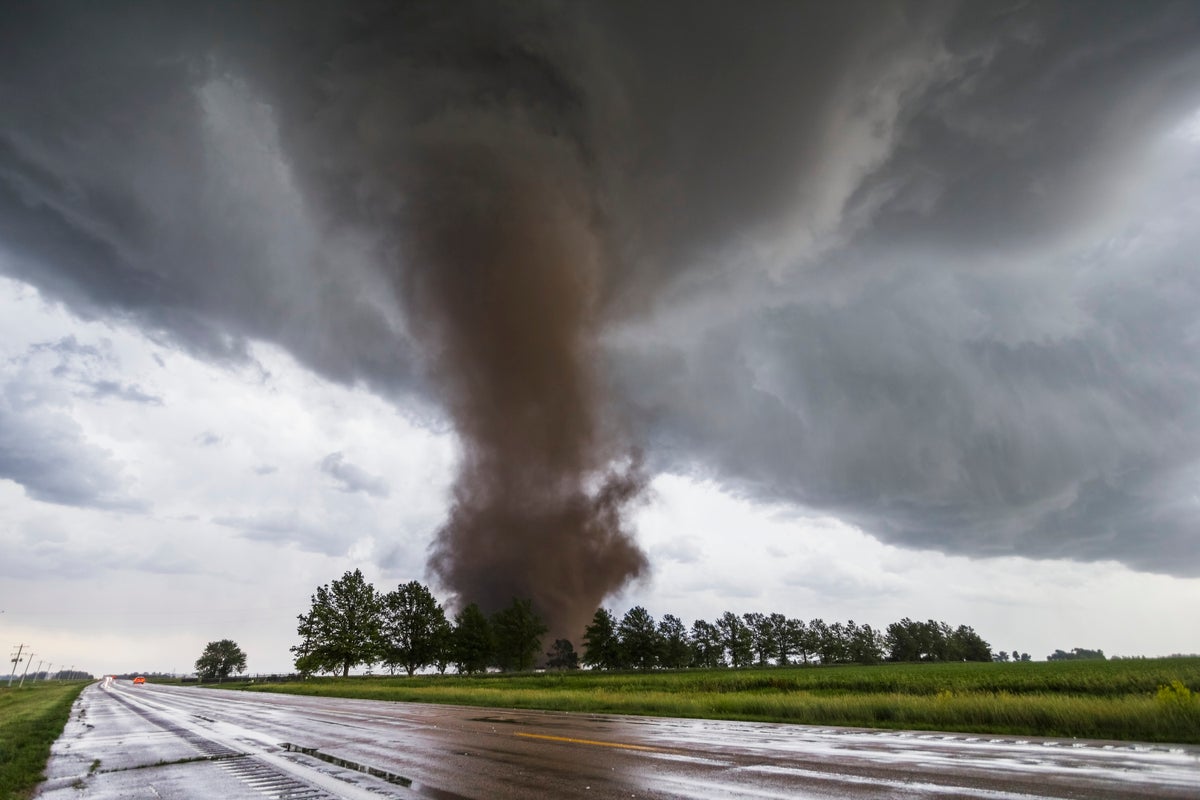
On an ordinary day in northwest Kansas, atmospheric scientist Perry Samson found himself in an extraordinary and terrifying situation-caught unexpectedly inside a tornado. His rare experience of surviving such a violent storm from within offers a unique and vivid perspective on what it is like to be inside one of nature's most destructive forces.
Samson, a professor emeritus of atmospheric science at the University of Michigan and a fellow of the American Meteorological Society, was in the field conducting research on supercell thunderstorms. These are the types of storms that often spawn tornadoes. Accompanied by a team of university students, Samson was positioned beneath a particularly dark and ominous thunderstorm. The sky was so overcast that they had to switch on their vehicle headlights in the middle of the day.
Suddenly, a tornado formed and began moving directly toward their location. The students, in separate vehicles, managed to escape, but Samson's car was engulfed by a swirling cloud of flying debris so dense that he could not even see the hood of his vehicle. With visibility near zero and options narrowing rapidly, Samson made a split-second decision: he turned the car into the wind, hoping the vehicle's aerodynamics would keep it grounded rather than allowing it to be flipped by the violent forces.
What Samson experienced inside the tornado's vortex went beyond the dramatic scenes often portrayed in movies. The pressure changes were extreme-his ears did not just pop, but ached as if his head was being squeezed by huge hands. The wind, measured nearby at nearly 150 miles per hour (241 kilometers per hour), likely intensified within the vortex to even greater speeds. At those velocities, the air itself felt like a solid object striking him. The environment was engulfed in darkness not because of an "eye" of calm, but a swirling ball of debris-pulverized soil, tree branches, building materials, and more-that blocked out all light, so much so that Samson's camera could not capture an image.
Flying debris battered the car's windshield relentlessly. Tornadoes are known to pick up and hurl all manner of objects: fences, wood and metal fragments, tree limbs, and even large animals like cows. Under such conditions, conventional wisdom advises seeking shelter in a ditch, lying flat to avoid flying debris. But the wind was so violent that Samson could not open his car door. Instead, he kept low inside the vehicle, hoping for the best.
After the tornado passed, the silence was profound. His rental car was stuck in mud, the antenna bent in half, and tiny bits of straw were embedded everywhere in the car's seams-a testament to the storm's ferocity. Samson acknowledges that he was incredibly fortunate to survive such an ordeal and emphasizes that he does not wish to experience anything like it again.
So how do such devastating storms form? Samson explains that tornadoes require a precise and volatile combination of atmospheric ingredients. First, there must be a supply of warm, moist air near the ground, often sourced from the Gulf of Mexico. Above this lies a layer of dry air, which creates instability in the atmosphere. A "cap" or inversion-a thin layer of stable air-acts like a lid, trapping the warm moist air until pressure builds enough for it to break through.
The meeting point of warm moist air and hot dry air from the west, known as the dry line, plays a critical role. The heavier dry air pushes under the lighter moist air, forcing it upward and disrupting the cap. Wind shear, which is the change in wind speed and direction with height, causes horizontal rotation in the atmosphere. When this rotating air is lifted, it can shift vertically, forming a mesocyclone-a rotating updraft essential to tornado development.
Higher in the atmosphere, the jet stream-a fast-moving river of air several miles above the surface-can create disturbances that further lower surface pressure and enhance upward air movement. When all these elements come together, they can form the powerful, rotating vortex recognized as a tornado.
Tornadoes are capable of producing wind speeds up to 300 miles per hour (482 kilometers per hour) and can carve paths of destruction over a mile (1.6 kilometers) wide, lasting from seconds to many minutes. Because their paths are difficult to predict, the best course of action is to seek safety immediately upon receiving a tornado warning.
In 2025 alone, tornadoes killed 61 people in the United States and injured many more, often due to flying debris. Samson stresses the importance of understanding tornado safety protocols: when an alert sounds, people should follow instructions promptly to protect themselves.
Scientists who chase storms, including Samson, are not thrill-seekers wanting to experience tornadoes firsthand. Instead, their goal is to study the small-scale processes within storms that cannot be adequately observed through traditional methods like radar or satellites. Many critical tornado-generating processes occur close to the ground and evolve rapidly, making them challenging to capture without direct observation.
Samson's harrowing encounter highlights the raw power of nature and serves as a sobering reminder that humans are not in control of every aspect of the environment. It underscores the need for respect, preparedness, and reliance on advanced technology such as drones and radar for studying these phenomena safely.
This account was contributed to by Willa Connolly, a middle school student from Ann Arbor, Michigan, as part of The Conversation's "Curious Kids" series, which invites questions from young readers and provides expert answers.
Samson's story, originally published by The Conversation and shared here with permission, offers a rare glimpse into the terrifying yet fascinating world of tornadoes through the eyes of a scientist who has been inside one and survived. It is a powerful testament to the unpredictable might of these storms and the importance of scientific research and public safety education in mitigating their impact.