
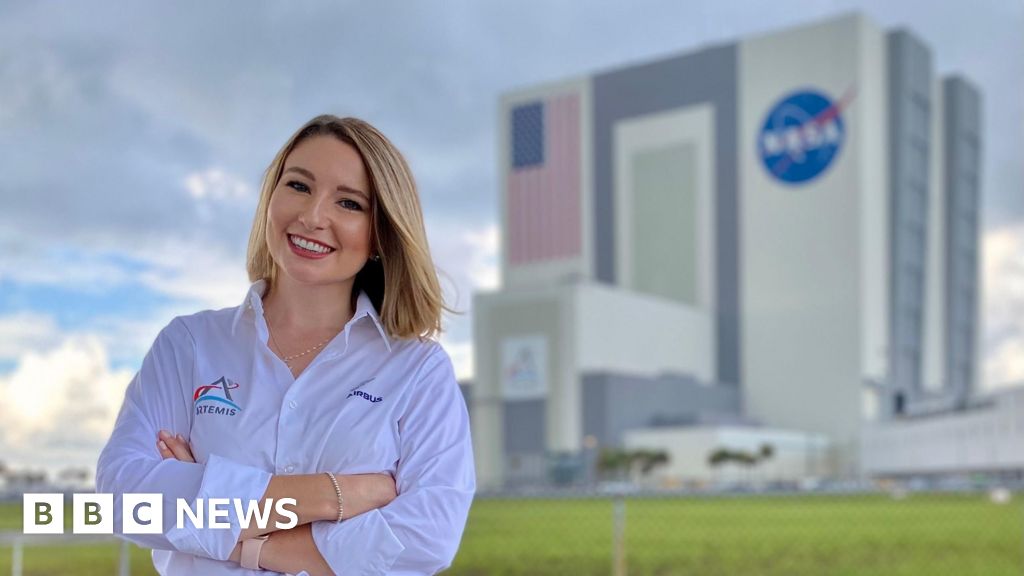
Sian Cleaver, a 36-year-old spacecraft engineer from Chelmsford, Essex, has defied long-standing stereotypes about women from her region to pursue her dream of working in space exploration. Despite the negative connotations historically associated with the term "Essex girl," Cleaver has never let such labels hold her back. Today, she is a key figure at Airbus in Germany, contributing to the development of the propulsion system for NASA's Orion spacecraft, which is set to play a central role in the Artemis II mission that aims to send humans to orbit the Moon.
The term "Essex girl" was until recently defined in the Oxford Dictionary as an "unintelligent, promiscuous and materialistic" young woman. Such stereotypes, however, have never affected Cleaver’s ambitions or self-image. “I don't think stereotypes like that have ever bothered me,” she said. “I've never worried about sticking to particularly girlie things. I don't think I've ever been bothered by the trends because I've been so far removed from it.” Her attitude reflects a broader rejection of limiting social labels, especially those that discourage women from entering fields like science, technology, engineering, and mathematics (STEM).
Cleaver’s passion for space began early in life. While a student at Chelmsford County High School, she developed a keen interest in astronomy. This curiosity led her to study physics at Durham University, setting the foundation for a career in aerospace engineering. She encourages young girls and women to pursue their ambitions regardless of societal expectations or stereotypes. “If you've got big ambitions and it feels like people are bogging you down, just go for it anyway,” she advised. “I always wanted to be an astronaut and that is always what inspired me and gave me drive. I still have that dream.”
The Artemis II mission, which Cleaver’s work supports, is one of the most anticipated space projects in recent years. Originally scheduled for launch in February, the mission faced a delay after a technical issue was discovered during a pre-test flight. NASA now aims to launch in early April. The mission will carry four astronauts, including Christina Koch, who will orbit the Moon during a 10-day journey. This mission marks a significant milestone as the closest humans will have been to the lunar surface since the last Apollo mission in 1972.
Christina Koch’s own inspiration to become an astronaut came from seeing a famous photograph of Earth taken by Bill Anders, a crew member of Apollo 8, the first mission to orbit the Moon in 1968. Similarly, Cleaver draws motivation from the vision of space exploration and the historic significance of the Artemis program. “I want to see the first woman walk on the Moon,” she said. “Artemis II will see a woman orbit the Moon.”
Central to the Artemis II spacecraft is the European Service Module, which provides propulsion and power for the mission. Cleaver and her team in Bremen, Germany, designed and built the module’s large solar arrays, critical components that enable the spacecraft to generate electricity while in space. Her involvement highlights the important contributions of European engineers to NASA’s lunar ambitions.
Despite the high-tech nature of the project, Cleaver noted that women remain a minority in her field. “Women are working on the project, but they are a minority,” she explained. She emphasized the value of diversity, stating that different perspectives and ways of working enrich the engineering process. “It’s a real shame that it is not so visible.”
To help change this visibility gap, Cleaver frequently delivers talks at schools, aiming to inspire younger generations by showing them that women can and do succeed in STEM careers. “It’s good for younger people to see women doing jobs like mine, so that when they start thinking of these jobs in the future they don’t automatically picture a man doing them,” she said. However, she acknowledged that role models for women in higher-level STEM positions are still scarce. “There’s definitely not enough role models, particularly at higher levels,” she added.
Statistics support Cleaver’s observations. According to the organization Women in Tech, while over 9.4 million people work in STEM across the UK, women make up only 25% of this workforce. This gender imbalance underscores the challenges women face in entering and advancing within these fields.
Cleaver’s journey has not been without frustration. She shared that she often feels she has to "push and fight extra hard" compared to some of her peers, a