
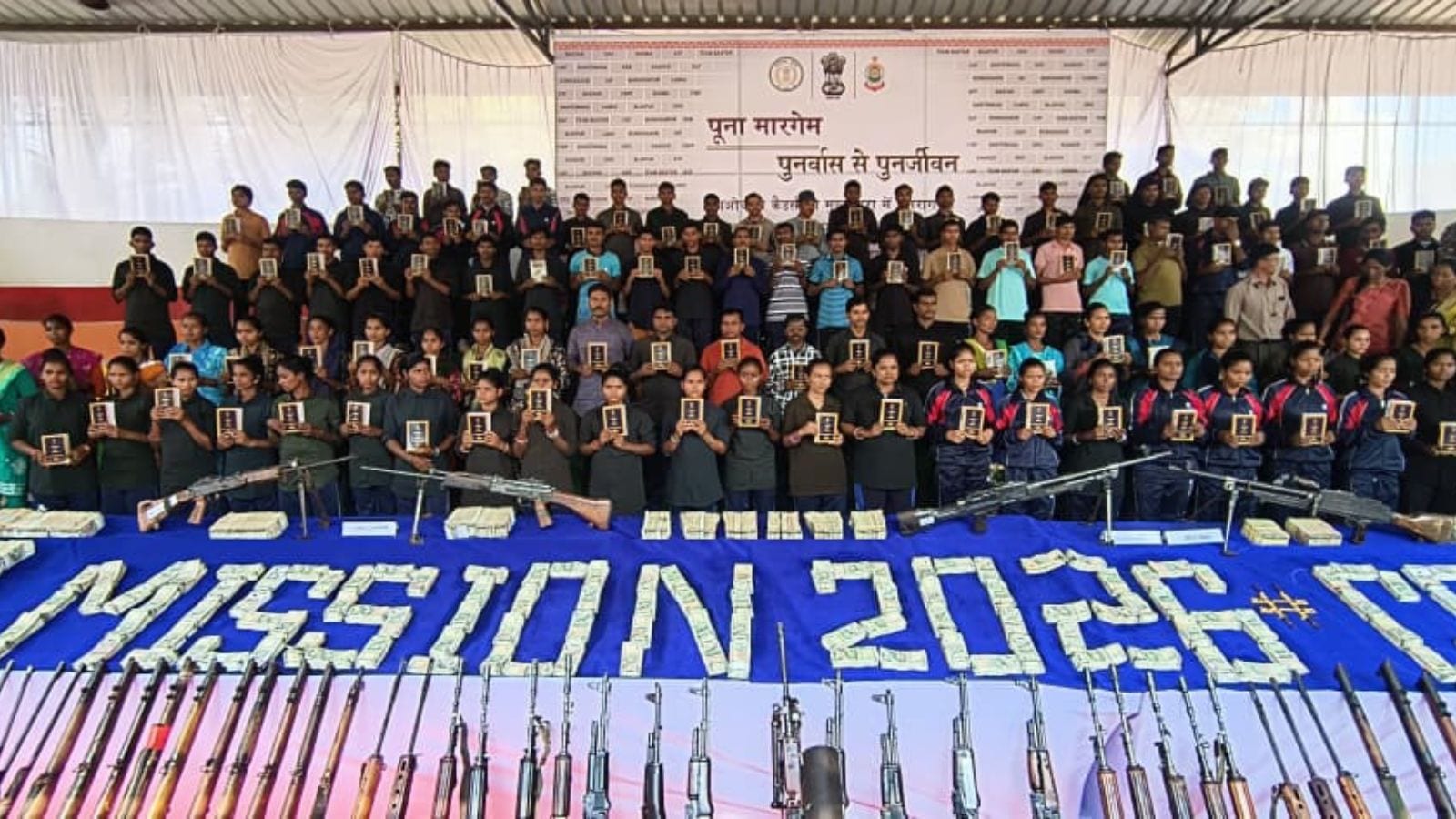
With just 20 days remaining to meet the March 31, 2026 deadline set by Union Home Minister Amit Shah for eradicating Left Wing Extremism (LWE) from India, security forces have recorded a significant breakthrough in the fight against Maoist insurgency. On Wednesday, a massive group of 108 Maoists, including 44 women, surrendered in Bastar, a region long considered a hotbed of Maoist activity. This surrender resulted in the recovery of 101 weapons, Rs 3.61 crore in cash, and 1 kilogram of gold, marking one of the largest recoveries of arms and materials from the Maoists to date. The Maoists who surrendered had a combined bounty of Rs 3.29 crore on their heads, highlighting the scale and importance of this achievement.
The surrendered Maoists were primarily operating within an area known as Dandakaranya, which encompasses Bastar’s seven districts along with border regions of Maharashtra, Telangana, Odisha, and Andhra Pradesh. Superintendent of Police for Bijapur, Jitendra Kumar Yadav, described the recovery of high-powered weapons such as AK-47s, INSAS rifles, and barrel grenade launchers as a significant blow to the Maoists’ military capabilities. The loss of these arms weakens the operational strength of the Maoist organization, which has been steadily losing ground in recent years.
The cash recovered from the Indravati area of Bijapur was amassed through extortion activities by the Maoists. Authorities noted that part of this money was used to purchase gold, a strategy employed by the insurgents to conceal their wealth more effectively. The use of gold as a hidden asset underscores the resourcefulness of the Maoists in managing their finances despite intense counter-insurgency operations.
Over the past 26 months, a remarkable number of Maoist cadres have abandoned violence to lead peaceful lives. According to Inspector General of Police for Bastar Range, Sundarraj P, a total of 2,714 Maoists in Chhattisgarh have surrendered during this period. Particularly notable is that within the Bastar Division alone, 2,625 cadres have laid down their arms between January 1, 2024, and March 9, 2026. This steady flow of surrenders reflects the growing success of government efforts to dismantle Maoist networks and reintegrate former militants into society.
A key initiative that has contributed to this progress is the Poona Margham (New Path) program, launched in July 2025. This scheme focuses on outreach by security forces, especially those who themselves are surrendered Maoists now recruited into groups like the District Reserve Guard and the Bastar Fighters. These personnel actively engage with families of active Maoist cadres, encouraging them to renounce violence and join mainstream society. The program also offers skill development training, promotes self-employment opportunities, provides psychological counseling, and supports social reintegration for those who surrender. This holistic approach addresses not only security concerns but also the socio-economic challenges that often drive individuals into insurgency.
Among those who surrendered in the recent event are several senior Maoist leaders, including Divisional Committee Members such as Rahul Telam, Pandru Kovasi, and Jhitru Oyam from the West Bastar Division; Ramdhar alias Biru from the East Bastar Division Committee; Mallesh from the North Bastar Division Committee; Commander Muchaki from PLGA Battalion 1; and Kosa Mandavi from the Andhra-Odisha border area. Their surrender is a significant development, as it leaves fewer than a hundred armed Maoist cadres in the entire Bastar region. Among the remaining few is Dandakaranya Special Zonal Committee Member Papa Rao, considered the last prominent Maoist leader in Bastar. This sharp decline in senior leadership signals that the Maoist movement is nearing a critical juncture.
The region of Bastar, located in the central Indian state of Chhattisgarh, has been a focal point of Maoist insurgency for decades. The Maoists, also known as Naxalites, have waged an armed struggle against the Indian state, claiming to fight for the rights of marginalized tribal populations. This conflict has caused immense human suffering and hindered development in affected areas. The government’s counter-insurgency strategy combines military operations with development initiatives and rehabilitation programs aimed at winning the “hearts and minds” of local communities.
Jayprakash S Naidu, the Principal Correspond