
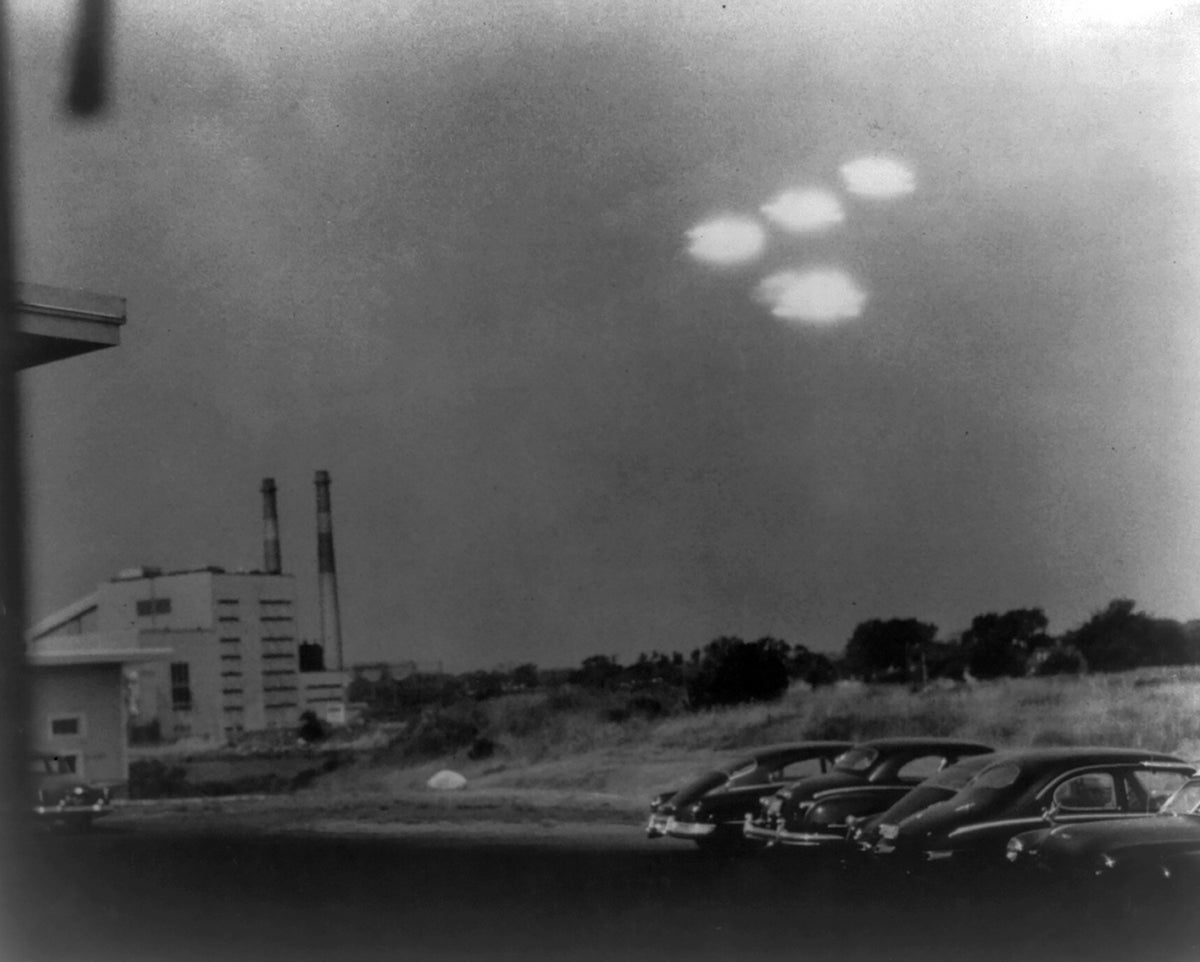
On February 20, 2026, U.S. President Donald Trump announced a directive to federal agencies, including the Department of Defense, to begin identifying and releasing government files related to aliens, extraterrestrial life, unidentified aerial phenomena (UAP), and unidentified flying objects (UFOs). The announcement, made on his social media platform Truth Social, sparked renewed public interest and debate about the existence of extraterrestrial life and the government’s knowledge—or lack thereof—regarding alien visitation.
This directive came shortly after a podcast interview featuring former President Barack Obama, who stated that he believed aliens might exist somewhere in the universe but that he had seen no evidence of extraterrestrials visiting Earth during his time in office. Trump criticized Obama’s comments during a press briefing aboard Air Force One, accusing him of revealing classified information. Trump suggested that his order to declassify UFO-related files might serve to “get [Obama] out of trouble.” However, experts like Sean Kirkpatrick, the Pentagon’s former director of the All-Domain Anomaly Resolution Office (AARO), have clarified that Obama’s statements contained no classified material and echoed publicly available information presented in congressional hearings and other official forums.
The timing of Trump’s announcement also follows the recent controversial release of heavily redacted federal documents related to the investigations surrounding Jeffrey Epstein, a financier with connections to numerous powerful figures, including Trump. This backdrop has led some observers to view the UFO file declassification order as a potential political distraction from ongoing societal and governmental issues.
In response to the uproar triggered by his podcast remarks, Obama issued a clarifying statement on Instagram. He reiterated that he had seen no evidence during his presidency that extraterrestrials had made contact with Earth. His belief in the possibility of alien life was based on statistical reasoning: given the vastness of the universe, it is likely that life exists elsewhere. However, due to the immense distances between solar systems, the chances of Earth having been visited by aliens are very low. This viewpoint aligns with that of Bill Diamond, president and CEO of the SETI Institute, a leading research organization dedicated to the search for extraterrestrial intelligence. Diamond emphasizes that statistically, humanity is almost certainly not alone in the universe, yet no confirmed evidence of alien contact has been found.
President Trump himself admitted uncertainty about the existence of aliens, stating, “I don’t know if they’re real or not.” This candid admission underscores the ongoing ambiguity and lack of definitive proof in this arena despite decades of study.
Historically, U.S. government investigations into UFOs and UAPs stretch back to the mid-20th century, with numerous official studies conducted to determine whether these phenomena represent evidence of extraterrestrial technology or visitation. In recent years, the Pentagon’s All-Domain Anomaly Resolution Office and a NASA-commissioned expert panel have compiled and reviewed reports of unexplained aerial sightings. While many incidents remain unexplained, neither body has concluded that any of these sightings are proof of alien presence.
Sean Kirkpatrick has stated unequivocally that there is no evidence suggesting that UAP sightings originate from extraterrestrial sources. He also warns against sensationalizing these phenomena, especially given the limited hard data available. Many sightings initially labeled as UAPs have later been attributed to misidentified aircraft, atmospheric phenomena, or sensor errors. Nonetheless, experts agree that much remains to be learned about these phenomena.
Astrophysicist Federica Bianco from the University of Delaware, who participated in NASA’s UAP panel, underscores that none of the observed phenomena have violated known physical laws or required extraterrestrial explanations. She notes that many unusual sightings can be explained by human technology or natural phenomena when analyzed with appropriate assumptions.
The strong public belief in alien visitation, Diamond argues, reflects more about human nature than about compelling scientific evidence. Humans, he suggests, have a deep desire not to be alone in the cosmos, which fuels fascination with UAPs and UFOs as possible signs of alien contact.
Outside of government investigations, some scientists have made independent claims hinting at potential alien visitation. Harvard astrophysicist Avi Loeb, for example, has focused on the unexpected behavior of interstellar objects passing through our solar system, suggesting they might be artificial in origin. Similarly, Beatriz Villarroel of the Nordic Institute for Theoretical Physics in Sweden has proposed that certain unexplained lights captured on photographic plates before the space age might indicate artificial objects orbiting Earth prior to human satellite launches. These hypotheses have been