
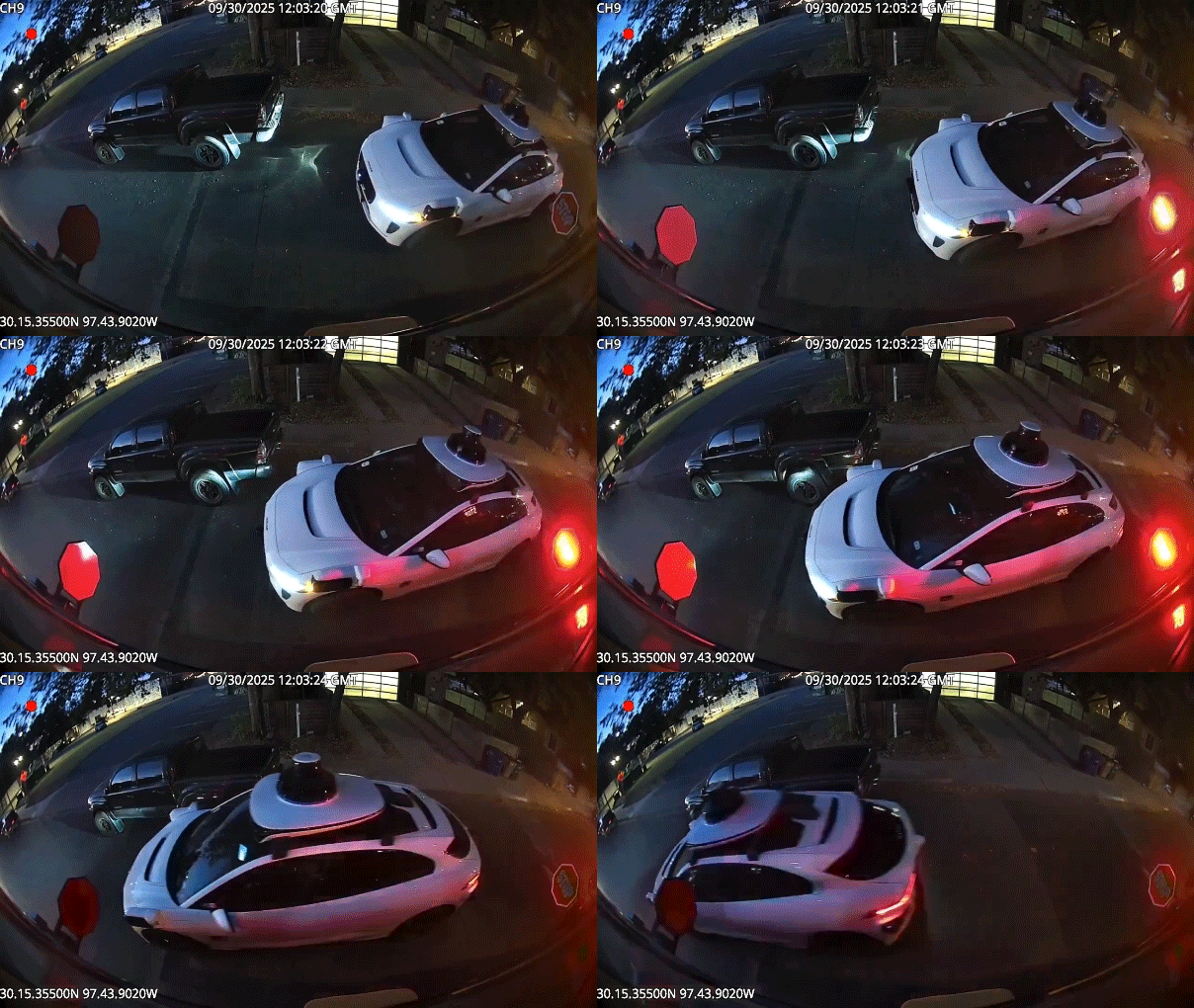
Autonomous vehicles are rapidly becoming a reality on American streets, with driverless cars now operating in several major cities across the country. These self-driving cars, often hailed as the future of transportation, promise convenience, affordability, and a fundamentally different experience from traditional rides. However, as the technology advances and adoption grows, questions about safety, regulation, and reliability remain at the forefront of public and governmental concerns.
In Santa Monica, California, a recent incident underscored the challenges of this emerging technology when an autonomous vehicle struck a student. Fortunately, the Santa Monica Police Department reported that no injuries occurred. This incident highlights that while self-driving cars offer many benefits, the technology is still evolving and not without risks.
Currently, in cities like Phoenix, San Francisco, and Los Angeles, commuters can summon a driverless car through an app. These autonomous vehicles pick up passengers without a human driver behind the wheel, offering a ride free from the usual inconveniences of human-driven cars—no small talk, no wrong turns, no tipping, and none of the sensory annoyances like overpowering perfume masking cigarette smoke. The experience is designed to be efficient and straightforward.
One of the most striking advantages of robotaxis is their cost. For example, a Waymo ride in San Francisco averages about $8.17, which is roughly half the price of a typical human-driven Uber ride in the same city, which costs around $17.25. This price competition is shaking up the ride-hailing industry, making autonomous vehicles an attractive option for many passengers seeking affordable transportation.
Waymo, a subsidiary of Alphabet (Google’s parent company), is the clear leader in the autonomous vehicle space. In 2025 alone, Waymo provided 15 million driverless rides and currently offers around 400,000 rides per week. The company is valued at an impressive $126 billion and operates in several cities, including Phoenix, the San Francisco Bay Area, Los Angeles, Austin, Atlanta, and Miami. The expansion plan for 2026 includes new markets like Dallas, Denver, Washington, D.C., London, and Tokyo, signaling the company’s ambition to make autonomous vehicles a global phenomenon.
Living in Phoenix, where Waymo is highly visible on the streets—whether at grocery store parking lots, freeways, or stopping at red lights with no one in the driver’s seat—many residents are becoming accustomed to seeing these vehicles as part of everyday life. Despite this, some potential riders remain hesitant. The author of the original report admits to not having taken a ride yet but plans to try one soon, acknowledging both curiosity and caution.
Meanwhile, other players in the autonomous vehicle market are also making strides, though none have matched Waymo’s scale. Tesla launched its robotaxi service in Austin in June 2025 but remains far behind with roughly 31 vehicles on the road. Each ride so far has required a safety monitor onboard, meaning the cars are still supervised by a human driver. Zoox, owned by Amazon, offers a unique approach with a pod-style vehicle that lacks a steering wheel and can drive in both directions. Zoox’s rides are currently free in Las Vegas and San Francisco as the company awaits regulatory approval to begin charging customers.
The technology behind these vehicles varies between companies. Waymo’s cars rely on a combination of cameras, lidar (a laser radar system that creates a detailed 3D map of the surroundings), and traditional radar. This multi-sensor approach allows Waymo’s vehicles to operate effectively even in total darkness and heavy rain. Tesla, on the other hand, uses only cameras—eight of them—and no lidar, which reduces costs and allows Tesla to offer rides at a lower price, about $1.99 per kilometer.
Safety remains a critical issue as autonomous vehicles become more common. Tesla has reported seven crash incidents to regulators since its robotaxi launch, while Waymo claims to have 80% fewer injury crashes than human drivers. However, the National Highway Traffic Safety Administration (NHTSA) has logged 1,429 Waymo incidents since 2021, including 117 injuries and two fatalities. Waymo has also had three software recalls, one as recent as December 2025, related to the vehicle’s failure to stop for school buses.
Users have reported occasional glitches as well. For example, one passenger recounted being dropped off a full mile away from their intended destination, with no way to correct the drop-off point or seek help from a human operator