
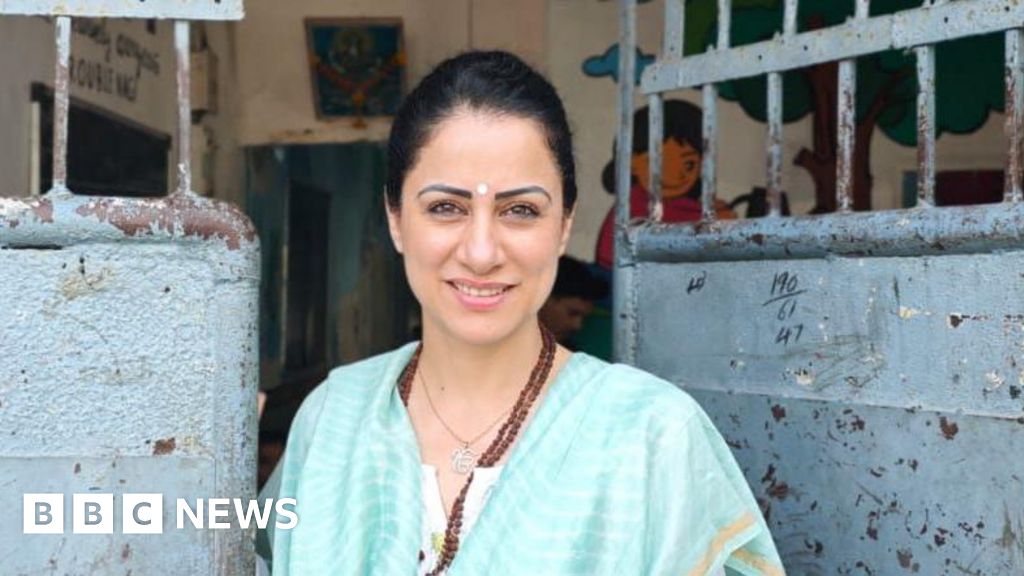
In the bustling city of Mumbai, tucked away in a narrow lane of the affluent Colaba district, lies an extraordinary community that offers a glimpse into the resilience and hope of some of the city’s most marginalized residents. This lane opens up to a patch of land dotted with small concrete cubicles—workspaces for washermen who clean and dry Mumbai’s laundry. Surrounding this area are brightly painted shanties in hues of red, blue, green, and yellow, stacked atop one another like a vibrant, irregular Tetris game. This settlement is home to many washermen and their families, who live and work in these cramped quarters.
Amidst this maze of homes and workspaces is a beacon of hope: a small learning centre that offers free lessons in basic mathematics and language skills. This centre serves as a crucial stepping stone for children in the community, many of whom are attending school for the first time or returning to education after dropping out. The presence of this learning hub is a testament to the transformative power of education even in the most challenging environments.
The centre is run by the Rouble Nagi Art Foundation (RNAF), a non-profit organisation founded by Rouble Nagi, a 45-year-old artist with a passion for education and social change. For over three decades, Nagi has dedicated herself to bringing learning opportunities to India’s underserved communities. Her work has not gone unnoticed; earlier this month, she was awarded the prestigious Global Teacher Prize, a $1 million award launched by the Varkey Foundation in partnership with UNESCO. This prize recognizes teachers who have made exceptional contributions to the profession worldwide.
Nagi’s achievement is remarkable given that she was selected from more than 5,000 nominations and applications spanning 139 countries. The Global Teacher Prize website highlights her impact, noting that through RNAF, she has established over 800 learning centres across India in more than 100 underserved communities and villages. This expansive network is a testament to her commitment and the scalability of her approach.
The inspiration behind Nagi’s journey into education came about unexpectedly nearly 30 years ago when a boy walked into one of her art workshops in Mumbai. She learned that he lived in a slum and was unable to afford schooling. This encounter compelled her to visit the boy’s community, where she proposed decorating the walls with murals to brighten up the environment. As she painted alongside volunteers, children began to gather, curious and eager to learn. When she asked if they wanted to hear a story, every child responded with enthusiasm. This moment made Nagi realize that children in impoverished communities had a strong desire to learn, and that art could be a powerful medium to ignite their interest in education.
Over the years, Nagi and her team have expanded their efforts to numerous cities across India. Their learning centres emphasize art-based education to simplify complex concepts and engage students creatively. Volunteers contribute by offering skill-based lessons, and donations help provide essential school supplies such as books and bags. Importantly, these centres are not confined to traditional classrooms; many sessions take place outdoors in slums, with children seated on mats and carpets. Nagi stresses that learning can happen anywhere as long as it is made interesting and accessible.
However, running these centres comes with significant challenges. Many children come from dysfunctional families, and teachers often have to assume multiple roles—not only as educators but also as counsellors and protectors. When a child fails to attend classes for a week, volunteers make home visits to check on their wellbeing. Additionally, Nagi holds regular sessions with parents to maintain their engagement in their children’s education, understanding that parental support is crucial for sustained learning outcomes. These efforts have borne fruit, with many students completing their schooling and even pursuing higher education after leaving the centres.
One inspiring example is Mayur, a former student who now runs his own art classes and a small printing business. On weekends, he volunteers with RNAF, hoping to provide other children from his community with the same opportunities that helped him thrive. Mayur’s story underscores the importance of building strong relationships not only with students but with the entire community, through support that goes beyond education. Nagi explains that trust is fundamental; whether it’s providing financial aid, supplying essentials during crises, or simply offering a listening ear, fostering a supportive environment is key to the foundation’s success.
Among RNAF’s standout initiatives is the ‘Misaal’ project—meaning “an example” in Hindi—which aims to transform slums