
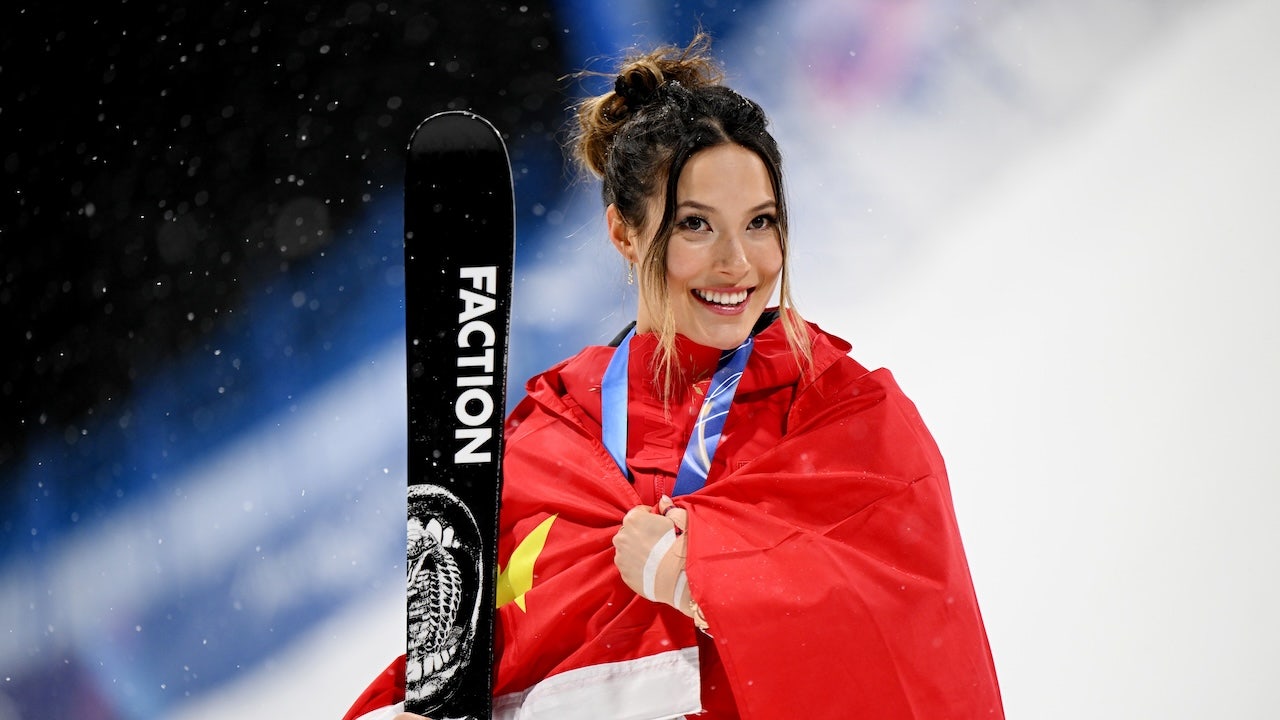
American-born freestyle skiing star Eileen Gu has become a focal point of controversy as she competes for China in the 2026 Winter Olympics held in Milan Cortina. Her decision to represent China instead of the United States has drawn widespread attention and criticism, sparking debates about nationality, loyalty, and the intersection of sports and politics. Amid this global scrutiny, two American athletes competing in the same Winter Games have voiced their support for Gu’s choice, shedding light on the complexities athletes face when choosing which country to represent on the world stage.
Kelly Curtis, a seasoned member of Team USA’s women’s skeleton team and a staff sergeant in the U.S. Air Force, expressed respect for Gu despite not having deeply considered the controversy surrounding her nationality choice. Curtis emphasized Gu’s extraordinary talent and achievements in freestyle skiing, calling her the “most decorated freestyle skier” and recognizing her as being at the pinnacle of her sport. Speaking to Fox News Digital, Curtis stated, “I honestly have not given it much thought. She is the most decorated freestyle skier, so she’s at the top of her run, and I have nothing but respect for her.” Curtis’s comments reflect a focus on athletic excellence rather than the political dimensions of Gu’s decision.
Supporting Gu from a similar perspective is AJ Edelman, captain of Team Israel’s bobsled team and an American-born athlete himself. Edelman, who grew up in New England, has chosen to represent Israel in both skeleton at the 2022 Beijing Winter Games and bobsled at the current Olympics. He has openly stated that although he is a proud American, he would never consider competing for the U.S. over Israel. Edelman criticized those who question Gu’s choice, arguing that each athlete’s journey and personal decisions are unique and should be respected without external judgment. He told Fox News Digital, “Every single athlete has a different athletic journey, and every single athlete chooses a path in their life of that athletic journey that is theirs and theirs alone. I think it is incredibly inappropriate for anyone to demand service of someone in sport for any particular reason that is not of that athlete’s own will.”
Edelman further elaborated that questioning an athlete’s decision to represent another country is “absolutely inappropriate and extreme,” and likened Gu’s situation to his own. His decision to compete for Israel was motivated by a desire to make an impact within a specific community, stating, “I felt that community would best be impacted through the appearance or through representation through the state of Israel.” This shared viewpoint underscores the personal and often complex considerations athletes weigh beyond national borders, including cultural, familial, and community ties.
While Edelman has made significant personal sacrifices to compete for Israel—living below the poverty line for over a decade and selling valuable assets such as bitcoin to fund his athletic career—Gu’s path has been markedly different in terms of financial gain. Gu has become the highest-paid Winter Olympic athlete in the world, reportedly earning approximately $23 million in 2025 alone from endorsements with both Chinese and Western companies. Notably, her partnerships include the Bank of China, reflecting her strong commercial ties to China. Reports from The Wall Street Journal indicated that Gu and Zhu Yi, another American-born athlete competing for China in figure skating, received a combined $6.6 million from the Beijing Municipal Sports Bureau in 2025 as incentives for their Olympic performances. Over three years, their earnings reportedly approached $14 million, highlighting the lucrative nature of representing China at the highest level of winter sports.
Gu has stated that her representation of China is a tribute to her mother, who was born there, emphasizing a personal and familial connection rather than purely a commercial or nationalistic one. However, her decision has not come without its challenges. Gu has faced intense backlash and hostility, including what she described as physical assault, death threats, and even a robbery at her dormitory. She revealed to The Athletic, “I’ve gone through some things as a 22-year-old that I really think no one should ever have to endure, ever.” Despite these hardships, Gu has maintained a relatively cautious public stance on political issues surrounding China.
When questioned about China’s alleged human rights abuses, particularly the reported persecution of Uyghurs and other Turkic Muslim minorities in Xinjiang, Gu expressed skepticism. In a Time Magazine interview, she admitted, “I haven’t done the research. I don’t think it’s my business. I’m not going to make big