
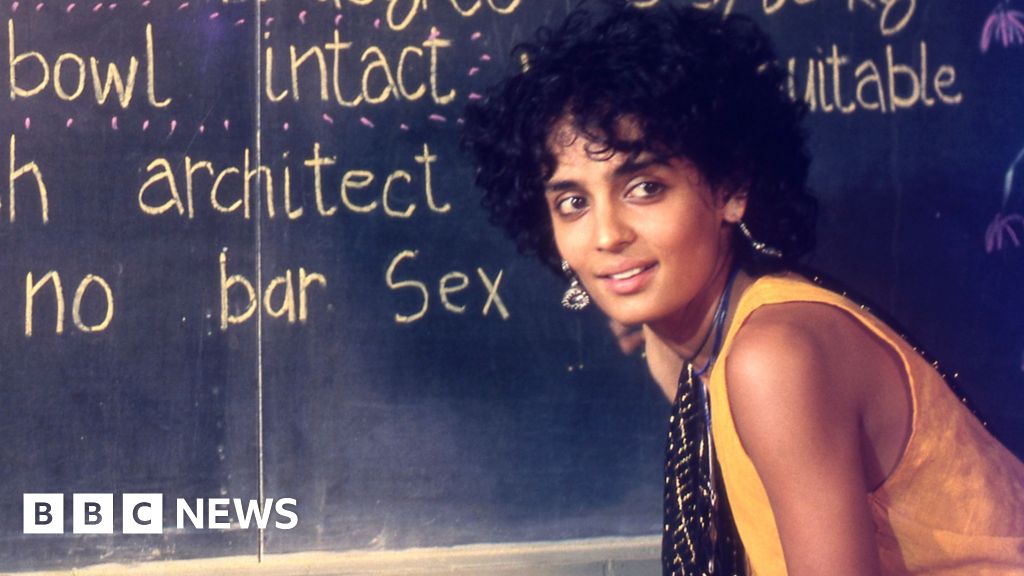
In the late 1980s, on a humid afternoon in Delhi, a group of architecture students wandered the city’s streets, caught in a liminal space between youthful idealism and the daunting realities of a society seemingly stuck in perpetual incompletion. These students were spirited and impatient, fluent in both slogans and sarcasm, acutely aware that the very system they were preparing to join might ultimately reject or disregard them. This evocative snapshot of student life forms the heart of the 1989 television film *In Which Annie Gives It Those Ones*, a seminal work penned by Booker Prize-winning author Arundhati Roy and directed by Pradip Krishen.
Almost four decades after its initial broadcast on India’s state television channel Doordarshan, a restored version of this cult classic is set to make its world premiere at the Berlinale Classics section of the 2026 Berlin International Film Festival. The Film Heritage Foundation, which spearheaded the painstaking restoration, plans to release the film in select theatres across India in March, deliberately pricing tickets affordably to attract younger audiences and introduce them to a cinematic time capsule that remains strikingly relevant today.
Shivendra Singh Dungarpur, filmmaker and Director of the Film Heritage Foundation, emphasized the film’s enduring significance: “We wanted it to be accessible. It’s a significant film. In its dialogue, in its portrayal of college life, in the kinds of characters it foregrounded—it achieved something unusual.” Often hailed as India’s first English-language feature film, *Annie* occupies a unique niche in the country’s cinematic history. It is local in texture yet cosmopolitan in voice; modest in budget but meticulous in its writing. The film captures a specific moment, both in terms of place and time, that resonates beyond its immediate setting.
The narrative centers on a ragtag group of final-year students at Delhi’s prestigious School of Planning and Architecture, who meander, debate, and sometimes falter on their journey towards graduation. The film’s title derives from a colloquial phrase used at Delhi University—“to give it those ones”—meaning to perform one’s typical act, flaws and all. At the center of the story is Anand “Annie” Grover, a lovable but distracted fifth-year student caught between youthful idealism and chronic underachievement. Annie’s quirks are endearing: he keeps hens in his hostel room and dreams up imaginative schemes to transform India, such as planting trees along railway tracks fertilized by the waste from passing trains. Yet, he is also burdened by his academic failures, having not passed any exams since a prank he pulled four years earlier—scrawling a crude joke about the dean in the men’s toilet.
Surrounding Annie is a vibrant cast of classmates—sharp-tongued, restless, and deeply thoughtful—who engage in spirited debates about everything from the works of Swiss-French architect Le Corbusier and the ideas of Karl Marx to the humble price of cigarettes. Arundhati Roy herself appears in the film as Radha, a character who embodies sharp wit and self-possession. The ensemble cast also includes a young Shah Rukh Khan, in what would become the Bollywood star’s screen debut.
What sets *Annie* apart is its candid and unpolished portrayal of student life. The film eschews glamorization in favor of authenticity: scenes unfold in cluttered hostel rooms, where friends lounge on charpoys, smoke, and engage in lively arguments about everything from bureaucratic inefficiencies to exam pressures. There is a breezy irreverence toward authority figures, with students openly mocking institutional rituals and even their principal, whom they nickname Yamdoot after the Hindu god of death—a blustering man who addresses them disdainfully as “My dear donkey.”
Radha, Roy’s on-screen alter ego, captures the spirit of youthful defiance. She smokes beedis—hand-rolled, cheap Indian cigarettes—and sports a bold sartorial style, pairing a traditional sari with a rakish hat. Her character radiates the free-spirited energy that defined the campus atmosphere. In her memoir *Mother Mary Comes to Me*, Roy reflects that the film’s script drew inspiration from “the wacky anarchy of that campus, the stoned, bombed-out students and the dialect of English that we spoke—an inventive mix of Hindi and English.”
The film’s initial reception was electric. At its premiere screening in Delhi,