
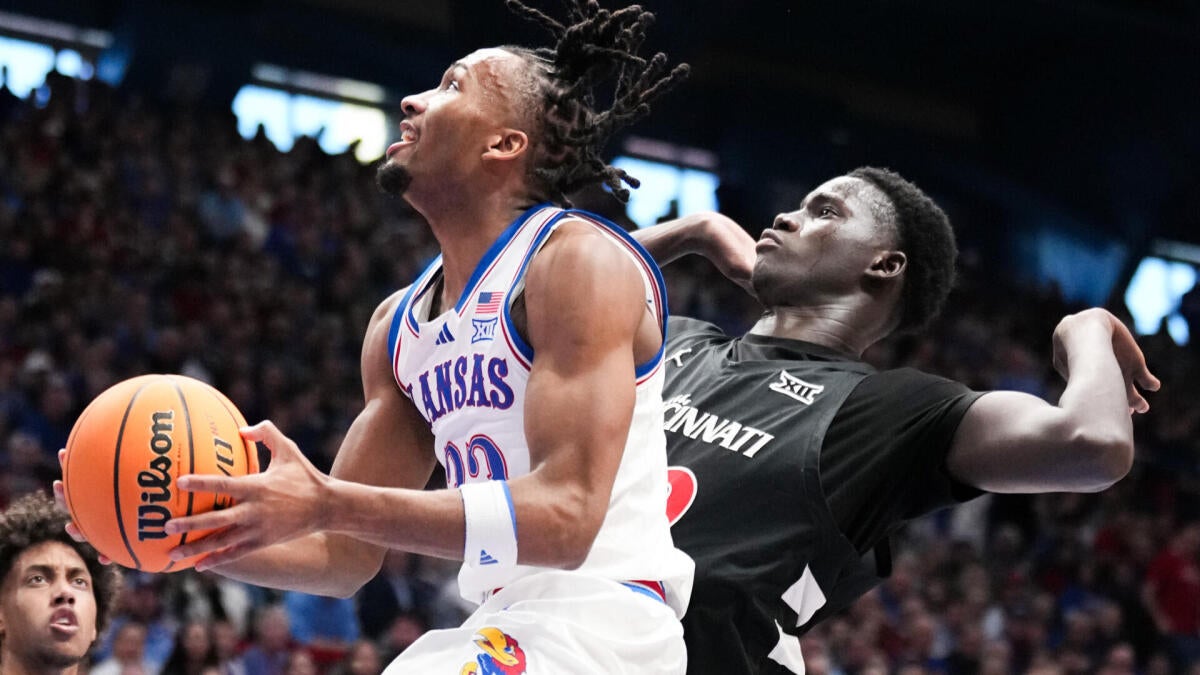
In the midst of ongoing debates surrounding Darryn Peterson’s role and availability, a broader and perhaps more pressing issue has emerged for the University of Kansas men’s basketball team: as late February rolls around, the Jayhawks are still trying to figure out exactly what kind of team they are. Despite the high expectations that come with their storied program and the reputation of head coach Bill Self, Kansas is struggling to find consistency and cohesion, highlighted by a disappointing home loss to unranked Cincinnati.
On Saturday night at Allen Fieldhouse, the No. 8-ranked Jayhawks were soundly defeated 84-68 by Cincinnati, a team not currently ranked in the top 25. This loss was notable not only for the margin but also because it marked Kansas’s first double-digit home defeat to an unranked opponent since 1993, according to CBS Sports research. The result was a harsh reality check for a Kansas team that many had pegged as a potential national championship contender.
In the postgame press conference, Coach Bill Self did not sugarcoat the performance. “We played soft,” he said bluntly. His succinct assessment captured the frustration felt by the team and fans alike, as Kansas failed to bring the toughness and energy expected from a top-tier program, especially on their home court.
Much of the discourse around the Jayhawks this season has centered on Darryn Peterson, whose availability has been inconsistent due to injury and other issues. The prevailing narrative has been that when Peterson is on the floor, Kansas is a title contender; when he is not, the team struggles mightily. However, Peterson played 32 minutes against Cincinnati — his most extensive appearance in two weeks — and still, the Jayhawks could not rise to the occasion. Fans could be seen leaving Allen Fieldhouse well before the final buzzer, underscoring the disappointment in the performance.
Amid the swirling questions about Peterson, the bigger picture is that Kansas is still very much a team in transition. While other national championship hopefuls have begun to solidify their identities and execute at a high level as March approaches, the Jayhawks appear to be stuck in experimentation mode. They have yet to fully unlock their potential or find a consistent formula for success.
One glaring weakness exposed by Cincinnati was Kansas’s interior defense. KU’s big man, Flory Bidunga, has been one of the team’s defensive stalwarts this season, but the Bearcats found ways to attack the edges of the Jayhawks’ defense effectively. Cincinnati forward Baba Miller scored eight of his 12 first-half points during stretches when Bidunga was not guarding him, revealing gaps in defensive assignments and rotations. Meanwhile, Cincinnati’s Moustapha Thiam, a 7-foot-1 big man celebrating his 20th birthday, dominated Kansas’s redshirt freshman Bryson Tiller, scoring 28 points and grabbing eight rebounds. Thiam’s performance was an emphatic statement, earning high praise from Cincinnati coach Wes Miller, who called it “one heck of a birthday present” and marveled at Thiam’s impact.
On the Kansas side, the failure of the big men to impose themselves was a serious concern. Coach Self acknowledged this bluntly: “I didn’t think our bigs played very big today.” This critique is particularly alarming given the importance of size and physicality in college basketball’s current landscape, especially among elite teams like Michigan and Florida, which boast dominant frontlines. Bidunga, listed at 6-foot-10 and 235 pounds, and Tiller, who is 6-foot-11, have the size but have struggled to consistently assert themselves. Additionally, 7-footer Paul Mbiya has yet to break into the regular rotation, leaving questions about Kansas’s depth and ability to compete physically in the paint. Cincinnati’s ability to grab 14 offensive rebounds further highlighted Kansas’s struggles on the boards, a critical factor that can swing games at this level.
Offensively, the Jayhawks were equally unconvincing. Kansas managed just 1.04 points per possession, a mediocre output, and struggled to generate fluid ball movement or create easy scoring opportunities. Over a difficult 15-minute stretch in the second half, the team recorded only two assists, a sign of stagnant offense and poor execution. While Peterson scored 17 points, his contributions felt largely invisible in the broader context of the team’s struggles. Melvin Council, often a key emotional and offensive leader for Kansas, had an off night,