
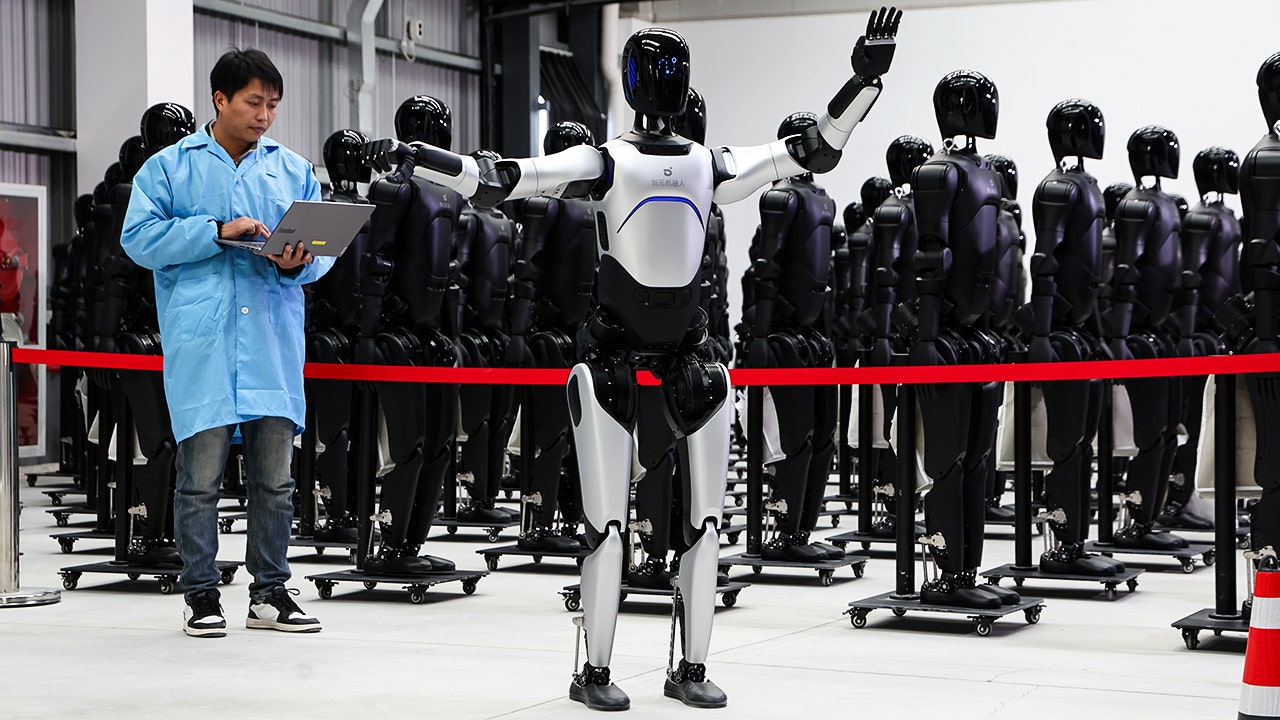
In a remarkable display of technological prowess and cultural celebration, Chinese robotics company Agibot recently staged an unprecedented live event featuring over 200 humanoid robots. Dubbed "Agibot Night," the one-hour televised gala took place in Shanghai just before the Chinese Lunar New Year, a timing that infused the event with both cultural significance and cutting-edge technological demonstration. According to Agibot, this was the world’s first large-scale live event entirely led by humanoid robots, marking a major milestone in the evolution of robotics from experimental prototypes to reliable, real-world machines.
At first glance, Agibot Night appeared to be an extravagant entertainment spectacle. The robots performed a dazzling array of routines, including synchronized dancing, martial arts displays, boxing matches, and runway fashion shows. Some robots executed Shaolin-style stances, while others incorporated acrobatics using props like fire torches. Even the audience itself consisted entirely of robots, underscoring the immense scale and ambition of the production. This visually stunning performance captivated viewers with its fluidity and precision, showcasing how far robotics technology has come in mimicking human movement and interaction.
However, beyond the spectacle, the event served a critical and highly demanding purpose: it was a live stress test for Agibot’s humanoid robotic systems. Unlike laboratory demonstrations where engineers can pause, troubleshoot, and adjust settings, a live broadcast offers no such margin for error. Any misstep—be it a stumble, delay, or synchronization issue—would be immediately visible to a global audience. By pushing its robots to perform complex, coordinated choreography for an entire hour, Agibot rigorously tested key technical aspects such as balance, motor control, battery endurance, and multi-robot coordination under real-world conditions. The sustained routines demanded precise joint control, real-time sensor feedback, and robust software stability, far beyond what short, controlled demos typically allow.
Adding further complexity, some segments of the show integrated human performers alongside the robots. This required the machines to not only execute their routines flawlessly but also to match the timing and fluidity of human dancers and magicians. One standout moment featured Elf Xuan, an ultra-realistic humanoid robot developed by AheadForm, whose lifelike facial expressions during a singing performance demonstrated the rapid advancements in expressive robotics and human-robot interaction. Additionally, comedic skits featuring multiple humanoids interacting and responding in sync highlighted growing sophistication in the robots’ timing and collaborative abilities.
Agibot’s diverse robotic portfolio was on full display during the gala. The G2 humanoid robots performed the bipedal dance and martial arts sequences, showcasing their ability to execute high-speed spins and synchronized formations with precision. Complementing these were the D1 quadruped robots, which added dynamic stability and agility, demonstrating adaptability to different terrains. The event also featured the full-sized A2 Series robots designed for multimodal interaction and navigation, alongside the smaller X2 Series robots optimized for natural conversation and expressive movement. This variety highlighted Agibot’s comprehensive approach to humanoid robotics, covering a broad spectrum of applications from entertainment to social interaction.
Agibot’s decision to hold such a public and high-stakes event signals a new phase in the robotics industry, moving from closed-door experimentation to social and cultural integration. By showcasing its robots in a national celebration, the company sent a clear message: their humanoid robots are no longer mere laboratory curiosities but are ready for large-scale production and deployment. The event functioned as both a proof of system-level reliability and a demonstration of Agibot’s broader ecosystem of products, indicating the company’s ambition to embed humanoid robots into everyday commercial and consumer environments.
This ambition is supported by Agibot’s impressive market performance. Founded in Shanghai in 2023, the company quickly rose to lead global humanoid robot shipments in 2025, delivering 5,168 units out of approximately 13,000 shipped worldwide that year, according to research firm Omdia. This dominant market share reflects strong demand and confidence in Agibot’s technology. However, shipment figures alone cannot fully capture the company’s strides in reliability and real-world readiness. Agibot Night’s live broadcast put its robots through a grueling endurance test: motors had to operate continuously without overheating, sensors maintained accurate feedback despite prolonged use, and software managed complex coordination flawlessly. In such conditions, even minor flaws would have been glaringly obvious.
The choice to stage Agibot Night ahead of a major national holiday