
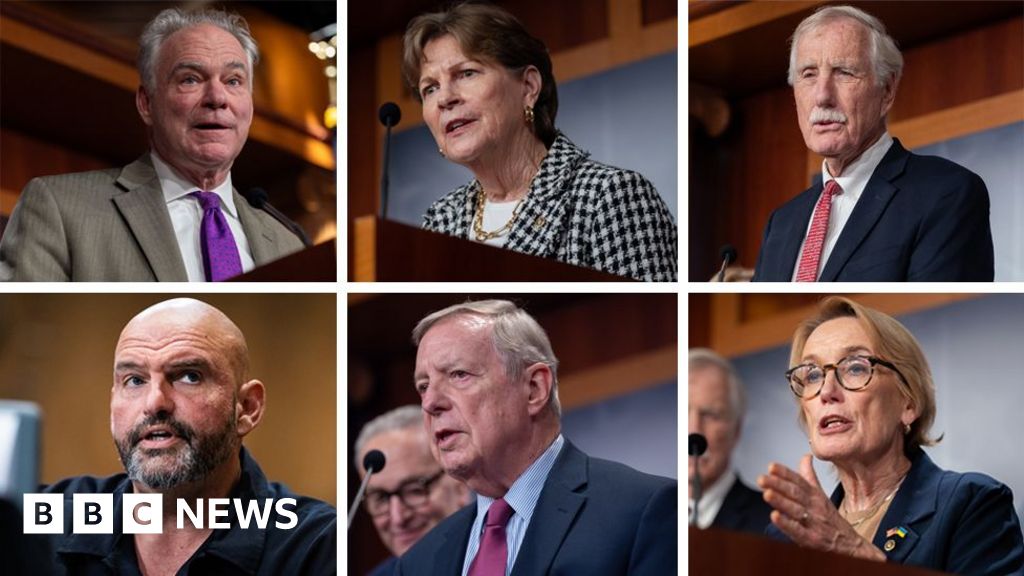
On Sunday, a significant breakthrough occurred in the long-standing impasse over reopening the United States government. Seven Senate Democrats, along with one independent who caucuses with the Democrats, crossed party lines to support a Republican-backed deal aimed at ending the longest government shutdown in US history. This unexpected bipartisan coalition effectively broke a weeks-long deadlock, during which Democratic opposition had largely centered on the expiration of healthcare subsidies affecting millions of Americans.
Throughout the shutdown, Democratic senators had steadfastly resisted efforts to reopen the government without assurances that healthcare subsidies—particularly those tied to the Affordable Care Act (ACA)—would be extended. They argued that allowing these subsidies to lapse would severely harm millions of households who rely on them for affordable healthcare coverage. The Republican proposal to reopen the government did not initially include extending these subsidies, which had been a sticking point for Democrats. However, the eventual deal incorporated a commitment to hold a vote in December on extending these healthcare provisions, an inclusion that helped sway some Democrats to support the deal.
The group of Democrats who voted with Republicans to reopen the government share a few notable characteristics. Importantly, none of them face re-election in 2026, which may have influenced their willingness to break with party leadership. Among them is Senator Tim Kaine of Virginia, widely known as Hillary Clinton’s running mate in the 2016 presidential election. Kaine cited the urgent need to protect federal workers—many of whom are based in Virginia and have been furloughed without pay during the shutdown—as a primary reason for his support. He emphasized that the deal would shield federal employees from wrongful terminations and ensure they receive back pay, referencing legislation he had successfully passed in 2019 to protect workers in such situations. Kaine acknowledged the deal sets the stage for addressing what he described as the “Republicans’ healthcare mess,” signaling a pragmatic approach to resolving the immediate crisis while leaving room for future healthcare reforms.
New Hampshire’s two senators, Maggie Hassan and Jeanne Shaheen, also voted in favor of the deal. Shaheen was one of the architects of the agreement and praised it for restoring a bipartisan funding process that includes allocations for food assistance and healthcare services for military veterans. She expressed frustration that Republicans had refused to address healthcare subsidies as part of the shutdown negotiations, warning that prolonged talks would only deepen the hardships faced by Americans. Hassan echoed these concerns, stressing the tangible impact the shutdown had on her constituents, who were bracing for increased healthcare costs amid the uncertainty. In justifying her vote, Hassan highlighted the moral imperative of keeping the government functional so that essential services continue—children receive meals, elderly citizens are cared for, air traffic controllers get paid and rested, and veterans are protected.
Senator Catherine Cortez Masto of Nevada, who had previously voted multiple times to reopen the government, reiterated the dire consequences of the shutdown for federal workers and vulnerable communities. She pointed to long lines at food banks in northern Nevada, reminiscent of the struggles seen during the COVID-19 pandemic, underscoring the urgency of ending the impasse. Similarly, Senator John Fetterman of Pennsylvania, a centrist Democrat, had consistently voted to reopen the government since the shutdown began. Following his Sunday vote, he lamented the prolonged failure that left military personnel, SNAP recipients, government workers, and Capitol Police unpaid for weeks. Fetterman framed his vote as a necessary step to mitigate ongoing harm while expressing regret that the situation had deteriorated to such an extent.
Another Democrat who shifted her stance was Senator Jacky Rosen of Nevada. She had not previously voted with Republicans to reopen the government but made an exception this time after negotiations yielded a concession allowing a vote on extending ACA tax credits. Rosen had recently clashed with Nevada’s Republican Governor Joe Lombardo, who had urged her to help end the shutdown. In a statement, she emphasized that the agreement advanced by the Senate Democrats included a bill that would bring the issue of healthcare subsidies back for consideration, reflecting a partial victory for Democrats’ core demands.
Among the Democratic leadership, Senator Dick Durbin of Illinois stood out as the only leader to support the Republican deal. As the Senate’s Democratic whip, Durbin’s vote broke ranks with Senate Minority Leader Chuck Schumer. Durbin acknowledged the bill was imperfect but argued that it took meaningful steps to alleviate the damage caused by the shutdown. He called on Senate Republican leader John Thune to fulfill his promise of scheduling a vote on the ACA tax credits in December, highlighting the deal’s potential to