
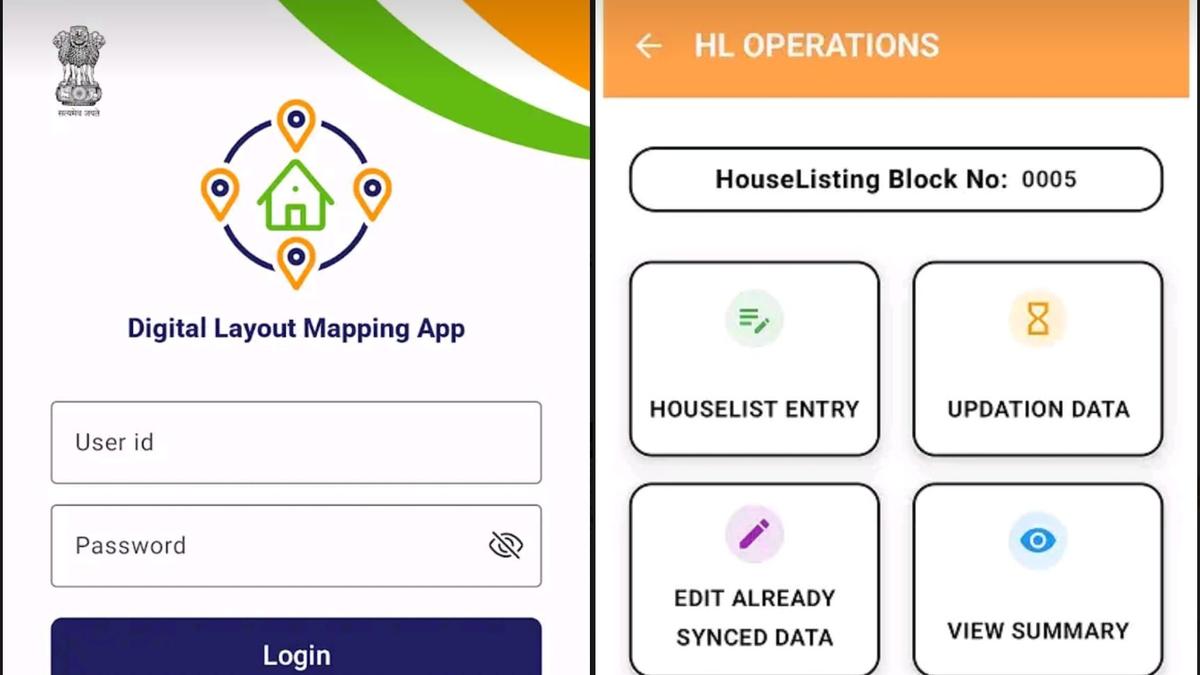
The Government of India is gearing up for a landmark event in the country’s administrative history — the first fully digital Population Census slated for 2027. In a significant move to modernize and streamline census operations, the Registrar General and Census Commissioner of India recently launched two dedicated mobile applications designed to facilitate the upcoming trial phase of the census. These apps, named Digital Layout Map (DLM) and Census 2027-Houselist, are now available on the Google Play Store but are restricted to authorized personnel only, including enumerators and officials involved in the data collection process.
India’s census is recognized as the world’s largest data-gathering exercise, traditionally conducted through meticulous fieldwork involving paper schedules and manual mapping. Until the 2011 Census, enumerators gathered data on paper forms, and layout maps of residential blocks were hand-drawn. This analog system posed challenges such as delays in data processing, inconsistencies, and a risk of errors during the manual digitization of scanned records. The 2027 Census represents a historic shift as it will be India’s first fully digital census operation, promising enhanced accuracy, faster data availability, and improved monitoring capabilities.
The Digital Layout Map (DLM) application plays a crucial role in this transition. It is designed to replicate the traditional method of sketching houselisting blocks — the fundamental units of census data collection — but with the advantages of digital technology. Enumerators using the DLM app will be able to geo-tag and record precise coordinates (latitude and longitude) of every building within a given area. They will also capture detailed information such as locality names, street names, building numbers, or, where unavailable, assign temporary census house numbers. Additional data points include building names (if applicable), building type (whether pucca or kutcha), building use (residential, partly residential, or non-residential), prominent landmarks, number of floors, and the total number of census houses within the block.
Importantly, the DLM app is designed to collect only structural and locational data about buildings and does not gather any personal information about the residents or occupants. This measure aims to maintain privacy while ensuring that the digital mapping process is thorough and systematic. This geo-tagging and digitization effort will not only improve the quality of data but also allow real-time monitoring of census operations by supervisors and officials, a feature that was not possible in earlier censuses.
Alongside the DLM app, the Census 2027-Houselist application has been developed to facilitate the House Listing and Housing Operations (HLO) phase of the census. This phase involves enumerators visiting households to collect information on housing amenities and other relevant details through a structured set of about 30 questions. The HLO phase is scheduled for a trial run, or pre-test, from November 10 to 30, 2025, in selected areas across the country. Enumerators, who include block development officers, revenue officials, and government school teachers, have been trained to use these digital tools to ensure smooth data collection.
To encourage public participation and familiarize residents with the new digital process, a self-enumeration facility has been introduced. From November 1 to 7, 2025, individuals living in the pre-test areas can voluntarily submit their housing information online through the Census Portal at https://test.census.gov.in/se. This initiative allows citizens to input their data prior to enumerators’ field visits, potentially reducing the time and effort needed for door-to-door data collection and enhancing data accuracy.
Looking beyond the trial phase, the overall Census 2027 operations are planned to unfold in two major phases. The first phase, the House Listing and Housing Operations, will be conducted between April 1, 2026, and February 28, 2027. During this phase, detailed information about housing structures, amenities, and other relevant parameters will be collected using the digital applications. The subsequent phase involves the actual population enumeration, which will count every individual residing in the country.
One notable feature of the 2027 Census is that it will include, for the first time since India’s independence, a population count by caste. This addition is expected to provide valuable insights into the demographic composition of the country, which can inform policy-making and social welfare programs.
The launch of these mobile applications and the move towards a digital census marks a significant technological advancement for India’s administrative processes. By leveraging digital tools, the government aims to overcome the limitations of past cens