
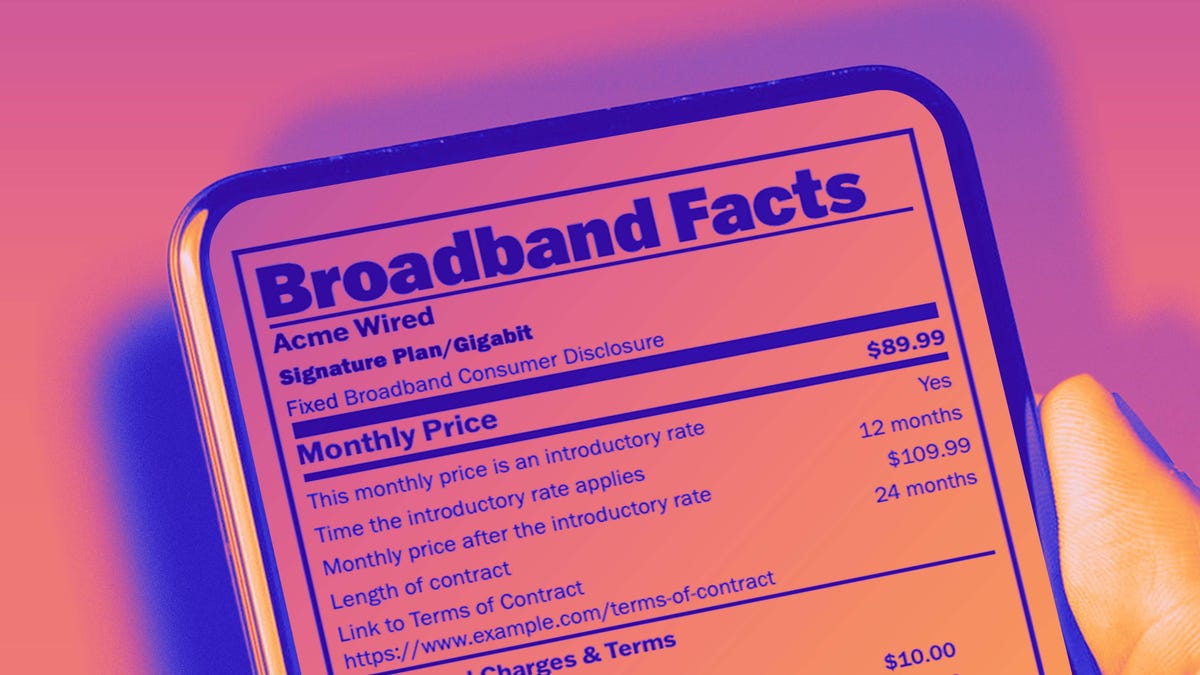
Over the past year and a half, many internet shoppers have become familiar with a helpful tool designed to clarify the often confusing landscape of broadband plans: nutrition-style labels that outline key facts about each plan. These labels were introduced to bring transparency to internet pricing, fees, and speeds, enabling consumers to make better-informed decisions when choosing an internet service provider (ISP). However, recent developments at the Federal Communications Commission (FCC), which is currently led by a Republican majority, threaten to weaken these consumer protections by scaling back where and how these labels are displayed, as well as what information they must include.
Last week, the FCC voted on a "Notice of Proposed Rulemaking" concerning the broadband labels. This procedural step invites public comment before a final decision is made, but given the current makeup of the commission, it is widely expected that the proposal will be adopted. If that happens, ISPs would no longer be required to read these labels to customers over the phone, nor would they have to provide a comprehensive breakdown of all the fees included in broadband plans. Additionally, the labels might no longer be accessible within a subscriber’s online account portal, a change that could make it harder for consumers to review their plan details at any time.
For the past seven years, journalists and consumer advocates have pointed out how difficult it is to obtain clear, straightforward information about broadband plans. Hidden fees, sudden price hikes, and confusingly advertised speeds have all contributed to a marketplace that often feels opaque and frustrating. Many customers have felt as though understanding their monthly bill required specialized knowledge or legal expertise. The introduction of broadband labels in April 2024 represented a significant improvement, as these labels provided clear, upfront pricing information and details about what customers could expect to pay both initially and in the future. Unfortunately, the FCC’s current proposal signals a possible return to that era of uncertainty and confusion.
Consumer advocates warn that this move is just the beginning of a gradual erosion of broadband transparency. Raza Panjwani, senior policy counsel at New America's Open Technology Institute, described the process as a two-step strategy: first, making the labels less useful and harder to find, and then using that diminished usefulness as justification for eliminating them altogether. This fear is compounded by the fact that the FCC’s proposal offers no clear explanation for why these rollbacks are necessary, a point highlighted by Anna Gomez, the commission’s sole Democratic member. Gomez criticized the proposal as one of the most anti-consumer measures she has encountered, emphasizing that instead of reducing information, the commission should be working to enhance the labels so that consumers can fully benefit from them.
The broadband labels have generally been well-received by consumers since their introduction. A 2024 survey involving over 2,500 broadband users found that 85% considered the labels useful for comparing plans. This strong approval suggests that the labels are fulfilling their intended purpose of demystifying broadband pricing and helping customers make informed choices. Despite this, FCC Chair Brendan Carr argued that many users still struggle to locate the necessary information efficiently. He claimed that some consumers find the search for plan details to be like a frustrating game of "Where’s Waldo," implying that the labels are not as effective as intended because they are difficult to find or interpret.
There is truth to Carr’s observation that broadband labels are often buried deep within ISP websites. For example, attempts to locate labels on popular providers like Xfinity and Spectrum revealed that users must first enter a valid address to see personalized plan information, and even then, the labels tend to be placed at the bottom of the checkout pages, far from immediate view. Panjwani confirmed this, noting that labels are often embedded so far into the sales flow that many customers are unlikely to notice them. However, rather than introducing measures to improve the visibility or clarity of these labels, the FCC’s proposal would reduce the frequency with which they appear.
Among the proposed changes is the removal of a requirement for ISPs to itemize state and local passthrough fees that vary by location. The FCC’s rationale is that listing these fees separately can result in an overwhelming number of labels and overly long disclosures, which might confuse or discourage consumers. However, critics argue that this reasoning simply acknowledges the proliferation of fees that ISPs impose, without addressing the underlying problem. Panjwani pointed out the irony in ISPs claiming they cannot list all their fees because it would clutter the label, suggesting instead that such fees should be incorporated into the overall cost of service. This