
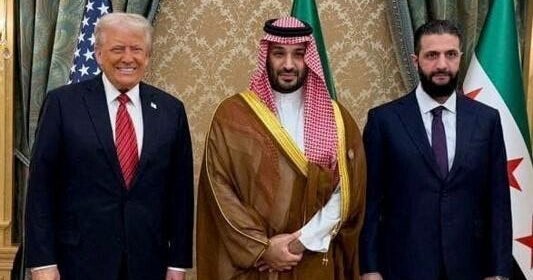
On Monday, Syrian President Ahmed Al-Sharaa is set to meet with U.S. President Donald Trump at the White House, marking a remarkable turnaround in his international standing. Just three days prior, Al-Sharaa was classified by the U.S. government as an international terrorist with a $10 million bounty on his head. This dramatic shift reflects not only changes in Al-Sharaa’s political trajectory but also evolving U.S. foreign policy toward Syria.
Al-Sharaa’s background is complex and controversial. He was formerly the leader of Hayat Tahrir al-Sham, an al-Qaeda affiliate in Syria, known during that period by his nom de guerre Abu Mohammed al-Golani. However, in a stunning transformation, he has since disavowed Islamic extremism and risen to lead Syria through a turbulent period. Nearly a year ago, his rebel militia successfully ousted long-time Syrian dictator Bashar al-Assad, forcing Assad into exile in Russia. This event ended decades of Assad’s brutal rule, under which Syria was heavily sanctioned and isolated internationally.
Syria has long been crippled by sanctions imposed primarily by the United States and other nations in response to Assad’s oppressive regime and ongoing civil conflict. The upcoming White House meeting could signify a further thaw in Syria’s geopolitical isolation as Al-Sharaa seeks to normalize relations with the U.S. and the broader international community. Central to this effort is Syria’s potential formal entry into the global coalition against ISIS, a group that Al-Sharaa’s former militia opposed only in the later years of the country’s 14-year civil war.
If Al-Sharaa and President Trump formalize an agreement on counterterrorism cooperation during their meeting—the third between the two leaders—it would mark a profound reversal in U.S. policy. For years, the U.S. viewed Syria as a breeding ground for extremist groups, with Assad’s government allowing ISIS to grow unchecked. At its peak, ISIS controlled vast territories along the Syria-Iraq border, becoming one of the most powerful terrorist organizations worldwide. The potential partnership signals a strategic pivot by the U.S. to engage with the new Syrian leadership to combat terrorism.
President Trump publicly acknowledged this shift in tone earlier this year. After meeting Al-Sharaa for the first time in Saudi Arabia in May, Trump described him as a “young, attractive guy, tough guy, strong past.” This personal rapport was further underscored over the weekend when Al-Sharaa became the first Syrian leader to play basketball with U.S. military personnel. A video released by the Syrian foreign ministry showed him sinking a three-pointer alongside a U.S. admiral and a brigadier general at an undisclosed location within the United States—a symbolic gesture of camaraderie and cooperation.
Despite these warming ties, as recently as Friday morning, Al-Sharaa remained officially designated as a terrorist by the U.S. government—a status he had held since 2013. That designation was lifted by the end of the day, clearing the way for more formal diplomatic engagement. This removal of the terrorist label is a crucial step in re-establishing Syria’s legitimacy on the world stage and facilitating closer collaboration with the United States.
Another major topic likely to be discussed during Monday’s White House meeting is the lifting of U.S. economic sanctions on Syria. In May, President Trump issued an executive order that began the process of removing sanctions on Syria, while maintaining restrictions on former president Assad, his associates, and other targeted groups, including human rights abusers, drug traffickers, and those linked to chemical weapons and ISIS. White House press secretary Karoline Leavitt clarified in June that sanctions against these specific entities remain intact, underscoring a nuanced approach that distinguishes between the Syrian government under Al-Sharaa and remnants of the previous regime and extremist groups.
Al-Sharaa’s transitional government has been lobbying the Trump administration for months to ease these sanctions, which have severely hampered Syria’s economic recovery. Efforts to reduce sanctions had already been underway prior to the May executive order, but many measures require formal revocation by Congress before they can be fully lifted. The easing of sanctions would be critical for Syria’s efforts to rebuild after years of devastating conflict.
In an apparent demonstration of its commitment to combating terrorism, the Syrian government announced the detention of over 70 alleged ISIS members just hours before Al-Sharaa’s arrival in Washington. This move was likely intended to underscore the new leadership’s resolve to crackdown on extremist factions and align Syria more closely with U.S