
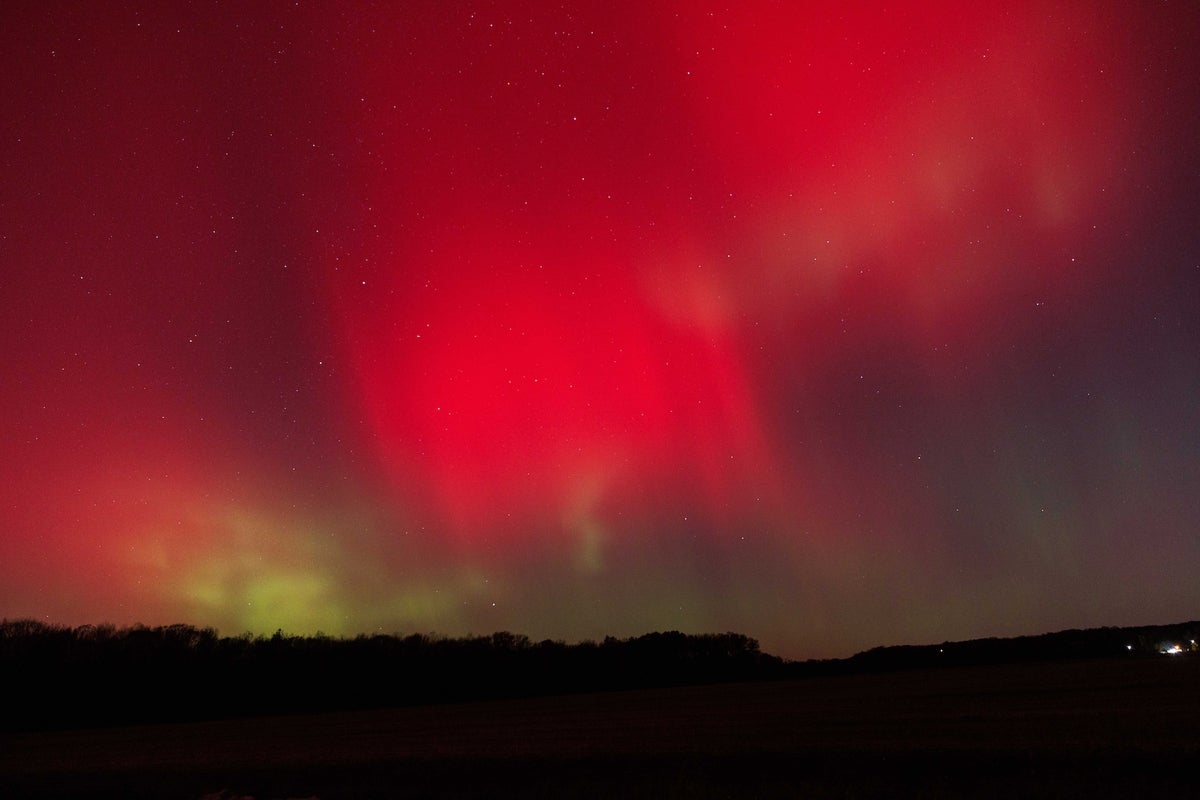
On the night of November 11 and into November 12, 2025, skywatchers across the United States were treated to an extraordinary natural light display as the northern lights, or aurora borealis, illuminated the skies far beyond their usual northern confines. This spectacular event was the result of a severe geomagnetic storm induced by recent bursts of solar activity, offering a rare and mesmerizing sight to millions of people in regions stretching from Indiana and New Jersey to northern California, Florida, and Texas. Such widespread visibility of the aurora borealis at these latitudes is highly unusual, as these shimmering light shows typically occur in a doughnut-shaped zone encircling the North Pole. Meanwhile, in the southern hemisphere, the southern lights, or aurora australis, were also visible in parts of Australia, underscoring the global scale of this solar event.
Auroras occur when charged particles emitted by the sun interact with Earth’s magnetic field and atmosphere. Specifically, they are triggered by coronal mass ejections (CMEs), massive bursts of plasma and magnetic field from the sun’s corona, which travel through space and collide with Earth’s magnetosphere. This interaction energizes atmospheric gases, causing them to emit the glowing light that creates the aurora’s characteristic greens, reds, and purples. The recent auroral displays were linked to CMEs released on the preceding Sunday and Monday, with more solar activity detected on Tuesday, indicating that this dazzling light show was far from over. Experts monitoring these solar emissions predict that additional auroral activity may continue, though likely confined to more northern parts of the U.S. in the coming nights.
The National Oceanic and Atmospheric Administration’s (NOAA) Space Weather Prediction Center, which tracks and forecasts solar activity and its effects on Earth, confirmed that geomagnetic storm conditions would persist but at somewhat diminished levels. These storms are a part of “space weather,” a term that encompasses various phenomena resulting from the sun’s activity and their influence on Earth and its near-space environment. While auroras are the most visible and celebrated manifestations of space weather, other effects can be far more disruptive. Intense geomagnetic storms have the potential to damage satellites, interfere with radio communications, and even disrupt power grids, highlighting the importance of monitoring solar activity closely.
The powerful solar storm responsible for this recent auroral spectacle was among the strongest in decades, as captured in vivid photographs from locations such as Monroe County near Bloomington, Indiana; a vineyard in Geyserville, California; and Cape Canaveral, Florida. These images reveal the ethereal beauty of the green-hued lights dancing across the night sky, captivating both casual observers and professional photographers alike. The event also had tangible consequences beyond the visual delight. For instance, the launch of a Blue Origin rocket carrying two NASA spacecraft destined to study space weather at Mars was delayed due to the heightened solar activity, underscoring how space weather can impact even cutting-edge space missions.
For those who missed the display or want to contribute to scientific understanding of such events, there is an opportunity to participate in citizen science through the Aurorasaurus project. This volunteer-driven initiative enables people around the world to report aurora sightings, helping researchers piece together a more detailed picture of how solar storms affect Earth’s atmosphere and magnetic environment. By combining observations from professional instruments and everyday skywatchers, scientists are better equipped to predict and study these phenomena, enhancing our ability to prepare for space weather impacts.
The excitement surrounding this event also reflects a broader public interest in space science and the natural wonders of our planet and solar system. Meghan Bartels, a seasoned science journalist based in New York City and a senior reporter at Scientific American, authored the original article detailing this event. With a background spanning several prominent science publications, Bartels brings expertise to the coverage of space and Earth science topics, helping to translate complex scientific phenomena into engaging stories for a general audience.
This aurora event arrives at a pivotal moment for science communication and public engagement with scientific research. Scientific American, where Bartels works, has a long history of advocating for science and sharing impactful stories about discoveries shaping our world. As editor-in-chief David M. Ewalt emphasizes, supporting such journalism through subscriptions helps ensure that essential science reporting continues, especially at a time when the value of science is sometimes underappreciated. Subscribers gain access to a wealth of resources, including news, podcasts, infographics, newsletters, videos, and more, all designed to educate and