
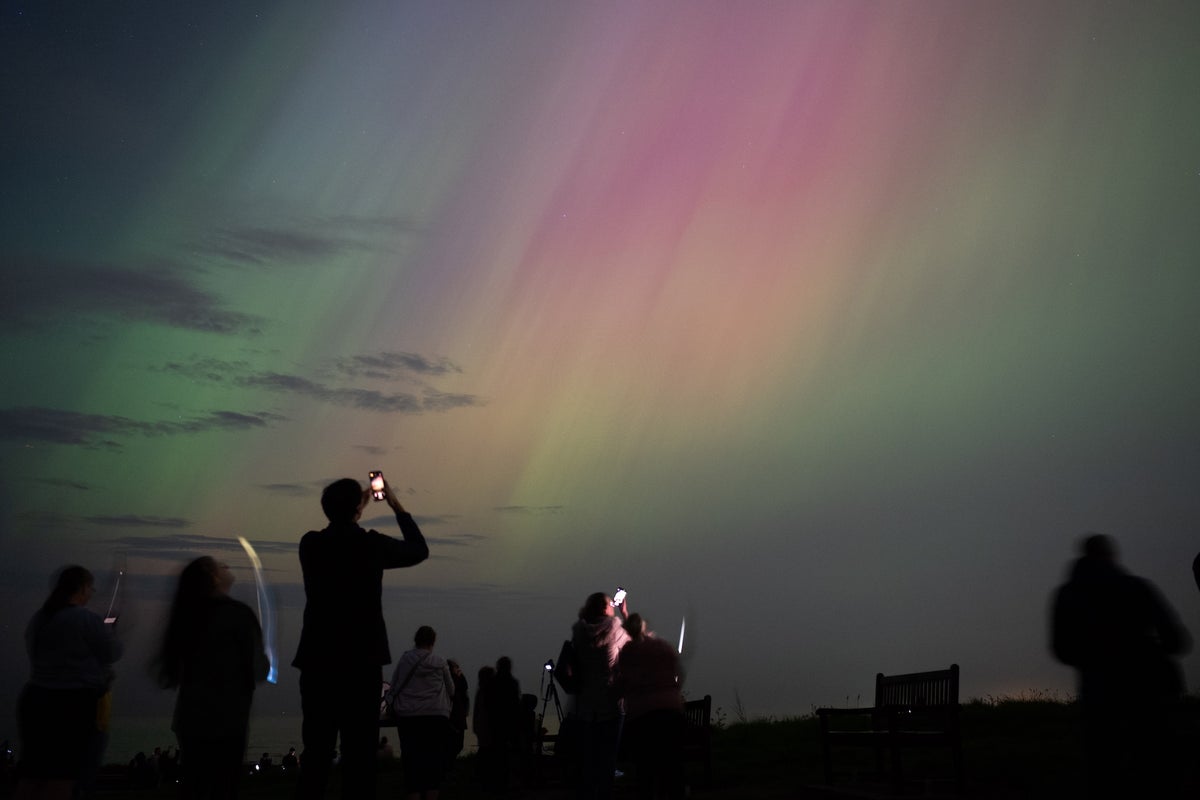
On November 11, 2025, scientists alerted the public to an impending powerful solar storm that has the potential to produce spectacular auroras visible as far south as northern California and Alabama. This event is linked to a highly active region on the sun, known as active region 4274 (AR4274), which has recently unleashed a series of intense solar outbursts, including one of the most powerful solar flares observed during the current solar cycle.
Solar flares are sudden flashes of brightness on the sun’s surface caused by magnetic energy release, and they are often followed by coronal mass ejections (CMEs). CMEs are massive clouds of magnetized plasma propelled from the sun into space at incredible speeds. When these CMEs are directed toward Earth, they interact with our planet’s magnetic field and atmosphere, creating what is known as space weather. This interaction can produce stunning natural light shows, or auroras, but it can also disrupt power grids, satellite operations, radio communications, and navigation systems.
The particular concern with AR4274 is that its recent CME is traveling at approximately 3.3 million miles per hour and is on a collision course with Earth. This CME is expected to catch up with two earlier, slower CMEs that were ejected on the preceding Sunday and Monday, potentially intensifying the storm’s impact. The combined energy from these solar eruptions prompted the National Oceanic and Atmospheric Administration’s (NOAA) Space Weather Prediction Center to issue a G4 geomagnetic storm watch for Wednesday. The G-scale for geomagnetic storms ranges from 1 to 5, with a G4 rating indicating a “severe” storm capable of causing significant disruptions.
A geomagnetic storm of this magnitude poses various risks. Power grids can experience voltage irregularities or even outages, satellites may suffer operational disturbances, and radio communications can become unreliable or interrupted. Navigation systems, which rely heavily on satellite signals, may also be affected, complicating travel and communication. Due to these potential hazards, monitoring and forecasting of space weather have become critical functions, akin to terrestrial weather forecasting. In fact, space weather prediction is considered mission-critical and continues unabated even during times when government operations face shutdowns.
Despite the exciting prospect of widespread auroras, there is a caveat for those hoping to witness the phenomenon. The peak of the solar storm’s activity is forecasted to occur during daylight hours in North America, making the auroras invisible to the naked eye. However, geomagnetic activity is expected to sustain a strong G3 level into Thursday. At this level, auroras could be visible much farther south, potentially reaching as far as Illinois and Oregon, offering a better viewing opportunity during nighttime hours.
The significance of this solar event is underscored by its timing in the current solar cycle, a roughly 11-year period during which the sun’s activity waxes and wanes. AR4274’s intense activity, including one of the most powerful solar flares recorded recently, highlights the dynamic and sometimes volatile nature of our star. Solar cycles influence not only space weather but also have implications for Earth’s technological infrastructure and our understanding of solar physics.
The coverage of this solar storm and its potential impacts comes from Meghan Bartels, a seasoned science journalist based in New York City. Bartels, who joined Scientific American in 2023 as a senior reporter, has a strong background in space and Earth science reporting. Her work has appeared in various respected science publications, and she holds a master’s degree in journalism focused on science, health, and environmental reporting. Her expertise lends credibility and clarity to the complex phenomena associated with solar activity and space weather.
This event also highlights the broader importance of supporting quality science journalism. Publications like Scientific American play a vital role in educating the public about scientific discoveries and challenges. They provide in-depth reporting on topics ranging from space weather to environmental issues, helping readers understand the implications of scientific research on daily life and global affairs. Subscriptions and support for such journalism ensure that these stories continue to reach audiences and foster a deeper appreciation for science.
In conclusion, the powerful solar storm originating from active region 4274 represents a significant space weather event with the potential to produce far-reaching auroras across the United States. While the most intense activity is expected during the day, limiting visibility, ongoing geomagnetic disturbances may still offer spectacular northern lights sightings in the days following the peak. Beyond the visual spectacle, this storm serves as a reminder of the sun’s