
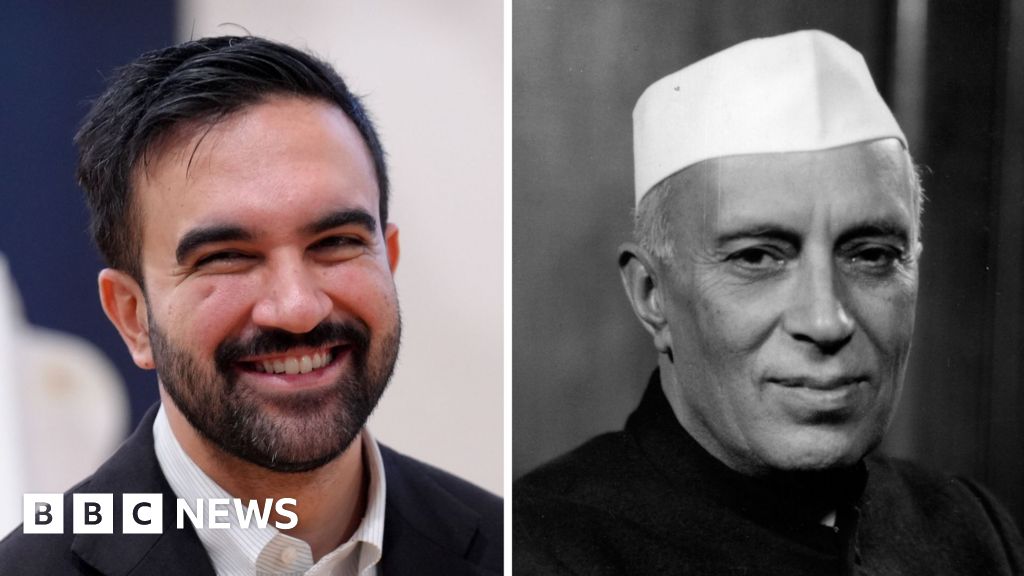
In a historic moment for New York City, Zohran Mamdani delivered a victory speech on Wednesday that resonated deeply not only with his supporters but also with a broader legacy of leadership and transformation. Quoting Jawaharlal Nehru, India’s first prime minister, Mamdani evoked a powerful image of stepping from the old into the new—a phrase originally uttered by Nehru during India’s midnight speech on August 15, 1947, when the country awoke to freedom after nearly two centuries of British colonial rule.
Mamdani’s speech, filled with optimism and a sense of purpose, captured the spirit of change and renewal. His words echoed Nehru’s historic sentiment: “When an age ends and the soul of a nation finds utterance, tonight we step out from the old to the new.” As Mamdani concluded his speech, the atmosphere was electric. The title track from the 2004 Bollywood hit *Dhoom* blared through the hall, followed by Jay-Z and Alicia Keys’ *Empire State of Mind*, a modern anthem that pulsed with fresh significance as New York celebrated its first mayor of Indian origin.
The cultural nods in Mamdani’s campaign extended beyond this moment. Months earlier, he had cleverly woven Bollywood references into his campaign messaging, a tribute to his South Asian roots—his mother is acclaimed filmmaker Mira Nair, and his father, Mahmood Mamdani, is a Ugandan-born scholar of Indian descent. On social media, Mamdani often communicated in Hindi, using playful imagery and dialogues borrowed from popular Bollywood films, which helped him connect with diverse communities and celebrate his heritage. Invoking Nehru in his victory speech was a poignant way to tie his own historic achievement to a larger narrative of freedom, leadership, and transformation.
Nehru’s midnight speech in 1947 was not just a declaration of independence but a visionary call to action. Speaking in the sweltering heat of the Constituent Assembly hall in Delhi, Nehru began with one of history’s most stirring openings: “Long years ago we made a tryst with destiny and now the time comes when we shall redeem our pledge, not wholly or in full measure, but very substantially.” His words marked a moment when India was on the brink of a new chapter, poised to awaken to life and freedom at the stroke of midnight.
The gravity and elation in Nehru’s speech were palpable. The speech balanced celebration with responsibility, emphasizing that freedom was not an end but a beginning—a beginning that required relentless striving and service. Nehru famously said the service of India meant serving “the millions who suffer” and working tirelessly to eradicate poverty, ignorance, disease, and inequality of opportunity. He pledged that India’s work would continue as long as there were “tears and suffering” and urged unity to build “the noble mansion of free India where all her children may dwell.”
Nehru’s speech, spanning roughly 1,600 words, has since become one of the most famous and revered speeches in history. It electrified the nation, inspiring generations with its eloquence and vision. The New York Times described it as a speech of “soaring eloquence,” while historian Ramachandra Guha praised it for its rich emotion and powerful rhetoric. Historian Srinath Raghavan noted that the speech still resonates in India today because it captured the moment with the timeless impact of great oratory.
The night of India’s independence was marked by a powerful gathering of leaders who each represented different facets of the newly independent nation. Alongside Nehru, Chaudhry Khaliquz-zaman spoke for India’s Muslims, and Dr. Sarvepalli Radhakrishnan, philosopher and scholar, contributed his vision. Yet it was Nehru’s speech that stood out as the defining moment. The atmosphere in the Constituent Assembly Hall was electric, with the chamber ablaze in the colors of the Indian tricolour flag—orange, white, and green. Time magazine described the scene as inspired, with leaders and attendees filled with hope and solemnity.
As midnight struck, history unfolded in a theatrical fashion. The twelfth chime was followed by the raucous sound of a conch shell, a traditional herald of dawn in Indian culture. Assembly members rose together, pledging themselves to the service of India and its people. Outside, jubilant crowds