
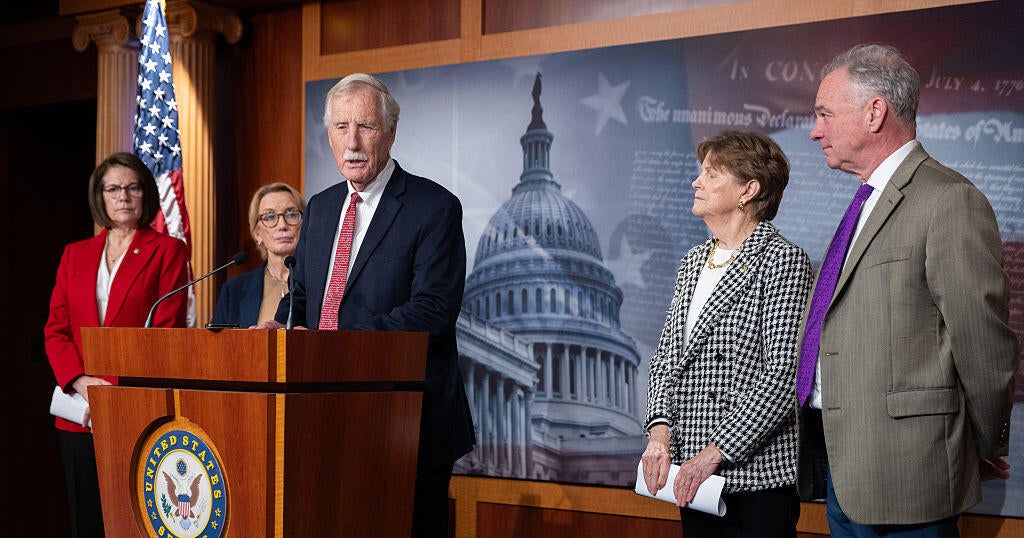
On Sunday night, the U.S. Senate took a significant step toward ending the ongoing government shutdown by advancing a critical funding bill designed to pave the way for a broader agreement on long-term federal spending. The legislation also included a commitment to hold a future vote on extending health care tax credits, a contentious issue that has divided lawmakers. The Senate voted 60-40 in favor of moving forward with the bill, with eight Democrats crossing party lines to support the measure alongside nearly all Republicans — only one Republican dissenting.
This bipartisan coalition of eight Democrats had been engaged in weeks of negotiations with Republicans, seeking to break the stalemate that had gripped Congress. Notably, their agreement was reached without the backing of the Democratic leadership in the Senate, signaling fractures within the party over the best path forward. The deal, while advancing funding discussions, notably did not resolve the looming expiration of health care tax credits under the Affordable Care Act (ACA), a key priority for Democrats. Instead, the agreement merely promises a future vote on the issue, a compromise that has sparked anger and frustration among many Democrats who view the move as a betrayal.
The procedural path ahead remains uncertain. The Senate must now conduct several procedural votes to incorporate various components of the agreement into a final bill. Given Senate rules, any senator could delay the process, leaving the timetable for final passage unclear as lawmakers try to hammer out a comprehensive funding solution.
### Key Elements of the Agreement
The centerpiece of the deal is a 31-page continuing resolution that extends government funding at current levels through January 2026. This extension is intended to provide lawmakers with more time to finalize full-year appropriations bills. The House of Representatives had previously passed a continuing resolution in September to extend funding only until November 21, but the Senate had been unable to advance that measure until now. With the previous deadline rapidly approaching, Senate negotiators agreed that a longer-term extension would be necessary to avoid another shutdown and allow more time for budget negotiations.
While some senators had advocated for a continuing resolution extending funding only through December, House Speaker Mike Johnson dismissed that option, arguing that it would place undue pressure on lawmakers to approve new spending ahead of the holiday season.
### Health Care Tax Credits Controversy
One of the most contentious points of the agreement surrounds the health care tax credits under the ACA, which currently help millions of Americans afford insurance purchased through state exchanges. These credits are set to expire at the end of the year, risking sharp increases in insurance premiums for many. Under the deal, the Senate has agreed to hold a vote on extending these tax credits by mid-December. Importantly, Democrats will have the final say over the contents of that bill.
However, the likelihood of the Senate passing an extension is slim, as most Republican senators oppose both the ACA and the tax credits themselves. This political reality has fueled anger among Democrats, many of whom criticize the deal for failing to secure an immediate extension and merely offering a future vote that may not succeed. Senator Chris Murphy (D-Connecticut) voiced his frustration publicly, stating, “There’s no way to defend this. And you are right to be angry about it. I’m angry about it.”
Just days before the vote, Senate Minority Leader Chuck Schumer had proposed that Democrats would agree to reopen the government if Republicans consented to a one-year extension of the health care tax credits. Republicans quickly rejected this offer and spent much of the following day delivering speeches on the Senate floor criticizing the ACA.
### Inclusion of Key Funding Bills
The agreement also bundles three separate year-long funding bills that lawmakers have been working on for months. This package, often referred to as a “minibus,” includes appropriations for military construction and the Department of Veterans Affairs; the Department of Agriculture and the Food and Drug Administration (FDA); and the operations of the legislative branch. These bills cover funding for the relevant agencies and programs through September 2026, offering a degree of certainty even if broader budget negotiations stall.
This minibus approach contrasts with the large “omnibus” spending bills that have typically been passed at the end of the year. Many Republicans have expressed a preference for returning to the traditional process of passing individual funding bills rather than bundling everything into a massive package. The minibus reflects that preference, while also ensuring that critical government functions continue uninterrupted.
Significantly, the minibus restores full funding for the Supplemental Nutrition Assistance Program (SNAP), which had faced shortfalls due to the shutdown