
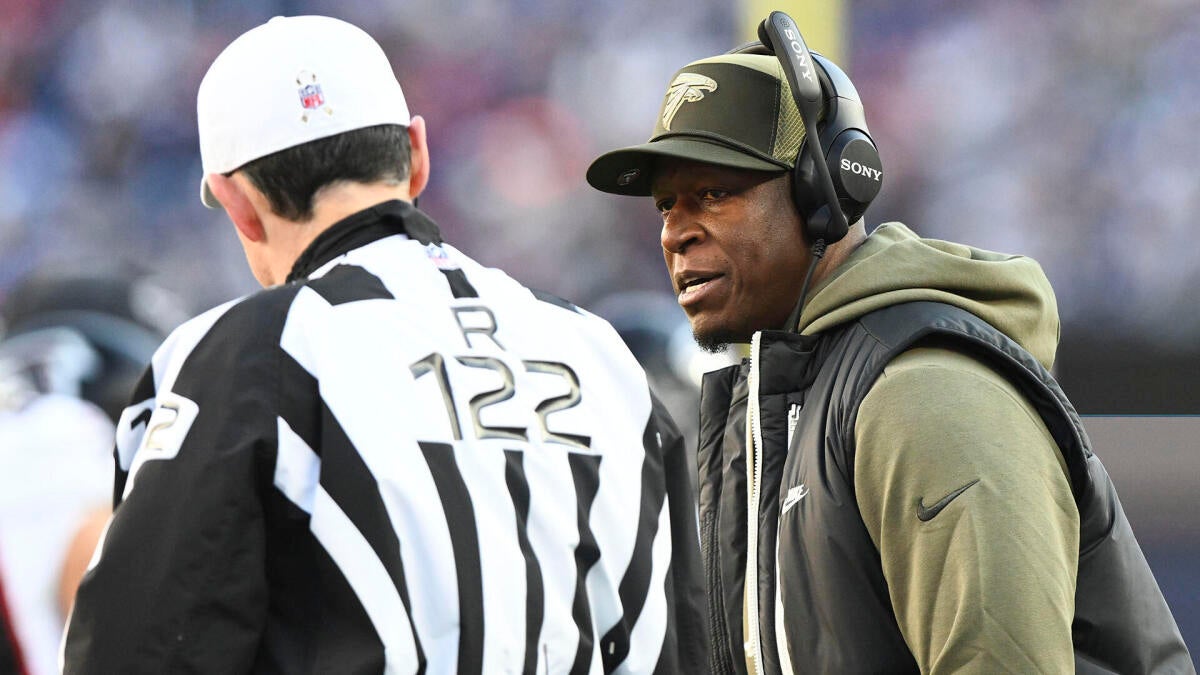
In a closely contested NFL game on Sunday, the Atlanta Falcons suffered a narrow 24-23 defeat against the New England Patriots. While the final score reflected a hard-fought battle, the postgame conversation was dominated not just by the outcome but by an unusual and serious allegation leveled by Falcons head coach Raheem Morris. Morris suggested that the Patriots engaged in illegal tactics during a critical moment late in the fourth quarter, implying that they simulated the Falcons’ snap count to confuse Atlanta’s offense — an accusation that, if true, involves a breach of NFL rules and comes with significant penalties.
The controversy centered around a pivotal play with just over two minutes remaining in the game. At that point, the Falcons were trailing by a single point, 24-23, and had possession of the ball near the Patriots’ 48-yard line. It was second-and-10, and the Falcons’ center, Ryan Neuzil, snapped the ball back to quarterback Michael Penix Jr. prematurely — before Penix was ready. This early snap forced Penix into a hurried decision as the Patriots’ defense quickly pressured him; to avoid taking a sack, Penix threw the ball away but was flagged for intentional grounding. This penalty moved the Falcons back 10 yards and turned what should have been a manageable third-and-10 into a daunting third-and-20 situation from their own 42-yard line.
Coach Raheem Morris was adamant that the Patriots’ defense had caused the early snap by simulating the Falcons’ snap count — essentially mimicking the sounds or signals Atlanta uses to initiate the play, thereby confusing Neuzil and causing the mistimed snap. “They did a nice job, they simulated a snap,” Morris said during the postgame press conference. “The ball came early, it was snapped early. Within that snap, that was when we got the intentional grounding.”
Because simulating a snap count is illegal in the NFL, Morris’s accusation carried significant weight and drew immediate attention. When asked to clarify if he was explicitly accusing the Patriots of this illegal tactic, Morris doubled down. “They were clapping. Simulated our snap, got us to snap the ball,” he stated. “That’s why the ball was snapped early to [Penix], and he wasn’t ready for the snap.”
Under NFL rules, simulating a snap count, commonly called a “disconcerting signal,” is prohibited. If officials catch a defense doing this, the penalty is a 15-yard infraction against the defense. Had the referees deemed the Patriots guilty of this tactic on the play in question, the Falcons would have been rewarded with a first down at the Patriots’ 33-yard line, a much more advantageous position late in the game.
Despite the gravity of the accusation, the evidence remained murky. Video footage of the play was widely circulated and scrutinized by fans, analysts, and players alike. Many observers struggled to identify any clear clapping or other signals from New England defenders that would have simulated the Falcons’ snap count. A video shared on social media showed the play from multiple angles, but no obvious clapping or mimicking was visible. The pressure on Penix appeared to come quickly, but whether it was triggered by deceptive signals or just a standard defensive rush was unclear.
Michael Penix Jr., the Falcons’ quarterback at the center of the controversy, weighed in on the matter after the game. Although he could not confirm with absolute certainty that the Patriots had clapped, he did relay that Neuzil, the center, heard clapping, which contributed to the early snap. “Supposedly they were clapping,” Penix said. “For us, whenever I’m clapping, that means I want the ball. I knew [Neuzil] said he heard them clapping, and he thought it was my clap, and he snapped the ball. I threw the ball in [Kyle Pitts’] direction. He had just released on a route. I thought I was going to be okay with the grounding part. Obviously that wasn’t the case.”
Neuzil’s account was significant because the center is responsible for timing the snap with the quarterback’s signal, and if he mistook an external noise for Penix’s cue, it could explain the timing error. However, if the clapping did happen, it was puzzling that none of the Patriots players appeared to acknowledge it or confirm such behavior.
On the Patriots’ side,