
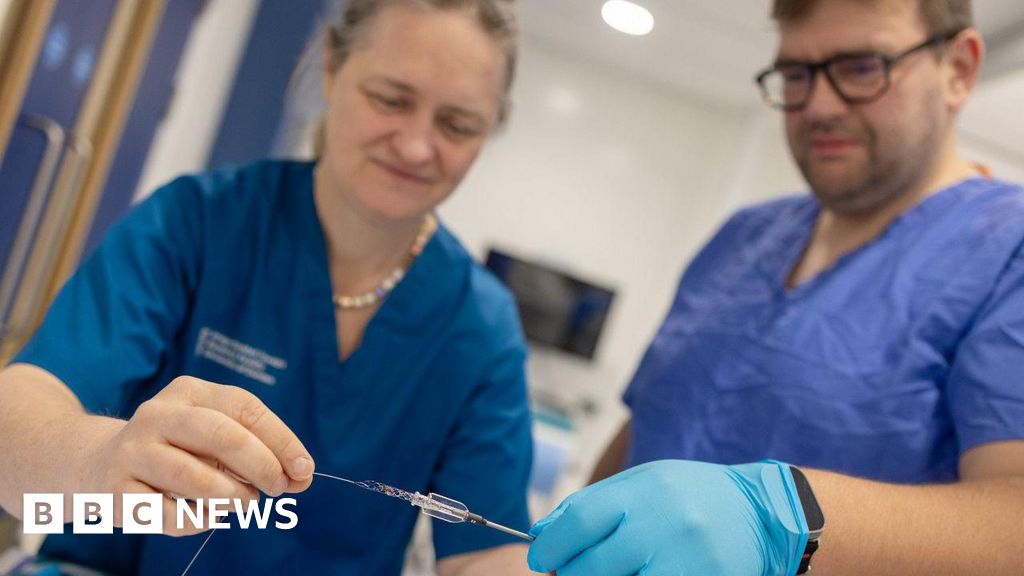
Doctors from Scotland and the United States have successfully completed what is believed to be the world’s first remote robotic stroke procedure on donated human bodies, marking a significant milestone in medical technology and stroke care. This breakthrough involved the use of advanced robotics to perform a thrombectomy—the removal of blood clots from arteries following a stroke—carried out remotely by specialists thousands of miles apart.
The pioneering procedure was led by Professor Iris Grunwald from the University of Dundee in Scotland. Using a robotic system, Prof Grunwald performed the thrombectomy on a human cadaver donated to medical science. Remarkably, she was located at Ninewells Hospital in Dundee, while the cadaver was positioned several miles away at the university. This setup demonstrated the feasibility of performing delicate, life-saving interventions without the surgeon being physically present at the patient’s location.
Hours later, neurosurgeon Ricardo Hanel in Jacksonville, Florida, used the same robotic technology to conduct a similar operation remotely on another human cadaver located in Dundee—over 4,000 miles (6,400 kilometers) away. This transatlantic surgery showcased how the technology can bridge vast distances, opening up the possibility of delivering specialist care anywhere in the world instantaneously. The medical team involved called the advancement a potential “game changer” for stroke treatment once it becomes approved for use in living patients.
Stroke care is extremely time-sensitive, and access to specialist treatment can greatly affect a patient’s recovery chances. An ischemic stroke occurs when a blood clot blocks an artery supplying the brain, cutting off oxygen and nutrients, which leads to brain cell death. The most effective treatment is a thrombectomy, where a specialist threads catheters and wires through blood vessels to physically remove the clot. However, the availability of doctors trained to perform thrombectomy is limited, and many patients—especially those in rural or remote areas—cannot reach specialized centers quickly enough.
Professor Grunwald, who is also the vice president of the World Federation for Interventional Stroke Treatment, explained how the robotic system works and its potential impact. The robot connects to the same catheters and wires that surgeons use in traditional thrombectomy procedures. A healthcare professional at the patient’s hospital attaches these instruments, and the remote surgeon uses the robotic interface to manipulate the catheters in real time, effectively performing the surgery from a distant location. This means that the specialist could operate from another hospital, a different city, or even from home, while the patient remains in a local operating room.
The experiments used human cadavers that had been donated to science and embalmed, with a liquid mimicking human blood circulated through their vessels to simulate real surgical conditions. Four different cadavers were used in the trials, and the procedures were carried out last month with robotics supplied by the Lithuanian company Sentante. While remote thrombectomy has been attempted before on models such as silicone replicas, 3D-printed versions, and animals, this is believed to be the first time the full procedure has been successfully performed on real human bodies.
The University of Dundee played a crucial role in this breakthrough, serving as the global training center for the World Federation for Interventional Stroke Treatment and being the only UK facility where doctors can practice operations on human cadavers with simulated blood circulation. Prof Grunwald highlighted that this was the first occasion where the entire mechanical thrombectomy procedure could be demonstrated on a real human body, proving that every step of the process is achievable remotely.
The technology development involved partnerships with tech giants Nvidia and Ericsson to ensure the robotic system’s connectivity and responsiveness. Dr. Hanel praised the system’s performance, noting there was only a 120-millisecond delay—a fraction of a second—between his inputs and the robot’s movements in Scotland, which he described as “truly remarkable.” Prof Grunwald also noted that operating the robot required only about 20 minutes of training, suggesting that the system is user-friendly and could be integrated into clinical practice without extensive additional training.
The potential benefits of this technology extend beyond convenience. Currently, thrombectomy services are scarce and concentrated in a few urban centers. For example, in Scotland, only three hospitals—located in Dundee, Glasgow, and Edinburgh—offer thrombectomy. Patients living outside these areas face delays traveling to these centers, which can reduce the effectiveness of treatment. Prof Grunwald emphasized that every six minutes of delay after stroke onset reduces the chance of a good outcome by 1%. Remote robotic thrombectomy could eliminate geographical barriers