
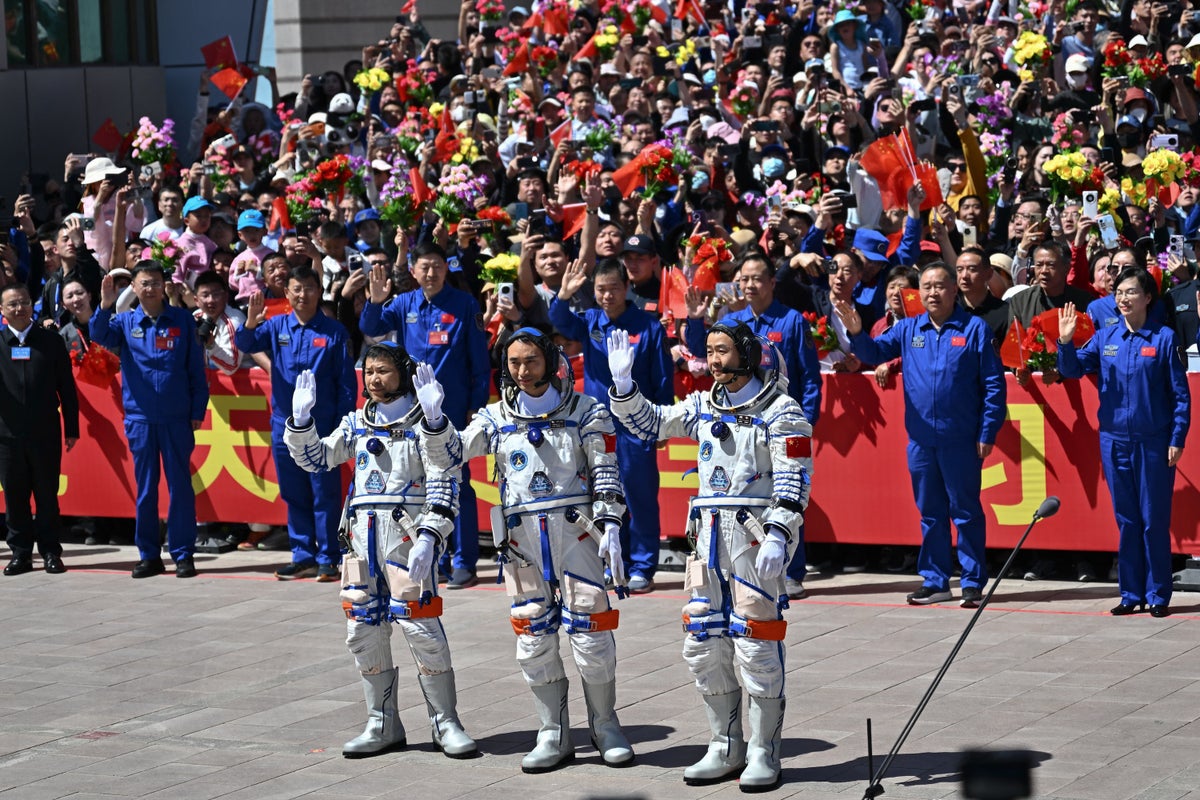
On November 11, 2025, concerns arose regarding the safety of astronauts aboard China’s Tiangong space station following a suspected collision with space debris. Currently, six astronauts are living on Tiangong, China’s modular space station orbiting Earth. This situation has drawn attention not only to the immediate safety of the crew but also to the challenges involved in returning them safely to Earth.
The incident reportedly involved the Shenzhou-20 spacecraft, which had sustained suspected damage due to a strike from space debris. Although details about the extent and nature of the damage remain unclear, Chinese officials have confirmed that the astronauts on Shenzhou-20 are safe for now. The China Manned Space Engineering Office (CMSE), the agency responsible for China’s human spaceflight programs, has stated that engineers are actively working on a backup return capsule intended to bring three of the astronauts home. Extensive tests on this backup vehicle are underway, and according to CMSE, all preparations for the rescue mission are advancing in a steady and orderly manner.
Tiangong, which measures approximately 180 feet in length, is designed to support a crew of three astronauts on six-month missions. Typically, arriving crews relieve the previous ones, ensuring a continuous human presence in orbit. In October 2025, a new three-person crew arrived to replace the astronauts aboard Shenzhou-20. However, due to the suspected damage, both the original crew and the new arrivals remain aboard the station simultaneously. While this dual occupancy is unusual, CMSE has reassured the public that the station’s systems can support two crews living and working together in orbit. The agency reported that the crews are collaborating on scientific experiments and that day-to-day life continues normally aboard Tiangong.
Despite these reassurances, the situation remains tense and somewhat uncertain. Jonathan McDowell, an astronomer at the Center for Astrophysics | Harvard & Smithsonian, noted that while the station can accommodate the increased number of astronauts, it is understandably cramped. The lack of detailed information about the debris collision is also a cause for concern within the scientific community. McDowell expressed frustration at the vagueness of official reports, emphasizing that it is unclear whether the strike caused a small or large breach, whether there was a pressure drop within the spacecraft, or if visible damage can be seen. This lack of transparency complicates assessments of the astronauts’ safety and the urgency of their return.
One critical issue relates to the logistics of bringing the astronauts home. The Shenzhou-21 spacecraft, which ferried the most recent crew to Tiangong, might be used to return the Shenzhou-20 crew. However, doing so would leave the new crew without an immediate return vehicle, effectively stranding them in orbit until a replacement spacecraft can be launched. McDowell speculates that China will likely prepare and launch a new vehicle specifically to retrieve the remaining astronauts, as it is standard practice not to leave any crew aboard a space station without a guaranteed ride home.
This incident underscores the growing challenges posed by space debris, which has become an increasingly pressing problem for all spacefaring nations. Space junk ranges from defunct satellites to fragments from past collisions and explosions, all traveling at high velocities that can cause serious damage to operational spacecraft. The suspected debris strike on Shenzhou-20 highlights the vulnerability of human spaceflight missions to such hazards and the need for improved tracking and mitigation measures to protect astronauts and equipment in orbit.
As the situation develops, the international space community is watching closely. China’s space program has made significant strides in recent years with the construction and operation of Tiangong and the successful deployment of multiple Shenzhou missions. The current predicament tests the program’s contingency planning and crisis management capabilities. The safe return of the astronauts remains the top priority, and Chinese officials have reiterated their commitment to ensuring the wellbeing of all personnel aboard Tiangong.
The incident also serves as a reminder of the complexities involved in maintaining a human presence in space. Beyond the technological challenges, missions must contend with unpredictable hazards such as space debris, requiring robust systems for detection, avoidance, and emergency response. The cooperation of multiple crews aboard Tiangong, despite the cramped conditions, exemplifies the adaptability and professionalism required in space missions.
In the meantime, the astronauts continue their work, conducting scientific experiments and maintaining the station’s operations. Their ability to live and work effectively in a confined environment, while under the stress of an unresolved emergency, speaks