
)
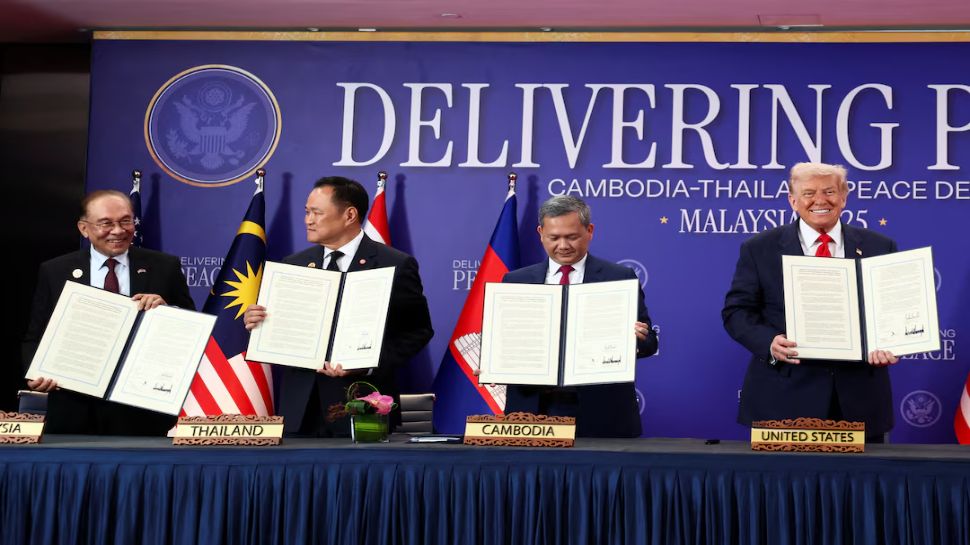
US President Donald Trump recently hailed the signing of the Kuala Lumpur peace accord between Cambodia and Thailand as a historic diplomatic breakthrough aimed at resolving long-standing border tensions between the two Southeast Asian neighbors. The ceremony, held in Kuala Lumpur, Malaysia, was largely centered around Trump’s presence and his expansive claims about the accord’s significance. However, experts, regional officials, and analysts remain cautious about the real impact of the agreement, emphasizing its largely symbolic nature amid a complex backdrop of historical disputes and geopolitical considerations.
At the event, President Trump delivered a lengthy speech in which he framed the accord as a momentous step forward for peace in Southeast Asia. He highlighted the involvement of the two prime ministers—Cambodia’s Hun Sen and Thailand’s Prayut Chan-o-cha—while noting their initial hesitation in reaching the agreement. Trump also recounted his personal role in facilitating dialogue between the nations, including a notable meeting held at his Turnberry golf course in Scotland. He portrayed his intervention as a serious diplomatic effort rather than mere leisure, stating that saving countries and people was of greater importance than personal enjoyment.
The timing of the ceremony was strategic. Trump had requested the signing event to coincide with his attendance at the ASEAN Summit, an important regional forum that he does not attend regularly. His presence at the summit was seen as an opportunity to present himself as a peacemaker on the global stage. Trump further bolstered his image by touting his administration’s record of ending “eight wars in eight months,” portraying these accomplishments as evidence of his skill and commitment to peace, rather than self-interest.
Despite the high-profile spectacle and Trump’s grand claims, the substance of the so-called “Kuala Lumpur Peace Accord” remains limited. The accord builds upon a ceasefire agreement that Cambodia and Thailand had already signed in July, which itself was reportedly expedited with Trump’s influence. The new agreement focuses on practical measures such as the removal of heavy weapons from disputed border areas, the establishment of a temporary monitoring team, landmine clearance efforts, and the creation of a joint task force to combat fake call centers. Additionally, the accord calls for the placement of temporary boundary markers in areas where official signs are absent.
Thai officials have approached the agreement with caution, acknowledging some progress but stressing that the historical border dispute itself remains unresolved. They warn that tensions could easily resurface without a comprehensive, long-term resolution. Thailand’s foreign minister notably declined to label the accord a formal peace deal, instead referring to it by its official title as a joint declaration from the prime ministers’ Kuala Lumpur meeting. This tempered characterization contrasts sharply with Trump’s expansive framing of the accord as a definitive breakthrough for peace.
Analysts and regional experts view the accord’s limited scope as evidence that Trump’s role was more ceremonial than substantive. While his presence brought global media attention to the issue, the actual provisions of the agreement do not constitute a major diplomatic transformation. Cambodia, however, expressed greater enthusiasm for the accord. The Cambodian government has previously sought to internationalize the border dispute, including efforts to bring the matter before the International Court of Justice. Cambodia’s Prime Minister Hun Sen praised Trump during the signing ceremony and even referenced Trump’s Nobel Peace Prize nomination as a testament to his peacemaking efforts.
Thailand’s Prime Minister Prayut Chan-o-cha, on the other hand, maintained a more cautious public stance. He faces domestic nationalist pressures and is mindful not to appear overly conciliatory toward Cambodia, a sensitivity that shapes Thailand’s preference for direct bilateral negotiations rather than external mediation. As such, Thailand views Trump’s involvement as a supplementary diplomatic gesture rather than a central solution to the conflict.
Trump’s presence at the ASEAN Summit and the peace accord signing was brief but accepted by both Cambodia and Thailand, as well as by ASEAN member states. Southeast Asia’s economic ties to the United States are significant, given the region’s export-driven economies and reliance on access to the U.S. market. The region has faced economic challenges recently, including earlier high tariff rates of up to 48 percent imposed by the U.S., which were later reduced to around 19-20 percent following negotiations. Trump’s visit to Kuala Lumpur lasted only a day and included a handful of bilateral meetings and a dinner before he proceeded to Japan for the APEC Summit.
Observers suggest that even Trump’s short visit may help stabilize U.S.-Southeast Asia relations, despite the contrast between his transactional, deal-focused approach and the region’s traditional preference for multilateral diplomacy and consensus-building. Nevertheless,